
Cut Bag Label Costs By Standardizing Pouch & Label Sizes
As a procurement manager, you’re constantly balancing quality, speed, and cost. But one of the most overlooked sources of budget drain isn’t the per-unit price of your labels; it’s the hidden expense of inconsistent packaging. Ordering new custom bag labels for every unique pouch size creates a cascade of tooling fees, setup charges, and inventory headaches that quietly inflate your total cost of ownership. Before you place your next RFQ, understanding this dynamic is the single most effective way to protect your budget.
From my 12 years in manufacturing, I’ve seen countless brands hemorrhage money by treating every label order as a one-off project. The smartest operators do the opposite: they standardize. By establishing a limited set of label dimensions that work across multiple products, you unlock economies of scale, simplify inventory management, and dramatically reduce long-term costs. It’s a strategic shift from reactive purchasing to proactive cost control.

Alin, Senior Custom Merch & Manufacturing Consultant
Hi there! I’m Alin—a custom merchandising specialist with 12 years of experience in the manufacturing trenches. Whether it’s perfecting the enamel color fill on custom pins, selecting the most durable backing for embroidered patches, or solving substrate challenges for printed labels, I’ve tackled it all. Here, I share my hard-won lessons from the factory floor—so you can avoid costly mistakes and get premium pins, patches, and labels right the first time. Let’s make your brand shine!
The Hidden Costs of Non-Standardized Bag Labels
When your product line expands, it’s tempting to design a unique pouch and label for each new SKU. While this offers maximum creative freedom, it introduces four distinct cost layers that accumulate over time. Each new label dimension, no matter how small the change, triggers a new set of fixed costs that a standardized approach would avoid.
- One-Time Die-Cutting Fees: Every unique label shape and size requires a physical or digital die. A physical die is a custom-made steel tool used to cut the labels from the printed roll. Each new die can cost hundreds of dollars. If you launch five products with five different label sizes, you’re paying that fee five times.
- Recurring Setup Charges: Each unique label job requires a new setup on our HP digital label presses. This involves loading the correct die, calibrating the cutters, and running test prints to ensure alignment and color accuracy. This process consumes time and materials, costs that are passed on in the form of setup fees for each small, distinct order.
- Lost Volume Discounts: Most manufacturers, including us, offer tiered pricing. The more custom printed roll labels you order of a single SKU, the lower the per-unit cost. By splitting your total label demand across many small, unique orders, you never reach the higher-volume tiers that offer the best pricing.
- Increased Inventory Complexity: Managing five different label SKUs instead of one or two increases warehousing costs, complicates forecasting, and raises the risk of obsolescence. If one product is discontinued, its dedicated roll of labels becomes worthless.
These factors combined mean that the “cheapest” per-label price on a quote might not reflect the true, long-term cost to your business.
A Five-Year Cost Model: Standardization vs. Proliferation
Let’s make this tangible. Consider a growing snack brand that plans to launch one new product each year for five years. We’ll compare two sourcing strategies: creating a unique label for every new product versus using a standardized size.
Assumptions for this model:
- Annual Order Volume: 20,000 labels per new product SKU.
- Confirmed Costs: One-time die charge is $200 per unique label size. Setup fee is $50 per unique print run.
- Estimated Costs: Per-label pricing is estimated based on typical volume tiers. Inventory holding costs are estimated at 1% of label value per year (a conservative figure).
| Cost Driver | Scenario A: SKU Proliferation (5 Unique Labels) | Scenario B: Standardization (1 Unique Label) |
|---|---|---|
| Total Die Charges | 5 dies x $200 = $1,000 | 1 die x $200 = $200 |
| Total Setup Fees (5 Years) | 5 SKUs x 5 years x $50 = $1,250 | 1 SKU (pooled volume) x 5 years x $50 = $250 |
| Estimated Per-Label Cost | Ordering 20k units/run @ ~$0.10/label | Ordering 100k units/run (pooled) @ ~$0.06/label |
| Estimated Total Label Cost (5 Years) | 500,000 labels x $0.10 = $50,000 | 500,000 labels x $0.06 = $30,000 |
| Estimated Inventory Holding Cost | Higher complexity, higher risk. Est. ~$500+ | Lower complexity, lower risk. Est. ~$300 |
| Estimated 5-Year Total Cost | $52,750+ | $30,750 |
| Estimated 5-Year Savings | ~$22,000 (Over 40%) | |
As the model shows, the savings from standardization are substantial. You reduce fixed costs and, more importantly, unlock significantly better per-unit pricing by pooling your total volume into a single, high-quantity order. This allows you to get premium features, like metallic foils or textured papers, for a fraction of the cost. Plus, with every bulk order, we include 100 bonus pieces, adding even more value to your high-volume runs.
Choosing Materials and Finishes for Flexible Pouch Labels
Standardizing your label size doesn’t mean your products have to look the same. The key is to choose a versatile base material and use design and finishing options to differentiate each SKU. At our ISO 9001:2015 certified facility, we ensure material consistency and print quality across every single run, so your brand standards are always met.
Here’s a breakdown of common materials for flexible packaging:
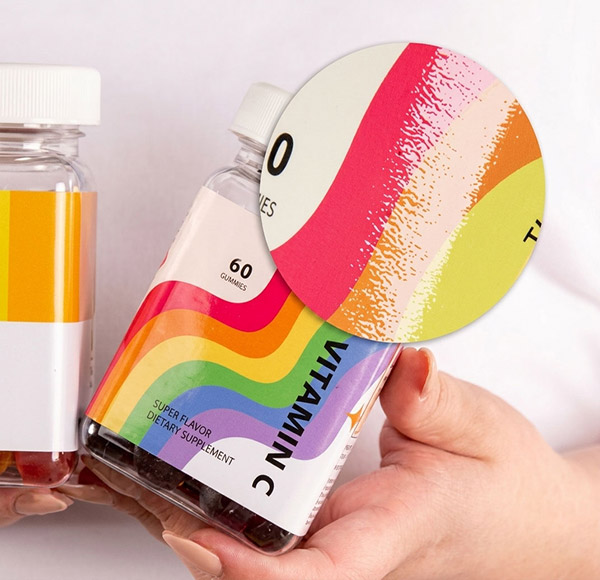
- BOPP (Biaxially-Oriented Polypropylene): This is the workhorse for bag labels. It’s a durable plastic film that resists water, oil, and chemicals. It’s flexible enough to conform to soft pouches without wrinkling. We recently produced metallic foil-stamped clear custom bopp labels for a health supplement brand in Australia; they needed a premium look that could withstand handling and shipping, and BOPP with a scratch-proof matte lamination was the perfect solution.
- PET (Polyester): For applications requiring extra durability against heat or abrasion, PET is an excellent choice. It’s slightly more rigid than BOPP and is often used for products that face harsh environmental conditions.
- Kraft Paper: If your brand has an organic, rustic, or eco-friendly aesthetic, custom kraft labels are ideal. They provide a natural, textured look perfect for products like coffee, artisanal snacks, or handmade goods.
Once you have your base material, you can use finishes to create a unique identity for each product:
- Lamination: A glossy finish makes colors pop, while a matte finish provides a subtle, premium feel and reduces glare.
- Foil Stamping: Add a touch of luxury with metallic, holographic, or custom-colored foils.
- Adhesive Strength: Specify an adhesive designed for your needs, whether it’s a freezer-grade adhesive that prevents peeling in cold storage or a high-tack version for textured bags.
Common Sourcing Mistakes to Avoid
Sourcing labels for flexible bags and pouches has unique challenges. Avoiding these common mistakes will save you from costly reprints and production delays.
- Ignoring the Application Surface and Shape. A label that works on a flat, rigid box may fail on a flexible, curved pouch. The label must be pliable enough to move with the bag without peeling, wrinkling, or cracking. Always test your label on the final filled package.
- Mismatching Durability to the Product’s Lifecycle. Using a standard paper label on a refrigerated product is a recipe for disaster. Condensation will cause the material to degrade and the ink to run. For anything that might encounter moisture, oil, or temperature changes, you need waterproof custom synthetic labels made from BOPP or vinyl.
- Poor Color Management. “Brand Red” can look very different from one printer to another. To ensure consistency, always provide Pantone (PMS) color codes for your brand assets. This is non-negotiable for brand integrity. If a color issue does arise, our color mismatch free reprint guarantee has you covered.
- Skipping the Sample Phase. Never commit to a 50,000-unit order without seeing and testing a physical sample first. You need to confirm the material feel, print clarity, and adhesive performance on your actual product. We offer a fast 3-day sample lead time specifically to prevent this expensive error.
- Forgetting About Application Method. Are your labels being applied by machine or by hand? Machine-applied labels must have a specific roll direction and core size. Forgetting to specify this can render an entire order unusable. Our free design assistance service includes a check of these technical specs before production begins.
By thinking through these points and embracing a strategy of standardization, you can turn a simple operational component into a source of significant competitive advantage. You get a better product for a lower total cost, all while simplifying your supply chain.
Ready to see how standardization can impact your budget? Submit your specifications for a comparative quote and a free design consultation.