

Custom Patches No Minimum Price by Material
A low-quantity patch order can look affordable until the quotation arrives with artwork preparation, digitizing, backing, mold, and shipping charges added separately. For procurement buyers, the risk is not simply paying a higher unit price. It is choosing a patch process whose fixed charges outweigh the value of a one-off sample, pilot launch, staff test, or limited event run.
Custom Patches No Minimum can be a practical option when the order is digitally produced or falls within a selected custom-item scope. However, “no minimum” does not mean every material has no setup cost. Embroidery may require digitizing. PVC can require a mold. Chenille needs a production approach suited to its raised yarn construction. A useful RFQ separates those items before comparing suppliers.
Custom Panda supports custom patches alongside pins, labels, coins, and related branded merchandise. The company operates from an 8,000 m² facility established in 2012, with 6 production lines and patch capabilities covering fine embroidery, woven labels, heat transfer, PVC soft rubber, chenille, Velcro backing, and heat-seal iron-on backing. Its ISO 9001:2015 certification and Disney FAMA certification provide relevant qualification signals for buyers who need documented supplier credentials rather than a marketplace listing alone.
Choose the patch material before comparing unit prices
Conclusion: Select the material based on artwork detail, end use, attachment method, and expected reorder pattern before asking for a per-piece price. The lowest first quotation can be the wrong commercial choice if the material does not suit the garment or if its fixed setup cost cannot be reused for future orders.
Material choice matters most on short runs because fixed work is divided across fewer pieces. A patch ordered for a single product photoshoot has different economics from a uniform program that will reorder the same badge over several seasons.
| Material or process | Best-fit scenario | Main small-run cost driver | When it is not the best fit |
|---|---|---|---|
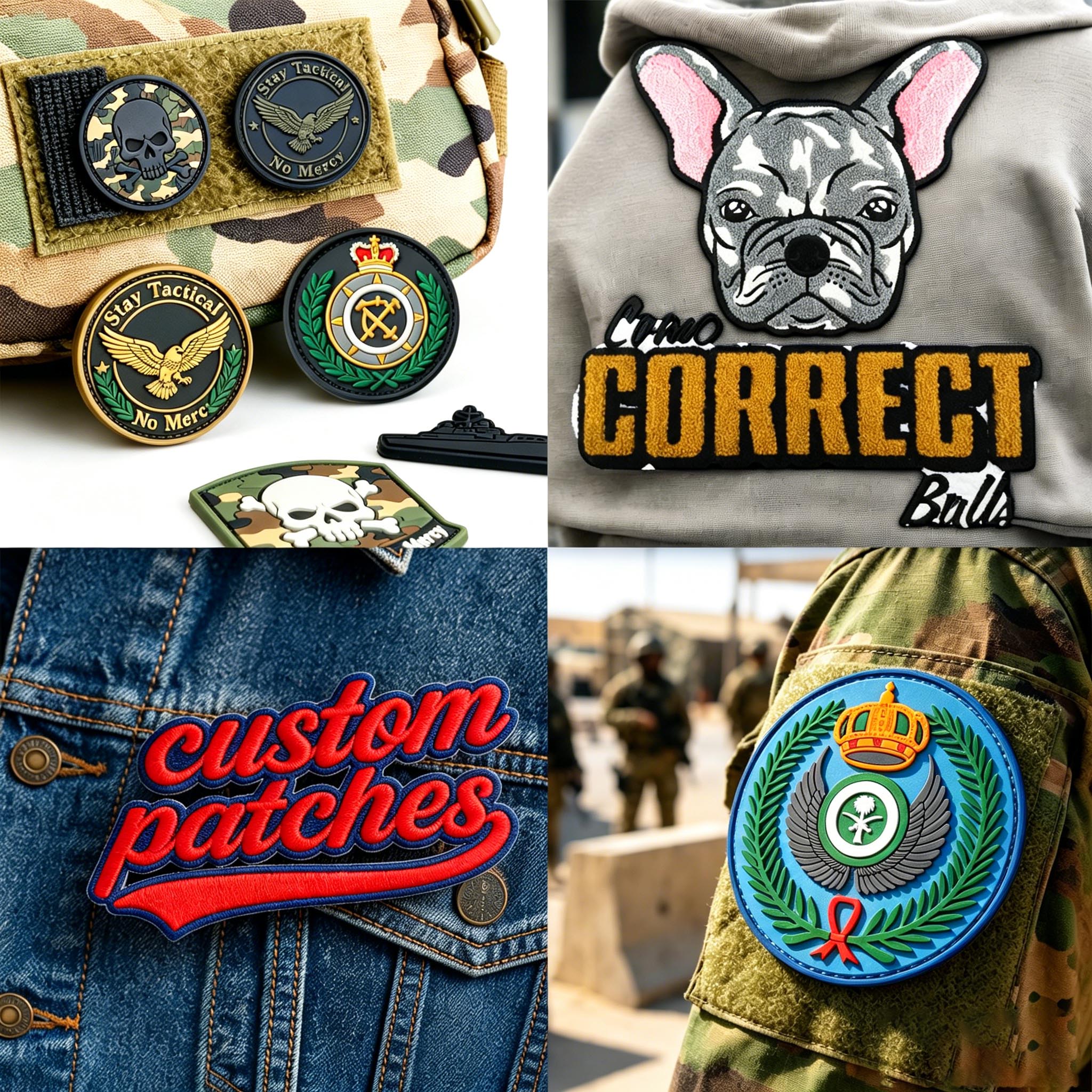
| Embroidered patch | Uniforms, clubs, workwear, outdoor gear, and logo designs with clear shapes | Digitizing, stitch complexity, thread colors, border treatment, and backing | Do not use it for very small lettering, photographic art, or fine gradients that may lose definition in thread. |
| Woven patch | Detailed logos, small text, flat branding patches, and garment applications | Artwork preparation, yarn construction, cut shape, and finishing | Do not choose it when a raised stitched texture is the primary brand requirement. |
| PVC soft rubber patch | Outdoor equipment, tactical uses, bags, caps, and moisture-exposed applications | Mold creation, color layers, shape, and backing choice | Do not choose it solely for a one-piece concept if the mold charge cannot be justified by later reorders. |
| Chenille patch | Varsity letters, sports teams, collegiate apparel, and high-visibility jacket decoration | Raised yarn construction, felt backing, shape, and stitching density | Do not select chenille for fine line art or small copy that requires sharp edge definition. |
| Heat-transfer patch | Detailed color artwork, short campaigns, and applications where a flat transfer is appropriate | Digital artwork preparation, print method, and application requirements | Do not use it without confirming that the intended garment and care conditions are suitable for the selected transfer. |
| Faux-leather patch | Denim, hats, premium workwear, and subdued logo branding | Embossing or debossing treatment, material finish, cut shape, and attachment | Do not select it for designs that depend on multiple bright colors or tiny visual details. |
For apparel and uniform programs, custom embroidery patches for apparel & uniforms are often the stronger choice when the logo has bold lines and the buyer needs a textile appearance. They are less suitable when the logo contains dense small text. In that case, a woven patch may deliver a clearer result because it is designed around woven yarn detail rather than raised stitch coverage.
There is supporting application evidence for material-led selection. Custom Panda manufactured heavy-duty embroidered Velcro patches for a United States outdoor gear brand, using weather-resistant threads and hook-and-loop backings for hiking backpacks and tactical vests. That example supports embroidery plus Velcro where removal and rugged gear use are required. It should not be treated as proof that every embroidered patch is weather-resistant; thread, backing, use conditions, and garment surface still need confirmation for each order.
Small-run cost model separating setup digitizing mold material backing and shipping charges
Conclusion: Ask suppliers to quote each cost category separately for a small run. This lets a buyer identify whether the price is driven by the patch itself or by one-time preparation. It also makes future reorder economics easier to assess.
A transparent quote does not need to use one universal price formula. The actual price depends on artwork, material, size, quantity, backing, packaging, and destination. But the quotation should show which costs are fixed, which rise with quantity, and which may change if the design is altered.
| Cost component | What it covers | How it affects a short run | Buyer action |
|---|---|---|---|
| Setup | Artwork review, production file preparation, and process-specific preparation | Usually has greater impact per patch when quantity is low because the charge is spread across fewer units. | Ask whether the setup remains valid for a repeat order with unchanged artwork and specifications. |
| Digitizing | Converting artwork into an embroidery-ready stitch file | Relevant mainly to embroidered patch work and may be affected by logo detail and stitch direction. | Request proof approval before production and ask whether later artwork changes require new digitizing. |
| Mold | Tooling used for shaped or molded products, particularly PVC soft rubber patches | Can make a one-off PVC order cost more than a textile patch, even if the per-piece material cost is attractive. | Ask whether mold ownership, storage, reuse conditions, and revision charges are included in the quote. |
| Material | Thread, woven yarn, PVC, faux leather, felt, transfer media, and other patch inputs | Usually scales with quantity, size, colors, and construction rather than remaining fully fixed. | Specify material rather than requesting a generic “patch” price. |
| Backing | Sew-on, heat-seal iron-on, Velcro, or other attachment choices | Can change both product cost and the end user’s application labor. | Match the backing to the actual surface and removal requirement before approving artwork. |
| Shipping | Freight and delivery handling to the destination | May represent a noticeable share of a very small order total. | Request shipping to be shown separately and confirm the destination, delivery method, and required arrival date. |
For a one-off embroidered logo patch, digitizing may be the fixed charge that dominates the order. For a PVC patch, mold cost may be the larger issue. For a small woven run, the decision may instead depend on whether the artwork includes detail that embroidery cannot reproduce cleanly. This is why a headline price without material and construction information is not enough for a quote comparison.
Custom Panda states that digital printing and selected custom items can be ordered with no MOQ, while offset printing and standard bulk items carry a 1,000-piece minimum for better pricing. Buyers should therefore state the required material and order quantity plainly rather than assuming every patch construction has the same no-minimum terms. This is especially relevant when an RFQ changes from a digitally produced proof run to a standard bulk construction.
Backings can change both the purchase cost and the operational cost
Conclusion: Treat the backing as a procurement decision, not a finishing detail. The right backing reduces application work and helps prevent attachment failures. The wrong backing can create costly rework even when the patch unit price is low.
- Sew-on backing: Choose this for garments where the buyer can sew the patch into place and expects a permanent textile attachment. It fits uniforms and apparel programs. It does not fit applications where field staff need to swap identification frequently.
- Heat-seal iron-on backing: Choose this for controlled garment application where the fabric is compatible with heat-seal attachment. It can simplify application, but it should not be assumed suitable for every fabric or washing requirement without confirmation.
- Velcro backing: Choose this when users need removable patches on tactical vests, backpacks, outerwear, or rotating staff identification. It adds material and assembly considerations, yet may reduce replacement labor. It is not the best option where a flush, permanent appearance is required.
- No backing or custom attachment plan: Choose this when the customer has a specialist application process or needs to integrate the patch into a product assembly line. It requires clear responsibility for attachment testing and final assembly.
Buyers sourcing for caps should also review the garment structure. Curved surfaces, seams, and limited application areas can affect material selection. A low-profile woven or faux-leather option may suit some hat programs better than a thick patch construction. For projects focused on headwear, a custom hat patches supplier inquiry should include cap fabric, placement area, application method, and whether the cap is already assembled.
Use a short-run RFQ process that exposes hidden cost drivers
Conclusion: A complete RFQ reduces quote revisions and makes material comparisons fair. It is most useful for buyers obtaining several quotes for a pilot quantity. It is less relevant only when the buyer is reordering an already approved patch with no changes to artwork, size, backing, or destination.
- Provide the artwork and intended use. State whether the patch is for a jacket, cap, bag, uniform, retail garment, or promotional item. Include the logo file and identify any text that must remain readable.
- Name the preferred material and one alternative. For example, request embroidery as the preferred option and woven construction as the fallback if small lettering cannot be reproduced clearly.
- Specify the backing. Identify sew-on, heat-seal, Velcro, or another attachment requirement. Do not leave the backing open if it affects field use or application labor.
- Request an itemized small-run quote. Ask for setup, digitizing where applicable, mold where applicable, material, backing, and shipping to be distinguished.
- Ask for proof confirmation. Custom Panda provides photo or digital sample confirmation before production. Use that stage to verify logo placement, colors, border style, backing, and visible detail.
- Confirm lead-time fit. The stated sample lead time for pins, patches, and labels is 3 days. Bulk production is listed as 8–9 days, followed by 5–6 business days for U.S. shipping. These stated timelines help with planning, but the final delivery plan should be confirmed against the actual material, quantity, and destination.
- Record reorder conditions. Confirm which files, molds, or digitized artwork can be used again, what changes would require new preparation, and whether the same backing is available on reorders.
Custom Panda includes 100 bonus pieces with every bulk order and offers color-mismatch free reprint, proportional replacement for defects, and 5-day fast re-stocking or repair under its stated terms. These points are most relevant to larger orders where continuity and defect handling matter. They should not be used as a substitute for approving the digital or photo sample on a small-run order.
Material-specific examples for deciding if a one-off patch run is financially sensible
Scenario one: A new apparel brand needs a small number of detailed logo patches for a market test. A woven patch may be the better commercial starting point if the design includes fine lettering and the brand needs a flat, garment-friendly finish. The buyer should compare the one-time artwork preparation against an embroidered option, but should not select embroidery merely because it appears more familiar. If the lettering becomes unclear, the lower initial quote can produce unusable branding.
Scenario two: An outdoor equipment team needs removable identity patches for backpacks and tactical vests. Embroidered patches with Velcro backing match the use case demonstrated in the United States outdoor gear project. The buyer should request weather-resistance requirements in writing and confirm the hook-and-loop dimensions. This approach does not apply if the patch must remain permanently attached after repeated laundering.
Scenario three: A university sports team wants a limited varsity jacket release. Chenille is appropriate when the visual goal is a plush letterman look. Custom Panda supplied chenille letterman jacket patches to a Swedish university sports team using plush felt backings and high-density stitching for heavy wool fabric. The limitation is clear: chenille is a style-led choice, not a low-detail solution for dense sponsor logos or small instructions.
Scenario four: A denim brand needs a restrained logo feature intended to tolerate demanding garment finishing. Faux leather may be a better option than embroidery when debossed branding and antique-style edges fit the product direction. Custom Panda supplied embossed faux-leather patches for an Italian premium denim line designed for industrial stonewashing and daily wear. That customer example supports the material choice for a similar use, but buyers should still supply their own washing and garment-finishing conditions for confirmation.
Buyer checklist before approving a no-minimum patch order
- Have you named the material rather than asking for a generic patch quote?
- Does the design contain small text, gradients, or image-like detail that may rule out embroidery?
- Have setup, digitizing, mold, material, backing, and shipping been shown separately?
- Have you confirmed whether the selected item qualifies for no-MOQ ordering rather than assuming all patch types do?
- Does the backing match the final surface, attachment workflow, and removal requirement?
- Have you reviewed the digital or photo sample before production?
- Have you stated the delivery destination and required arrival date?
- For a repeat program, have you asked which preparation files can be reused without change?
The best small-run patch order is not automatically the one with the lowest per-piece figure. It is the one where the material suits the artwork, the backing suits the use, fixed charges are visible, and the supplier has enough documented capacity to support a later bulk order if the trial succeeds. Custom Panda’s daily label capacity exceeds 1,000,000 pieces, while its patch and metal production facilities support broader branded merchandise programs when a buyer later needs matching products such as labels, pins, or coins.
Send your artwork, preferred material, backing, quantity, and shipping destination to request an itemized patch quote.