

Custom Brand Label Pins Need Artwork Proofs That Prevent Rework
The most expensive pin mistake is the one you approve without looking closely. Once metal is cut and enamel is filled, a thin line that vanished or a gold edge that bled into a color field cannot be edited away. For marketers and designers, the proof is the last cheap place to catch a problem. If you are ordering custom brand label pins, the checks below show what to verify on that proof, what to ask the manufacturer, and where the limits of the process lie.
What a Pin Proof Must Show Before You Release the Order
A proof is not a formality. It is a production drawing that shows how your logo will be translated into metal, color fills and plating. A usable proof carries more than a flat mockup of your logo on a pin outline.
- Color callouts per area: each enamel field labeled with a Pantone reference, not just a screen color.
- Metal line layout: the raised metal outlines and dividers drawn clearly, so you can see which details become metal and which become color.
- Plating designation: gold, silver, nickel, antique or dual plating marked on specific zones.
- Actual size reference: dimensions printed on the proof, so you can check legibility at real scale.
- Back and attachment details: pin post, clutch type and any stamped marks.
If a proof arrives as a logo on a silhouette with none of these markings, ask for a revised version. Approving a vague proof moves the interpretation risk to the factory floor, where you cannot see it.
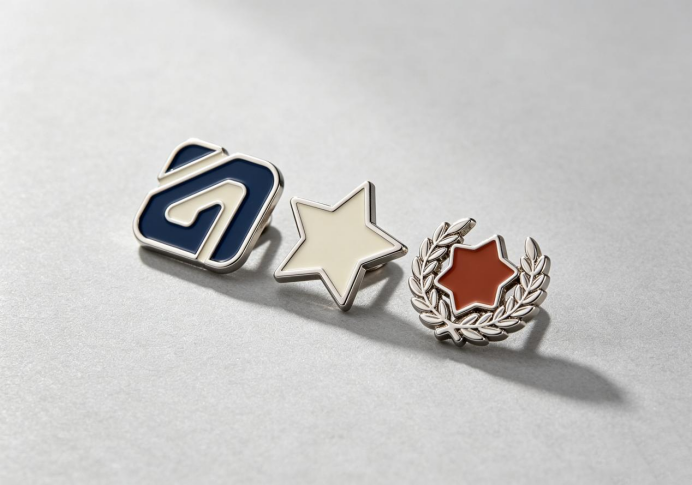
Proof Approval Answers on Line Thickness, Pantone Matching, Plating Boundaries, and Small Text Legibility
These four checks cause most rework on brand pins. Each answer below gives the conclusion, the reasoning, and the case where it does not apply. We have not listed exact millimeter figures, because minimum widths depend on the pin process, size and metal. Request them in writing for your specific spec.
Will my thin lines survive production?
Short answer: only if they are wide enough for the chosen process. In enamel pins, lines are raised metal that separates color areas. Very fine lines can fill with enamel, lose definition or look uneven. Fine hairline detail from a vector logo often needs thickening. This is common with logos designed for print or screen. The exception is laser engraved or offset printed pins, where fine detail is handled differently, but each method has its own trade-offs.
Will the Pantone color match my brand guide?
Short answer: supply Pantone codes, then verify against the proof. A code removes guesswork, but it does not make a monitor accurate. Enamel is a physical material filled into metal, and a screen render will never be identical. Metallic neighbors also change how a color reads, because a gold border makes a navy look different than it does on white paper. Confirm the digital or photo sample before production starts. We offer photo and digital sample confirmation and a color mismatch free reprint, so ask for the exact terms in your quote. Colors that sit outside the achievable enamel range may need a closest-match decision from you.
Where exactly does plating stop and enamel begin?
Short answer: plating applies to the metal lines and base only, never to the enamel. The proof should show which metal zones get which finish. Dual plated finishes, such as gold lines with a silver base, need a clear boundary drawn between them. Plating cannot split inside a single connected metal line. If your design needs two metal colors, put the transition at a natural break, such as the edge of a raised section. A gradient from gold to silver along one line is not achievable.
Is my small text going to be readable?
Short answer: print the proof at 100 percent size and read it at arm's length. Small text rendered as metal lines holds up better than text filled in enamel, and light text on a dark field is the riskiest combination. If a tagline fails the arm's length test on paper, it will fail on the pin. Your options are to enlarge it, simplify it, drop it, or move it to a laser engraved back or a different process. This check does not apply to decorative text you are comfortable losing.
| Proof checkpoint | What to look for | What to ask | Limit to accept |
|---|---|---|---|
| Line thickness | Hairlines, tight gaps between color fields | Minimum line width for this process and size | Very fine detail may be thickened or removed |
| Pantone matching | A code per color area | Is a photo or digital sample provided before production? | Screen color is not enamel color |
| Plating boundaries | Which metal zones get which finish | Where does one plating stop? | No gradients within one metal line |
| Small text | Text size, contrast, metal versus enamel fill | Will this read at actual size? | Tiny text may need a redesign |
Pick the Pin Process Before You Finalize Artwork
Artwork that suits one process can fail on another. Decide the process first, then adjust the file. This comparison helps you match the artwork to the method.
| Process | Best for | Proof watch point |
|---|---|---|
| order soft enamel pins | Textured feel, clear metal lines, bold color blocks | Raised metal lines must stay visible and consistent |
| premium hard enamel pins for brands | Smooth, polished surface and a premium finish | Color boundaries and plating edges |
| offset printed pins | Gradients and photographic or highly detailed logos | Color accuracy of the print |
| 3d cast lapel pins | Sculpted relief and dimensional logos | Depth, cut-outs and finish tone |
Our materials include zinc alloy, brass and iron, and our finishes include dual plated options, laser engraving and 3D die casting. The right pairing depends on your logo. A flat two color mark usually works well in hard or soft enamel. A complex gradient mark often belongs in offset printing. If you want to see how a logo-focused option works, look at custom brand enamel pins.
A Step by Step Proof Approval Workflow
- Send a vector logo file. Provide AI, EPS or a clean PDF, plus Pantone codes for every color. Raster files tend to produce soft edges on the proof.
- Choose the process and size. State soft enamel, hard enamel, offset printed or die cast, and the finished dimension.
- Review the first proof against the four checkpoints. Use the table above and mark each item pass or fail.
- Print the proof at actual size. Check small text and tight gaps on paper, not only on screen.
- Request a photo or digital sample confirmation. We offer this before production, and our pin sample lead time is 3 days.
- Sign off in writing. List the approved Pantone codes and plating zones in your approval message.
- Release bulk production. Bulk lead time is 8 to 9 days, and U.S. shipping typically takes 5 to 6 business days.
Keep every revision labeled by version number. Disagreements about what was approved are far easier to settle when the signed version is clear.
Common Proof Mistakes That Cause Rework
- Approving on a phone screen. Colors and tiny details look different at real size. Check on paper.
- Leaving out Pantone codes. "Brand blue" is not a spec. Send the reference for every fill.
- Trusting a hairline from a print logo. A line that is fine on a brochure can fill in on metal.
- Placing small light text on a dark enamel field. This combination is the first to blur.
- Leaving plating zones undefined. If the proof says "gold" without marking the area, you may get a result you did not picture.
- Skipping the back. Pin posts, clutch style and any stamped mark should be on the proof.
- Approving a revision verbally. If it is not written down, it cannot be checked later.
These mistakes map to problems buyers report most often on pins, including enamel overflow, blurred detail and unstable pin backs. Most of them are visible on a careful proof.
What Real Pin Projects Show About Proof Decisions
Real orders show how proof choices turn into physical results. For an esports tournament championship in Canada, we made hard enamel pins with polished gold plating and bold dual tone colors. Those pins depend on clean plating boundaries and color separation, which is exactly what the proof should lock in. For a Tokyo museum exhibition in Japan, we produced 3D cast souvenir lapel pins with deep antique bronze relief and cut-out details. In relief work the approval question shifts from flat color to depth and finish tone. For a specialty coffee brand's anniversary in Germany, we designed spinning enamel pins with a 360 degree rotating element, which adds a mechanical check to the usual artwork review.
These are individual projects, not promises about every order. They do show that the review points change with the pin type, which is why the proof should match the process.
Buyer Checklist Before You Click Approve
- Is the file vector, with Pantone codes assigned to each color area?
- Have you printed the proof at actual size and read all text?
- Are thin lines and narrow gaps confirmed as achievable for the process?
- Are plating zones marked, with clean breaks between metal colors?
- Have you received a photo or digital sample confirmation?
- Does the proof show the pin back and attachment?
- Is the final approval written down with version number and date?
Our work is backed by an ISO 9001:2015 certified quality management system, and we hold Disney FAMA certification. We have been manufacturing since 2012 from an 8,000 m² facility with 6 production lines and in-house die-casting. Every bulk order includes 100 bonus pieces, and if a defect appears we offer proportional replacement and 5 day fast re-stocking or repair. Minimums depend on the item, with no MOQ on select custom items, so confirm the terms for your pin type when you request a quote.
If you are preparing custom brand label pins, send your vector artwork and Pantone codes to our team for a proof review. We can flag line thickness, plating and small text concerns before you commit to production, and you can request a sample to confirm the result first.