

Sourcing Custom Candle Labels That Withstand Heat and Adhere to Glass
A bubbling, peeling label on a warm candle jar undermines brand quality before the customer even lights the wick. This common packaging failure is not just an aesthetic issue; it points directly to a mismatch between the label's material, adhesive, and the unique thermal stress of candle containers. Sourcing the right custom candle labels requires a technical specification process that goes beyond simple artwork approval. Overlooking the heat resistance of the face stock or the adhesive formulation leads to product returns, a damaged brand reputation, and costly reprints.
Many brands invest heavily in fragrance and wax, only to apply a generic paper sticker that lifts at the edges the moment the glass warms. The key is to specify materials designed for performance under thermal cycling—the repeated heating and cooling of the jar. At our ISO 9001:2015 certified facility, we address these challenges daily, using high-performance substrates and adhesives that maintain their integrity from production to the final burn. With a daily capacity exceeding 1,000,000 labels, we manage high-volume orders for global brands requiring consistent, reliable performance.
Why Standard Adhesives Fail on Warm Glass Jars
The primary point of failure for candle labels is the adhesive. A standard, general-purpose adhesive is not formulated to handle the temperature fluctuations and surface characteristics of a candle jar. When the candle burns, the glass surface can heat significantly, causing the adhesive to soften and lose its bond strength. This is the boundary where a sourcing decision directly impacts in-market product quality.
Understanding these failure modes is essential for specifying a label that performs correctly. The wrong choice results in edge lift, bubbling, and adhesive bleed, all of which communicate a low-quality product to the end user. Below is a direct comparison of how standard adhesives react to heat versus specialized, high-performance alternatives.
| Failure Mode | Standard Adhesive (e.g., General Purpose Acrylic) | High-Tack, Heat-Resistant Adhesive (e.g., Modified Acrylic) |
|---|---|---|
| Edge Lifting | The adhesive softens and loses its "tack" or stickiness as the glass warms. The inherent tension in the label face stock then pulls the edges away from the curved surface, causing them to curl up. | Maintains high shear strength and cohesion at elevated temperatures. The formulation is engineered to resist softening, ensuring the label edges remain firmly bonded to the container. |
| Bubbling & Wrinkling | Air trapped during application expands when heated. If the face stock is not flexible, or the adhesive is too weak to hold it down, this expansion creates unsightly bubbles and wrinkles. | Paired with a conforming face stock like BOPP that adapts to minor surface expansion. The stronger adhesive bond prevents the face stock from delaminating due to air expansion. |
| Adhesive Bleed | The adhesive's viscosity drops significantly with heat, causing it to liquefy and ooze from the label's edges. This creates a sticky, dust-collecting residue around the label. | Features a higher viscosity formulation that remains stable under heat. It does not flow or migrate, keeping the adhesive cleanly contained under the label. |
| Condensation Failure | When the candle cools, condensation can form on the glass. If the initial bond was weak, this moisture can get under the label and break the adhesive bond, causing it to slide or peel off completely. | Engineered for a strong initial bond on a variety of surfaces, including glass. It is more resistant to moisture, preventing condensation from compromising the adhesion. |
For candle brands, specifying an adhesive is not an arbitrary choice. You must request a permanent, high-tack adhesive specifically formulated for thermal applications. This ensures your product looks as professional on its last burn as it did on the retail shelf.
Choosing a Face Stock That Resists Heat, Wax, and Oils
The label's face stock—the material you see and touch—is just as important as the adhesive. Paper labels, while cost-effective, are highly susceptible to damage from heat, wax drips, and fragrance oils. They can easily stain, tear, or discolor, diminishing the product's premium feel. For this reason, synthetic materials are the industry standard for high-quality candle labeling.
Our production facilities are equipped to handle a wide variety of substrates to ensure your labels are durable and visually appealing. Here are the top material choices for candle applications:
BOPP (Biaxially-Oriented Polypropylene): This is the most common and versatile choice for waterproof custom jar labels for food & candles. BOPP is a plastic film that is inherently waterproof and resistant to oils and chemicals. It offers excellent print clarity and is available in white, matte, and clear finishes, making it perfect for achieving the popular "no-label" look. A protective BOPP lamination adds a final layer of defense against scratches and scuffs.
PET (Polyester): For applications requiring maximum durability and heat resistance, PET is the superior option. It can withstand higher temperatures than BOPP and is extremely tough, making it resistant to tearing and stretching. PET is often used for high-end waterproof custom synthetic labels that need to endure for the life of the product.
Textured & Kraft Paper: For brands cultivating a rustic, organic, or artisanal aesthetic, paper can be a compelling choice. However, it must be treated correctly. Custom kraft labels can provide a beautiful, earthy feel but should be finished with a protective varnish or matte lamination to prevent staining from wax or fragrance oils. It is critical to pair these paper stocks with a high-temperature adhesive to prevent lifting.
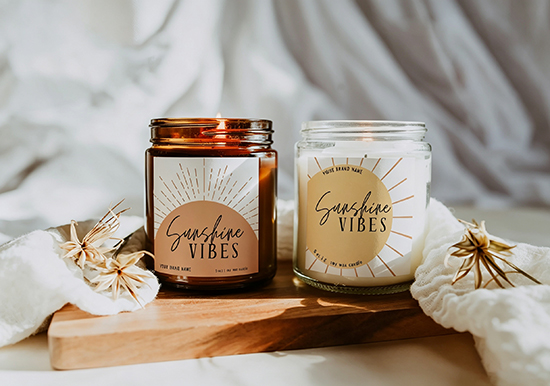
The right material choice depends on your brand identity and the specific conditions your product will face. For example, a luxury candle in a dark glass vessel might use a matte BOPP label with gold foil, while an all-natural beeswax candle may be better suited for a textured kraft paper label.
Ensuring Print Integrity and Premium Finishes for a Luxury Look
A label's design execution is what captures a customer's attention. High-resolution printing and premium finishing options transform a simple identifier into a key part of the brand experience. Candle labels often feature complex color palettes, fine text, and metallic elements that require precise printing technology.
Our facility utilizes 6 HP digital label presses, which are perfectly suited for the demands of producing `luxury candle labels`. This technology provides several key advantages:
Color Accuracy: Digital printing allows for precise Pantone color matching, ensuring that your label colors align perfectly with your brand guidelines. We are so confident in our color process that we offer a free reprint for any significant color mismatches.
High-Resolution Graphics: Fine details, small text (like on `candle safety labels`), and intricate logos are rendered with exceptional clarity. This prevents the blurriness and low detail resolution that can occur with lower-quality printing methods.
Opaque White Ink: When printing on `clear candle labels`, a layer of highly opaque white ink is essential. It acts as a base layer under your colored graphics, making them appear bright and solid instead of transparent. We ensure our white ink provides a solid foundation for your design on any clear substrate.
Custom Foil Stamping: Adding metallic elements can significantly enhance a label's perceived value. We offer custom foil stamping in a wide range of colors beyond standard gold and silver, allowing for unique design combinations. This technique was successfully used for an Australian health supplement brand that required metallic foil-stamped roll labels to create a high-end retail presence.
A Sourcing Checklist for High-Performance Custom Candle Labels
To avoid common pitfalls and ensure you receive labels that perform as expected, use this checklist when preparing your request for a quote (RFQ) or placing an order. Providing your supplier with clear, technical requirements from the start will prevent production errors and ensure your final product is flawless.
Define Your Application's Temperature Range: Before contacting a supplier, measure or estimate the maximum surface temperature of your candle jar during a typical burn cycle. Provide this temperature to your supplier and ask them to recommend a material and adhesive combination rated for that environment.
Specify a High-Tack, Permanent Adhesive: Do not accept a "general purpose" adhesive. Explicitly request a high-tack, permanent acrylic adhesive engineered for thermal applications and adhesion to glass.
Choose a Synthetic Face Stock: For durability and resistance to oils and moisture, select a synthetic material like BOPP or PET over uncoated paper. If you require a paper look, ask for a version with a protective laminate or varnish.
Confirm Protective Lamination: Always opt for lamination. A matte or gloss BOPP laminate protects the printed layer from scratches, fading from UV light, and damage from wax or oil spills. This is a small cost that dramatically extends the life and appearance of the label.
Request a Production-Grade Sample: Before committing to a bulk order, ask for a sample printed on the exact material and adhesive combination you plan to order. Test this sample on your actual candle jar. Fill it, burn it, and let it cool to see how the label performs in a real-world scenario. We offer a 3-day sample lead time to facilitate this critical step.
Verify Supplier Certifications and Quality Guarantees: Partner with a manufacturer that holds an ISO 9001:2015 certification. This ensures they have a robust quality management system in place. Also, clarify their policies on defects. We offer proportional replacement for defects and include 100 bonus pieces with every bulk order to cover any minor application issues.
Clarify Production Timelines and Logistics: Confirm lead times for both samples and bulk production (we offer 8-9 days for bulk). With options for free shipping and same-day dispatch on select items, understanding the full logistics timeline helps you manage your inventory and launch dates effectively.
By following this structured approach, you can confidently source high-quality `custom candle stickers` and labels that enhance your brand and satisfy your customers.
To ensure your candle labels meet the demanding requirements of your product, it is best to work with a knowledgeable supplier. Get a material recommendation for your specific container and wax type. Contact our technical team for a quote and free design assistance.