

Custom Company Label Pins Cost Comparison
A branded pin order can look inexpensive until a quote leaves out plating, color count, backing, proofing, and defect coverage. Procurement teams should compare like-for-like specifications before choosing a process. A lower headline unit price is not useful if one supplier quotes a printed face with a basic backing while another quotes metal plating, enamel fills, and upgraded attachment hardware.
Custom Company Label Pins are typically purchased for staff recognition, corporate anniversaries, trade shows, membership programs, uniform identification, and branded merchandise. The right method depends less on the word “pin” and more on the artwork, intended wear, brand standard, quantity, and approval deadline.
Custom Panda supports custom lapel pins alongside labels, patches, and custom coins. For buyers comparing suppliers, the relevant production scope includes zinc alloy, brass, and iron pins; hard enamel, soft enamel, offset printed, 3D die-cast, and laser-engraved formats; plus dual-plated finishes. Our facility has operated since 2012, covers 8,000 m², and includes metal die-casting and embroidery production facilities. It is ISO 9001:2015 certified and Disney FAMA certified.
Start with the pin method that matches the artwork and use case
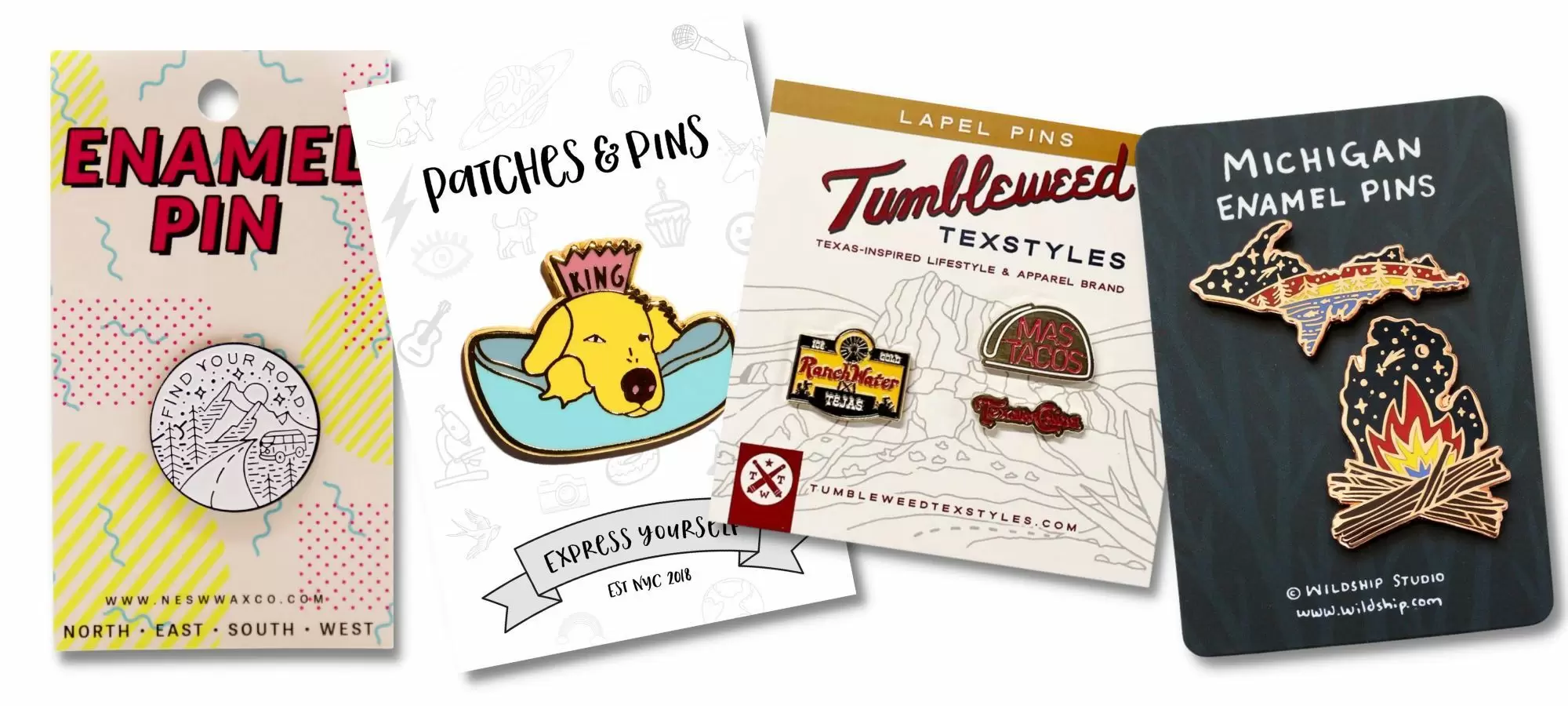
Choose enamel when the design needs defined metal borders and a durable branded-metal appearance. Soft enamel and hard enamel suit logos built from solid color areas, recognizable outlines, text with adequate spacing, and designs where plating is part of the visual identity. The metal lines separate colors, so enamel is a practical choice when a purchaser wants the pin itself to feel like a lasting recognition item rather than a printed giveaway.
Choose offset printing when artwork depends on fine image detail, tonal transitions, or many colors. Printed pins reproduce artwork as a printed surface rather than relying on raised metal lines to divide each color area. This makes the process better suited to photo-based art, subtle shading, fine logo details, and designs that would become unclear if converted into multiple enamel compartments.
| Buying requirement | Best-fit method | Reason | When it does not fit |
|---|---|---|---|
| Corporate logo with solid brand colors and metal outlines | Soft or hard enamel | Metal borders give each color a clear boundary and make plating a visible design feature. | Do not choose enamel if the logo relies on very small gradients or photographic detail. |
| Premium executive gift or anniversary pin | Hard enamel or die-cast metal | Hard enamel offers a smooth finished surface, while die-cast options support raised relief. | Do not select this route only because it sounds premium if the campaign needs detailed printed art at a controlled budget. |
| Illustration with gradients, tiny lettering, or portrait detail | Offset printed pin | Printing can retain visual information that would be difficult to separate with metal enamel lines. | It is not the first choice when the buyer specifically wants raised metal sections and enamel texture. |
| Large event giveaway with a simple badge-style logo | Soft enamel | It gives recognizable color separation and a metal-pin appearance without requiring the smooth finish of hard enamel. | It is less appropriate for artwork that contains many tiny isolated color zones. |
| Architectural, sculptural, or heritage motif | 3D die-cast pin | Cast relief can present depth without forcing the design into a flat printed graphic. | Do not use it when the artwork depends on full-color illustration. |
For example, Custom Panda produced 3D cast metal souvenir lapel pins for a Tokyo museum exhibition. The order used deep antique bronze relief and cut-out details to represent traditional architectural aesthetics. That is a good example of a design where physical relief carries the message. It should not be treated as proof that 3D casting is right for every corporate logo.
Buyers wanting a classic branded metal piece can also review custom logo pins for corporate branding. If the artwork contains detailed imagery, compare that option against offset printed pins before approving a method.
Compare enamel and printed pin costs using the same quote structure
Conclusion: request a specification-matched quote, not a single starting price. Enamel and printed pins have different cost drivers. A quote comparison is meaningful only when run size, artwork treatment, plating, backing, packaging, and freight assumptions are stated on both sides.
Custom Panda does not publish a universal pin price table because actual order pricing depends on the approved specification. Instead, the cost model below shows where a buyer should expect pricing to change and what to place on an RFQ comparison sheet. It avoids false precision and helps procurement teams identify missing charges.
| Cost variable | Enamel pin cost effect | Printed pin cost effect | What to state in the RFQ |
|---|---|---|---|
| Run size | Unit cost is affected by shared fixed preparation across the order quantity. | Unit cost is also quantity-sensitive, but the artwork and surface treatment still need to be defined. | List the exact quantity and any split by design, colorway, or department. |
| Color count | Each enamel-filled color area can affect production complexity because colors are separated by metal borders. | Color-rich art may be a better fit when many colors or tonal detail are required. | Provide the final artwork and identify mandatory brand colors. |
| Plating choice | Plating is a visible part of the pin design and must be quoted as specified, including dual-plated finishes where needed. | Plating may still matter for the metal base or edge, depending on the construction. | State the requested plating appearance and whether dual plating is required. |
| Backing choice | Backing affects the functional cost and should match the garment, lanyard, cap, or display card. | The same rule applies; a printed face does not remove the need for a secure attachment choice. | Specify the preferred backing and whether it must resist frequent wear. |
| Artwork complexity | Small separated fills, thin outlines, and detailed shapes can raise production difficulty. | Fine artwork may favor printing, but the buyer must still approve the final printed appearance. | Submit editable art when available and flag small text or gradients. |
| Surface finish | Hard enamel, soft enamel, die-cast relief, or laser engraving are distinct quoted constructions. | Printed pins require the print treatment to be named rather than grouped under “full color.” | Ask the supplier to name the exact process on every quote line. |
| Packaging and freight | These items can change total landed cost even when the pin unit price is unchanged. | The same applies. | Request packaging detail, shipping method, destination, and whether freight is included. |
For a practical budgeting exercise, build two quote lines for the same order. Quote Line A should list a soft enamel design with the agreed metal plating and backing. Quote Line B should list the same quantity, same backing, same packaging assumption, and the printed alternative. Then compare total order cost, not only the pin price. If Line B removes plating from the stated scope or Line A includes upgraded backing without an equivalent printed-pin option, the comparison is not valid.
Run size matters, but it does not decide the process alone. Digital printing and select custom items can be ordered with no MOQ at Custom Panda. Standard bulk items using offset printing have a 1,000-unit minimum, with better pricing for higher volumes. A buyer needing a small internal trial should therefore confirm which process is available for the required quantity rather than assuming every printed method follows the same order rule.
Check the quote lines that often create budget surprises
Conclusion: insist on a quote that converts every visual and functional choice into a named line item. This protects the buyer from receiving a product that technically matches a low-cost quote but does not match the approved use case. The limitation is simple: an RFQ cannot resolve unprovided information. If the design, quantity, delivery location, or backing preference is still open, the supplier can only provide a conditional estimate.
- Pin construction: Ask whether the quote is soft enamel, hard enamel, offset printed, 3D die-cast, or laser engraved. “Custom metal pin” is not enough for supplier-to-supplier comparison.
- Base material: Confirm whether zinc alloy, brass, or iron is proposed. Do not accept a material substitution without reviewing whether it changes appearance or intended use.
- Plating: Record the selected finish and ask whether dual-plated areas are included. This is particularly relevant when brand artwork uses contrasting metal details.
- Color treatment: For enamel, identify each approved color area. For printing, submit the finished art and flag gradients, small text, or fine details.
- Backing: State the attachment requirement. A pin worn regularly on uniforms has different stability expectations from a pin attached to a retail card or event lanyard.
- Proof approval: Request photo or digital sample confirmation before production. Custom Panda provides this confirmation step, which gives buyers a documented chance to check artwork and construction before the order proceeds.
- Defect remedy: Ask how defects and color mismatch will be handled. Our stated terms include color-mismatch free reprint, proportional replacement for defects, and 5-day fast re-stocking or repair.
- Quantity allowance: Confirm whether extras are included. Custom Panda includes 100 bonus pieces with every bulk order; treat them as extras, not as a substitute for specifying the required delivered quantity.
- Freight scope: Confirm the destination and shipping responsibility. Free shipping is offered, but the buyer should still make sure the quote documents the delivery basis for the destination order.
Use production evidence to judge supplier fit rather than headline pricing
Conclusion: use relevant evidence to assess whether a supplier can produce the specified pin, then use price to choose between comparable offers. The lowest offer is not automatically the lowest procurement risk. A supplier must be able to support the chosen material, finish, color treatment, and proof stage. However, evidence from one project should remain limited to that project’s use case.
Custom Panda has six production lines and reports daily label capacity above 1,000,000 pieces, alongside complete metal die-casting and embroidery facilities. For pins, stated sample lead time is 3 days, bulk production is 8–9 days, and U.S. shipping is listed at 5–6 business days. These timelines help a buyer plan backward from an event date, but they are not a substitute for confirming order-specific artwork approval, method, quantity, and destination.
A Canada esports tournament championship project used hard enamel pins with polished gold plating and dual-tone colors for fans and players to wear on jackets and lanyards. This supports hard enamel as a suitable option for a presentation-focused event design with visible plating. A different case in Germany used interactive spinning enamel pins for a specialty coffee brand anniversary, combining custom die-casting with a 360-degree rotating element. That example shows that moving components require an explicitly defined construction; it does not mean a standard corporate logo order needs a spinning feature.
For a standard business identity program, premium hard enamel pins for brands may suit formal recognition or anniversary use. For campaigns that prioritize art detail over raised metal borders, printed production may be easier to justify. The decision should follow the approved design, not a generic claim that one process is always cheaper.
Build an RFQ that procurement and design can approve quickly
Conclusion: send one complete specification sheet rather than a logo file alone. This shortens the back-and-forth required to compare enamel and printed options. It works best when brand, purchasing, and event teams agree on the non-negotiable elements before quotation. It will not solve timing risk if approval is delayed after a proof is issued.
- Set the order purpose. Write whether the pins are for executive recognition, trade-show distribution, uniforms, a retail campaign, or a commemorative event. This determines whether finish, wear resistance, or visual detail takes priority.
- Provide final artwork. Include the logo, mandatory colors, any gradients, and text that must remain readable. Mark the areas that cannot be simplified.
- Request two matched methods. Ask for an enamel option and a printed option when both are feasible. Keep quantity, backing, packaging, and delivery destination consistent.
- Name the metal and plating expectation. State whether the appearance requires a single plating or dual-plated finish. If you have a reference product, include photographs.
- Choose the backing for actual use. Explain whether the pin will be worn on a jacket, uniform, lanyard, cap, or packaging card. Do not leave backing unspecified.
- Confirm quantity rules. Identify whether the order is a no-MOQ select custom item or a standard bulk request. For offset printing, account for the 1,000-unit minimum.
- Approve the proof before production. Review the digital or photo sample for color placement, readable copy, plating appearance, and backing location.
- Document acceptance and remedies. Keep the approved proof, quote, quantity, and agreed defect terms with the purchase order.
Buyers with a logo that may also be used on packaging can coordinate pin artwork with custom labels printed in bulk, although pin manufacturing and label substrate selection remain separate specifications. Keeping visual assets aligned is useful; treating the products as identical production jobs is not.
Choose the right cooperation terms for the planned order
Custom Panda is a suitable fit when a buyer needs a specified pin process, documented pre-production confirmation, and a supplier that can also support related labels or patches. The company provides free design assistance and live human support, which can help when a procurement team needs to clarify whether a logo is better suited to enamel lines or offset printing.
For a bulk order, buyers should use the stated production conditions as planning inputs: 3 days for pin samples, 8–9 days for bulk production, and 5–6 business days for U.S. shipping. Same-day dispatch is available only for select ready-stock or digital items, so it should not be assumed for a custom enamel pin purchase. Confirm the actual schedule after artwork, process, quantity, and destination are known.
Request a matched enamel-versus-printed quote with your artwork, quantity, plating preference, backing requirement, and delivery destination.