

Custom Embroidered Patches Cost Less When Specifications Match the Job
The biggest sourcing regret is approving a low patch unit price without checking what the quote excludes. A patch that looks economical on a purchase order can become costly after attachment labor, replacement orders, freight, or a design that is too detailed for embroidery. For repeat uniform and promotional programs, Custom Embroidered Patches should be specified around the garment, wear conditions, attachment method, and reorder plan before buyers compare suppliers.
The aim is not to buy the least expensive patch. It is to avoid paying twice for the wrong backing, an oversized design, unstable borders, or a specification that production cannot reproduce clearly. A sound RFQ separates confirmed supplier charges from internal estimates and unknown exposure. That gives procurement, operations, and finance a better basis for approval.
Start With the Specifications That Affect Quote Economics
Conclusion: Reduce cost by removing features that do not serve the use case, rather than reducing quality controls. The reason is simple: patch construction, artwork complexity, backing, and attachment all influence the production route. This approach fits repeat staff uniforms, workwear, school programs, outdoor gear, and promotional apparel. It does not apply when a brand requirement, wearer safety requirement, or buyer approval standard requires a particular finish.
Before requesting prices, provide the same specification package to every supplier. A quote based on only a logo image is not directly comparable to a quote based on approved artwork, backing choice, border preference, attachment method, and shipping destination.
| Specification area | Cost control decision | Best fit | Limit or tradeoff |
|---|---|---|---|
| Patch size | Use the smallest size that keeps the logo readable | Chest logos, sleeve identification, staff uniforms | Small patches may not hold fine text or small visual elements |
| Artwork detail | Combine tiny color areas and remove unreadable text | Corporate logos and repeat uniform programs | Not suitable where every small element is a required brand asset |
| Border style | Select a standard border where the shape permits it | Simple circles, shields, rectangles, and ovals | Complex outlines may require a different edge treatment |
| Backing method | Match attachment to the garment and replacement plan | Uniforms, bags, event apparel, tactical gear | The lowest patch price may raise application labor costs |
| Order consolidation | Combine predictable variants into one production plan | Multi site uniform programs with settled artwork | Do not combine quantities if departments need different sizes or backings |
Fine embroidery is a strong choice for bold logos, clear lettering, and visual texture. It becomes less efficient when artwork contains photographic shading, tiny legal text, or many small isolated color areas. In those cases, simplify the emblem before approval or consider another patch construction. For highly detailed brand marks, buyers may compare embroidery against custom woven patches, which can be better suited to small lettering. That is not an automatic substitution: woven construction creates a different surface feel and may not match an established embroidered uniform program.
Choose attachment before approving the artwork
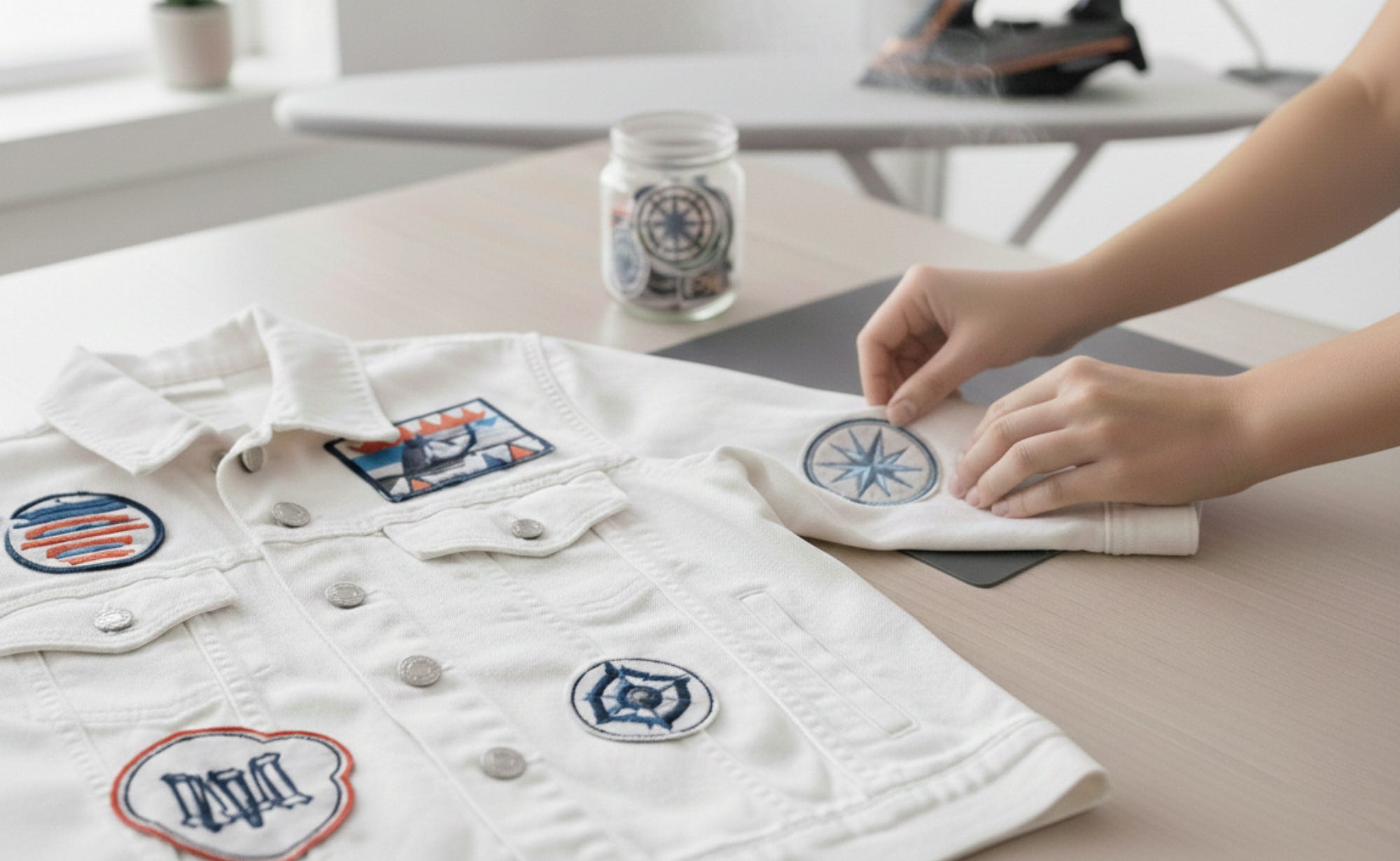
Attachment should be decided at the same time as the patch face. This is where many quote comparisons break down. A sew on patch may carry a lower supplier charge, yet require more internal sewing time. An iron on option can reduce application steps for certain garments, while hook and loop supports replacement and role changes.
- Sew on backing: Choose this when the patch is intended to stay on a garment through long term use and sewing labor is already available. It is less suitable for fast field replacement or temporary identification.
- Heat seal backing: Choose this when the garment material and application process have been reviewed for heat compatibility. It can suit planned apparel application, but it should not be selected without testing the actual garment fabric.
- Hook and loop backing: Choose this when staff roles, names, or unit identifiers change regularly. custom hook and loop patches can lower future replacement effort because the garment can retain its matching attachment surface. This is less useful for a permanent fashion placement where a removable edge is unwanted.
- Iron on backing: Choose this for controlled applications where buyers can verify garment compatibility and application instructions. custom iron on patches may not be the right answer for every wash process or fabric type.
A useful RFQ question is: “Who attaches the patch, on what garment, and how often will it need to be changed?” If the answer is unclear, the buyer does not yet have enough information to choose a backing on unit price alone.
Use a Five Year Total Cost Model Before Selecting a Quote
Conclusion: Approve the option with the lowest five year ownership cost, not automatically the lowest quoted patch price. The reason is that a repeat program includes recurring orders, incoming freight, attachment work, and possible replacement exposure. This model fits uniform contracts, club merchandise, school apparel, outdoor equipment, and recurring promotional campaigns. It does not produce a final financial answer until your organization adds its actual quantities, labor rates, freight quotes, and reorder assumptions.
Use the following model for each supplier option. Keep confirmed figures separate from estimated and unknown figures. Do not convert assumptions into stated supplier facts.
| Cost category | What to include | Cost status | Buyer action |
|---|---|---|---|
| Unit price | Quoted patch price by design, size, backing, and quantity | Confirmed only after supplier quotation | Request the price basis and confirm whether the quantity is per design or combined |
| Setup costs | Artwork preparation, digitizing, sampling, or other quoted preparation charges | Confirmed only if listed in writing | Ask whether setup applies to repeat orders or revised artwork |
| Freight costs | Delivery charge, destination, shipment method, and split shipment exposure | Confirmed only after destination and shipping terms are stated | Compare delivered cost, not factory price alone |
| Replacement costs | Expected replacement patches, reorders, and defect handling | Estimated unless supported by contract terms | Record supplier remedies separately from internal replacement assumptions |
| Attachment labor costs | Sewing, heat application, hook and loop installation, inspection, and rework time | Estimated from internal labor data | Use the same labor method across every quote option |
| Unknown costs | Artwork changes, urgent shipments, garment damage, approval delays, and unplanned reorder quantities | Unknown | Flag them for management rather than hiding them in the unit price |
The five year calculation can be expressed as:
Total ownership cost = patch unit purchases + setup costs + freight costs + replacement costs + attachment labor costs + identified unknown cost allowance.
The final element should not be presented as a fact. If your finance team requires an allowance for unknown exposure, label it as an internal planning estimate and document the assumption used. If no reliable assumption exists, show the item as “not yet quantified.” That is more honest than assigning an artificial value.
For example, compare two patch options for the same recurring uniform emblem. Option A has a lower quoted patch price but requires sewing for every garment and each replacement. Option B has a higher patch price with hook and loop attachment, allowing the garment-side attachment to remain in service when an identifier changes. Option A may be suitable where garments remain assigned for a long period and sewing is already planned. Option B may be suitable where staff turnover, role changes, or field replacement are expected. The procurement decision depends on verified internal labor and replacement assumptions, not a generic rule that one backing is always cheaper.
Prevent the Specification Errors That Create Reorders
Conclusion: Treat approval samples and written production instructions as cost controls. The reason is that unclear expectations lead to border fraying, blurred small details, weak backing performance, or a patch that does not suit the intended garment. This practice fits every first order and every artwork revision. It is less necessary only when the buyer is reordering an unchanged approved specification from the same controlled production record.
At Custom Panda, patch samples are available with a stated sample lead time of 3 days, while bulk patch production is listed at 8 to 9 days. That timing allows buyers to review the actual construction before committing a larger recurring order. Our ISO 9001:2015 Quality Management System Certified facility and Disney FAMA Certified status are relevant proof points for buyers who need documented supplier qualifications, but certifications do not replace buyer review of the patch sample and garment application.
Common mistakes to stop before purchase approval
- Approving artwork at screen size: A logo can look readable on a monitor and still lose small text when converted to thread. Ask for a production proof that shows the proposed detail treatment.
- Leaving backing unspecified: “Patch only” is not enough for a uniform RFQ. State sew on, heat seal, hook and loop, or another approved attachment method.
- Comparing different quantities: One quote may be based on an annual total while another covers a single department order. Normalize quantities before comparing unit prices.
- Ignoring garment construction: Thick jackets, lightweight polos, backpacks, and tactical vests do not present the same attachment conditions. Send garment information or a physical sample when the application is sensitive.
- Assuming every reorder is identical: Record the approved artwork version, thread colors, backing, border, size, and packaging request. A verbal reorder request can introduce variation.
- Forgetting replacement policy: Ask how defects are documented and resolved before placing the first bulk order.
Custom Panda provides photo or digital sample confirmation before production, color mismatch free reprint, proportional replacement for defects, a 5 day fast re stocking or repair process, and 100 bonus pieces with every bulk order. These are supplier commitments that should be reviewed alongside the quotation terms. They do not remove the buyer’s need to approve artwork, backing, and intended use before production begins.
Build a Quote Request That Produces Comparable Supplier Answers
Conclusion: Issue one structured request to all suppliers and require exceptions to be listed. The reason is that quote differences often come from missing assumptions, not true price differences. This method fits sourcing teams seeking budget approval or supplier comparison. It does not apply when a buyer is simply reordering a fully documented, unchanged item under an existing agreement.
- Define the use case. State whether the patch is for employee uniforms, outdoor gear, retail apparel, event giveaways, or another use. Include expected replacement frequency if known.
- Provide production artwork. Send the approved logo file and identify details that cannot be simplified. If text is small, ask the supplier to state whether embroidery will reproduce it clearly.
- Set the physical specification. List shape, final size, border requirement, thread colors, backing, and attachment method.
- State order structure. Identify first order quantity, estimated repeat order pattern, number of artwork versions, and whether departments require separate packing.
- Request an itemized quote. Ask for unit price, setup charges, sample process, freight basis, production lead time, payment terms, and stated defect remedy.
- Verify the sample. Review edge finish, text clarity, thread coverage, backing placement, and fit on the actual garment before authorizing bulk production.
- Store the approved record. Keep the proof, quote, backing choice, and shipment details with the purchasing file for future reorder control.
Buyers with stable yearly programs can also review whether an embroidered patch should be paired with a garment identification label. For neck branding or care information, custom woven clothing labels can keep permanent garment information separate from a removable or role based emblem. This is useful for uniforms requiring both identification and brand presentation, but it adds another component and should be budgeted separately.
Use Supplier Evidence to Reduce Repeat Order Risk
Conclusion: Select a supplier that can show production capability, a defined approval process, and relevant application experience. The reason is that repeat orders depend on controlled records and dependable production capacity, not only an attractive first quote. This is especially relevant for programs with multiple sites or seasonal demand. It does not mean the largest supplier is automatically the best fit; buyers still need to assess communication, specification accuracy, and delivery terms.
Custom Panda was established in 2012 and operates an 8,000 m² facility with 6 production lines, including embroidery production facilities. For a relevant use case, the company manufactured heavy duty embroidered hook and loop patches for a United States outdoor gear brand, using weather resistant threads and rugged hook and loop backings for hiking backpacks and tactical vests. That example supports hook and loop consideration for demanding gear applications; it should not be treated as a blanket performance promise for every garment, climate, or use condition.
A second example is a Sweden university sports team program using chenille letterman jacket patches with plush felt backings and high density stitching on heavy wool fabric. This illustrates why fabric type matters. A construction selected for wool letterman jackets is not automatically the right construction for lightweight staff polos or waterproof outerwear.
Submit your patch artwork, garment details, expected reorder pattern, and attachment preference for an itemized quote comparison.