

Custom Kraft Labels Roll Planning Can Reduce Total Procurement Cost
A low quoted label price can become an expensive purchase when the roll does not fit the applicator, the quantity leaves too many unused labels, or the selected size wastes package space and material. Procurement teams should check roll construction before approving artwork or comparing supplier quotes.
Custom Kraft Labels should be specified as an application system, not only as a printed design. The finished label dimensions, labels per roll, roll count, core size, and total production run all affect purchase cost, warehouse handling, line stoppages, and leftover inventory. A practical RFQ makes those variables visible before the order is placed.

Set the Finished Label Size From the Package Application Area
Start with the package, not the artwork canvas. The right finished size is the smallest format that holds required product information, keeps important text away from edges, and fits the available application panel. This reduces unnecessary material use and may allow more labels on a roll. It fits brands applying labels to flat cartons, paper bags, jars, sleeves, and retail packaging. It does not apply when a larger label is needed for legally required content, shelf visibility, or a wraparound presentation.
For kraft paper labels, leave enough quiet space around barcodes, lot information, and handwritten fields. Kraft stock has a natural base tone, so light colors and very fine reverse text may need a proof review before bulk production. If warehouse staff must write batch details by hand, identify the writing area in the artwork and request confirmation that the selected surface suits that use.
Use this package measurement checklist
- Measure the usable panel: Record the flat area available after folds, seams, curves, closures, and package edges are excluded.
- Mark the application direction: State whether the label dispenses first from the left, right, top, or bottom. This matters for automatic or semi automatic placement.
- Identify variable information: Separate permanent printed content from batch codes, dates, pricing, or handwritten fields.
- Check package surface: Confirm whether the label is applied to paperboard, glass, coated board, flexible packaging, or another surface.
- Approve a readable layout: Do not reduce type size simply to force content into a smaller format. A smaller label is not a saving if operations cannot read or scan it.
The conclusion is simple: choose the smallest workable label, not the smallest possible label. That distinction protects readability and reduces rework. For product ranges that need a natural paper appearance across several packaging formats, review affordable paper packaging labels alongside the kraft specification so the material and finish match the actual use case.
Calculate Total Cost From Dimensions, Rolls, Core Size, and Run Length
The unit price shown on a quotation is only one part of the buying decision. A useful total cost calculation separates confirmed commercial terms from estimates and unknowns that must be clarified in the RFQ. This prevents a procurement team from treating an assumed saving as a confirmed saving.
| Cost category | What can be included | How to use it | What remains to confirm |
|---|---|---|---|
| Confirmed costs or credits | Quoted production charge, any stated free shipping service, and free design assistance when offered | Use only written supplier terms and the approved quotation | Whether the quoted shipping scope covers the destination and order conditions |
| Estimated operating costs | Line labor, changeover time, unused labels, relabeling, and internal storage | Use the buyer’s own recorded operating data or a controlled trial | Actual waste rate until the chosen roll is tested on the intended equipment |
| Unknown external costs | Taxes, duties, customs charges, special delivery handling, and applicator adjustments | List separately from label manufacturing cost | Destination requirements and carrier or broker charges |
Build the calculation before requesting quotes
Use the following variables. They work for manual application, hand dispensers, and label applicators without inventing a price or waste percentage.
- D = usable labels needed for the planned production period.
- R = labels per roll quoted by the supplier.
- N = rolls required, calculated as D divided by R and rounded up to a whole roll.
- Q = labels purchased, calculated as N multiplied by R.
- W = labels remaining before any line waste, calculated as Q minus D.
- A = trial based application waste allowance, determined by the buyer’s process rather than assumed in the supplier quote.
- T = total labels to order, calculated as D plus A, then adjusted to full rolls.
Next, calculate the operational unit cost: divide the total landed purchase cost by D, not by Q. This method exposes the cost of labels that remain in storage or are lost during application. If the product charge is divided only by Q, a roll format with excessive leftovers can appear cheaper than it is.
| Planning factor | Effect on unit pricing | Effect on application waste | Buyer action |
|---|---|---|---|
| Label dimensions | A larger label generally uses more material and can change the production layout and labels per roll | An oversized format can create package placement errors or cover needed product information | Provide the exact finished width and height, plus package panel dimensions |
| Labels per roll | Changes the roll count and can affect handling and storage requirements | Incorrect roll quantities can leave excess labels after the production run | Request two or more roll count options using the same finished label size |
| Core size | May affect roll construction and compatibility requirements | A core that does not suit the dispenser or applicator can cause setup delays and rejected rolls | State the required core size from the equipment specification |
| Run length | A longer production run may spread fixed preparation work across more labels, but supplier pricing must be quoted | Ordering far beyond expected demand can create obsolete inventory after a design change | Compare the next planned replenishment quantity, not only the current minimum need |
For example, a buyer with demand D should first select a candidate labels per roll figure R. The required roll count is N, rounded upward. Any difference between purchased quantity Q and demand D is planned remainder W. The buyer then adds only a documented application allowance A based on internal trial results. If the core size does not fit the existing applicator, the calculation stops: a lower manufacturing price does not offset a roll that cannot run on the line.
This approach fits procurement teams comparing several quote formats. It does not replace a live production test where labels must run at speed, apply to curved packaging, or withstand moisture. For products exposed to water, oils, or condensation, compare waterproof bottle labeling options before assuming kraft stock is the right material choice.
Choose the Run Length That Fits Demand and Obsolescence Risk
Run length should reflect how stable the artwork, packaging, and demand forecast are. A larger order can improve quoted economics, especially when standard bulk production requires a minimum of 1,000 units. Yet a large run is not automatically the lowest total cost when product claims, ingredient lists, prices, or branding may change before the labels are used.
| Buying situation | Recommended approach | Reasoning | Limit |
|---|---|---|---|
| Stable packaging and repeat demand | Request pricing at the immediate need and the next forecast replenishment level | It shows whether a longer run reduces the quoted unit cost enough to justify extra inventory | Do not choose the larger run if upcoming artwork or compliance changes are expected |
| New product launch | Use a smaller validation order where eligible and confirm the applied sample first | It limits obsolete stock while packaging and market response are still uncertain | Digital printing and select custom items may have no minimum order quantity, but availability must be confirmed for the exact specification |
| Multiple product variants | Calculate demand and leftovers by each SKU, not by the combined family quantity | A high total quantity can hide low demand for individual flavors, scents, or sizes | Shared design elements do not guarantee that every SKU will have the same production price |
| Manual application | Choose a roll count that workers can handle consistently | Fewer roll changes may reduce interruptions when labels are applied by hand | Very large rolls may not fit the available dispenser or work area |
At Custom Panda, standard bulk items using offset printing have a 1,000 unit minimum, while digital printing and select custom items can be ordered without a minimum. Procurement should treat those as production route options rather than assume one route suits every kraft label order. Ask for the print method, the quantity basis, and the exact roll configuration on every comparable quote.
Prevent Avoidable Waste During Label Application
Most label waste is not caused by the graphic design itself. It is caused by incomplete operating details at the quote stage. The following mistakes can be prevented before production begins.
- Ordering by total label count only: This ignores full roll rounding. Calculate required rolls and remainder labels before approval. This is most useful for seasonal or limited production runs; it matters less when the same label is consumed continuously.
- Leaving core size unspecified: A supplier cannot confirm equipment compatibility without it. Include the core requirement from the dispenser or applicator manual. This does not remove the need to verify roll outside diameter if the equipment has a physical limit.
- Ignoring unwind direction: A correctly printed label can still be awkward to apply if it presents in the wrong orientation. Send a package photo with an arrow showing how the label should dispense. The request may not matter for labels applied individually by hand, but it should still be documented.
- Adding unplanned spare labels: Extra labels can be sensible when internal trials show repeatable losses. They should not be a guessed percentage. Use recorded waste from a comparable packaging line, then revise after the first run.
- Choosing kraft for wet conditions: Kraft appearance does not make a label waterproof. If a package will face refrigeration, condensation, or repeated moisture, assess synthetic alternatives instead of relying on appearance alone.
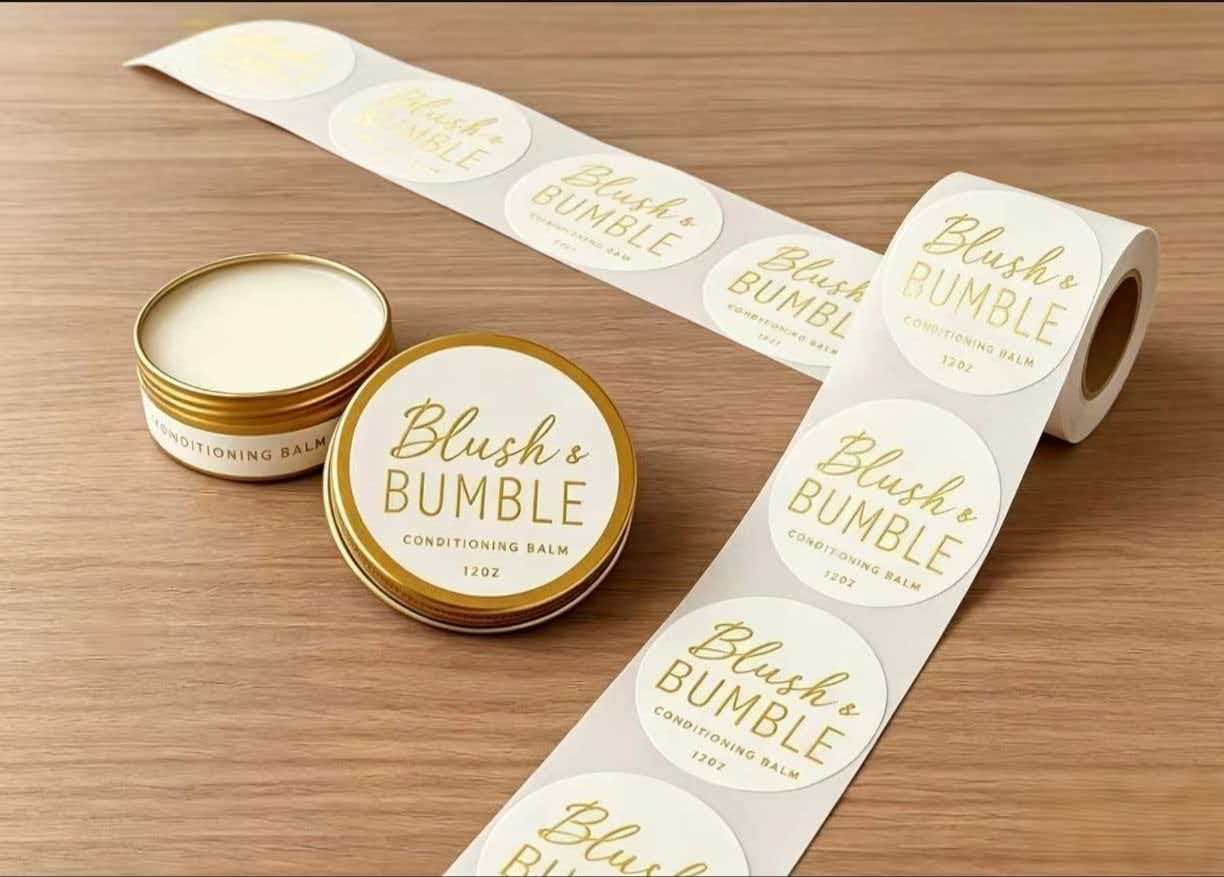
For a natural retail presentation on candle jars, coffee bags, or gift packaging, see kraft paper label formats. For packaging that needs a different substrate, clear BOPP label options may be more suitable where moisture resistance and a transparent appearance are required.
Use Supplier Controls That Reduce Reprint and Delay Exposure
Price comparison should include supplier controls, not just the line item price. Custom Panda operates an ISO 9001:2015 certified quality management system and is Disney FAMA certified. The facility was established in 2012, covers 8,000 m², and operates six production lines with six HP digital label presses. Daily label capacity exceeds 1,000,000 units.
Those capabilities matter when procurement needs repeatable artwork approval and a defined response to defects. For pins, patches, and labels, samples have a stated lead time of 3 days, while bulk production is listed at 8 to 9 days. Photo or digital sample confirmation is available before production. Bulk orders also include 100 bonus pieces. If a confirmed color mismatch occurs, the stated remedy is a free reprint; proportional replacement applies to defects, with 5 day fast restocking or repair.
A relevant production example comes from Australia, where metallic foil stamped roll labels were supplied for a natural health supplement brand using matte BOPP film and scratch proof lamination. That case supports the value of matching material and finish to retail use. It does not mean every kraft label requires foil, BOPP, or lamination. Select features only when they solve a defined packaging or handling problem.
Send an RFQ Package That Produces Comparable Quotes
- Provide the final artwork or identify the elements that still need design assistance.
- State finished label width and height, shape, corners, and quantity needed by SKU.
- Specify the package surface and whether application is manual, dispenser based, or automated.
- State labels per roll options requested, required core size, unwind direction, and any maximum roll limit from the equipment.
- Give the forecast demand period and identify whether artwork or packaging changes are expected.
- Ask the supplier to separate quoted production cost from shipping, taxes, duties, and any other unconfirmed charges.
- Request photo or digital sample confirmation before approving bulk production.
Submit your label dimensions, roll requirements, and forecast quantity for a quote that compares total operating cost rather than label price alone.