

What Buyers Regret Missing Before Ordering Custom Patches for Hats
Most hat-patch orders don't fail because of bad artwork. They fail because nobody confirmed the panel curve, the backing method, or the reorder timeline before production started. If you're sourcing custom patches for hats for the first time — or switching suppliers after a batch of loose Velcro or fraying borders — the questions below are the ones that actually block orders, not the ones that make good marketing copy.
We've built patches for outdoor gear brands, university teams, and denim labels, so this isn't theoretical. A backing that works on a flat tote bag can peel off a curved snapback within a season. Getting the panel shape, thread density, and attachment method right the first time saves a reorder cycle — and with bulk production running 8-9 days plus 5-6 business days for U.S. shipping, a wrong spec means weeks lost, not days.
Matching Patch Type to Hat Style and Wear Conditions
Not every patch construction survives a curved front panel or repeated washing. The right choice depends on where the hat is worn, how often it's laundered, and what look the brand wants on shelf.
| Patch Type | Best For | Limitation |
|---|---|---|
| Embroidered | Structured caps, classic logo looks, uniforms | Fine text under 4mm can blur; not ideal on very curved panels |
| Chenille | Varsity/letterman-style caps, bold lettering | Adds bulk; not suited to low-profile or curved brims |
| PVC / soft rubber | Outdoor, tactical, or waterproof-need caps | Limited fine detail compared to embroidery |
| Woven | Small logos with fine detail, flat caps | Less texture than embroidery, no 3D puff option |
| Leather / faux-leather | Premium, denim, or heritage branding | Higher cost per unit, limited color range |
A Sweden-based university sports program needed fluffy chenille varsity patches for letterman jackets with plush felt backing and high-density stitching — that same density works well on flat-front caps but would sit awkwardly on a curved 6-panel dad hat. If your hat has a pronounced curve, we generally steer buyers toward embroidered or woven construction under 3 inches wide, since large chenille or PVC pieces tend to pucker on the seam.
Artwork Proofs, MOQ, Curved Panels, Attachment and Delivery — Answered Directly
These are the five questions that stall orders most often. Here's what applies, and what doesn't.
Do I need to approve a proof before production starts?
Yes, and you should insist on it even if a supplier offers to skip it. Every order goes through a photo or digital sample confirmation before production — this catches thread color mismatches and stitch density issues before they're baked into 500 units. It does not replace a physical sample; if color accuracy is critical (brand Pantone matching), request a physical pre-production piece, which adds to lead time but avoids a full reprint later.
What's the minimum order quantity for custom patches for hats?
It depends on the production method. Digital printing and select custom items carry no minimum order, which suits small-batch startups or one-off event runs. Offset printing and standard bulk embroidery/woven items require 1,000 units minimum, but per-unit pricing drops meaningfully at that volume. If you need 200 patches for a pilot run, expect to pay a premium per piece or look at digital-friendly formats instead of full embroidery.
Can a patch really lay flat on a curved cap panel?
Only up to a point. Patches under 2.5 inches with a slight backing flex handle curved front panels fine. Anything wider than 3.5 inches on a structured 6-panel curve tends to bubble at the edges unless you split the design or reduce the patch to a die-cut shape that follows the seam. This is a physical constraint, not a workmanship issue — no backing material fully eliminates it on tight curves.
Which attachment method should I choose — sew-on, iron-on, or Velcro?
- Sew-on: most durable for commercial laundering and long-term wear; requires stitching labor at the hat factory.
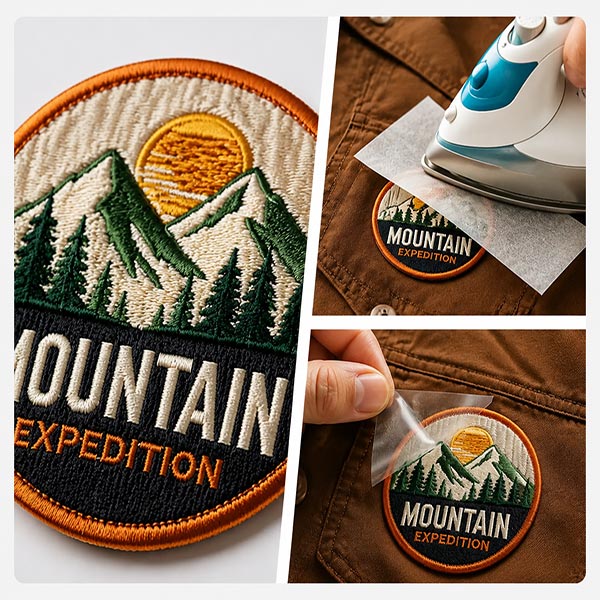
- Iron-on / heat-seal backing: fastest to apply, good for retail-ready caps, but can loosen under repeated high-heat washing.
- Velcro (hook and loop): best when patches need to be swapped — team names, rank badges, seasonal logos. A U.S. outdoor gear brand used this exact approach for embroidered patches on hiking backpacks and tactical vests, choosing weather-resistant thread and rugged hook-and-loop backing for repeated field use.
If your hats go through commercial washing (uniform programs, hospitality staff), sew-on or heat-seal with reinforced stitching outperforms plain adhesive-backed Velcro over time.
How does delivery scheduling actually work?
| Stage | Typical Timeline |
|---|---|
| Sample / proof approval | 3 days |
| Bulk production after approval | 8-9 days |
| U.S. shipping | 5-6 business days |
Same-day dispatch applies only to select ready-stock or digital items — it is not standard for custom embroidered or chenille patches, which require tooling and stitching setup regardless of order size.
A Step-by-Step Checklist Before You Submit Artwork
- Confirm the hat panel type — flat-front, curved 6-panel, or trucker mesh — since this determines maximum patch width.
- Decide attachment method based on wash frequency and whether the patch needs to be removable.
- Send vector artwork (AI, EPS, or high-res PDF) with Pantone color codes, not just a JPEG screenshot.
- Specify backing type: iron-on, sew-on, or Velcro loop — mixed orders need this noted per SKU.
- Request a digital proof and, for brand-critical colors, a physical pre-production sample.
- Confirm quantity against MOQ tier — under 1,000 units, ask specifically about digital-friendly formats to avoid setup surcharges.
- Lock delivery date backward from your event or retail launch, allowing for the 3-day sample plus 8-9 day bulk window.
Common Mistakes That Delay Hat Patch Orders
- Sending flattened mockups instead of vector files — causes edge blurring on embroidery digitizing, forcing a redo cycle.
- Skipping the curve check — a patch designed for a flat panel doesn't automatically fit a curved brim without adjustment.
- Choosing iron-on for high-wash-frequency uniforms — backing loosens faster than sew-on under repeated commercial laundering.
- Not specifying thread color numbers — "navy blue" reads differently across factories; Pantone or thread chart numbers remove ambiguity.
- Ordering exactly at your needed count — production naturally yields some variance; buffer stock avoids reorders for small shortfalls.
On the last point, every bulk order already includes 100 bonus pieces, which usually covers minor damage in transit or last-minute staff additions without triggering a second production run.
A Worked Example: Denim Brand Sourcing Leather Hat Patches
A premium denim line needed patches durable enough to survive industrial stonewashing — a process that destroys standard adhesive-backed patches. The solution used for their apparel line was embossed faux-leather with debossed logos and antique edges, built specifically to hold up through repeated heavy wear. The same construction logic applies to hat patches for brands expecting rough handling: choose a debossed or engraved leather-style patch with sew-on backing rather than adhesive, since heat and friction during stonewashing (or heavy daily wear on caps) breaks down glue-based bonds faster than stitched seams.
Quality and Reorder Assurance Worth Confirming Upfront
Before placing a bulk order, ask your supplier directly what happens if a batch arrives with color drift or a defect rate above normal. Look for these terms in writing:
- Color mismatch triggers a free reprint, not a partial refund negotiation.
- Defective units get a proportional replacement rather than a full-batch charge dispute.
- Re-stocking or repair for confirmed defects should run around 5 days, not weeks.
These terms matter more for hat patches than most merchandise categories, because a mismatched thread color on a cap is far more visible than the same issue on a small clothing tag. Facilities certified under ISO 9001:2015 and Disney FAMA standards typically apply these checks as a matter of process, not as a one-time favor — worth confirming during your first RFQ conversation.
Patches aren't the only branding element that needs this level of order-readiness. If your product line also uses printed tags or labels, the same proofing discipline applies — see our guide on custom labels printed in bulk for parallel sourcing questions on adhesive and substrate choices. For caps specifically, browsing a dedicated hat patches supplier page can help you compare embroidered, PVC, and chenille options side by side before you lock a spec sheet. And if your run mixes patch styles across a product line, checking custom iron on patches options alongside sew-on variants helps you standardize backing choices across SKUs instead of managing five different attachment types.
Getting Your Spec Sheet Ready
The fastest way to avoid a stalled order is sending a complete spec sheet on the first submission: hat panel type, patch size, attachment method, thread or PVC color codes, and target delivery date. If you're not sure which construction fits your cap style, send your artwork and hat sample photos over and ask for a recommendation before committing to a production method — a five-minute conversation upfront is cheaper than a reprint after the fact.
Ready to move forward? Send your logo file and target quantity, and request a digital proof before bulk production begins — that single step prevents most of the reorders we see in this category.