

How to Source Custom Patches for Work Uniforms
A uniform patch can look acceptable at delivery and still become a costly problem after issue. Loose borders, lifting backing, blurred lettering, and color variation create replacement work for procurement teams and frustration for wearers. Before placing an RFQ, buyers need to specify where the patch will be worn, how it will be attached, and what repeated wear and cleaning will involve.
Custom Patches for work uniforms should be sourced as a functional identification component, not simply a decorative badge. A warehouse vest, restaurant apron, maintenance coverall, security jacket, and outdoor work bag all place different demands on the patch. The right construction depends on the garment fabric, logo detail, attachment method, and replacement process.
Start the RFQ with the Uniform Application
Begin with the garment and its actual use. This is the fastest way to rule out unsuitable patch types before comparing supplier prices. A patch that works on a promotional cap may not be appropriate for a garment issued to staff who wash it frequently or work outdoors.
State the following in every quotation request:
- Garment type and fabric: Identify whether the patch will be applied to cotton, polyester, blended workwear, fleece, canvas, denim, softshell fabric, or another material. The fabric affects sewing access, heat application, and how the patch sits on the garment.
- Placement: Specify chest, sleeve, shoulder, back, pocket, cap, bag, or vest placement. Curved surfaces and pockets can limit patch size and backing options.
- Wear conditions: Explain whether the uniforms face abrasion, rain, sun exposure, frequent handling, outdoor use, or regular laundering. This gives the supplier context for recommending materials and attachment methods.
- Artwork purpose: Confirm whether the patch contains a logo, employee name, department title, rank, safety identifier, or event designation. Name and role patches often need easier replacement than permanent brand patches.
- Quantity by design: List each artwork variation separately. A bulk order may include one logo design plus many individual employee names.
- Approval requirement: Request a digital proof or physical sample before bulk production. This is especially useful where logo colors and text legibility are controlled by brand guidelines.
The conclusion is simple: source according to use conditions first and appearance second. This suits all uniform programs. It does not mean appearance is unimportant; premium hospitality and retail uniforms may require a more refined finish. However, a visually attractive patch with an unsuitable attachment method is still a poor procurement decision.
For staff identification programs, custom name patches can separate employee details from the permanent company emblem. This approach fits organizations with regular staff turnover because only the removable or replaceable name component needs reordering. It is less suitable where every uniform must show a permanently fixed identification mark.
Application Focused Sourcing Criteria for Work Uniforms
For work uniforms, three checks deserve direct comparison: wash durability, edge finish, and backing selection. These factors affect whether the patch remains attached, maintains a professional outline, and suits the garment’s maintenance routine. Ask suppliers to address each item in writing rather than accepting a general statement that a patch is “durable.”
| Check item | What to specify | Why it matters | Best fit | Limit or caution |
|---|---|---|---|---|
| Wash durability | Expected cleaning method, frequency, detergent exposure, and whether industrial laundering is used | A patch faces stress from water, heat, tumbling, friction, and cleaning chemicals. Without application details, a supplier cannot sensibly recommend construction or attachment. | Workwear, aprons, coveralls, hospitality garments, and rental uniforms that receive repeated cleaning | Do not assume a sample attached to a display garment proves suitability for your laundry process. Test on the actual garment before approving bulk production. |
| Edge finish | Merrowed border, stitched border, or laser cut edge, plus required shape | The edge controls appearance and can affect snagging, fraying, and fit around fine shapes. It also changes how much of the artwork remains visible. | Merrowed border for conventional shapes; laser cut edge for logos with corners, curves, or nonstandard outlines | A merrowed border may not follow very detailed contours closely. A laser cut edge should be reviewed carefully on the intended fabric and use case. |
| Backing selection | Sew on, heat seal backing, hook and loop, or other requested attachment approach | The backing determines installation time, replacement flexibility, and risk of lifting during use. It must match both the patch and garment. | Sewing for permanent placement; hook and loop patches for changing roles or name identification; heat application where garment material permits it | Do not choose heat application only because it is faster. Some uniform fabrics, garment finishes, or placement areas may require sewing instead. |
| Detail method | Embroidery, woven construction, heat transfer, or PVC soft rubber | Small lettering and fine logo elements can become unclear if the chosen method is not matched to the artwork. | Embroidery for textured logo areas; woven name patches for fine lettering; PVC uniform patches for dimensional rubber styling | PVC soft rubber is not the preferred choice for every uniform. Consider the wearer’s comfort, placement, and brand presentation before approving it. |
Wash durability conclusion: build the requirement around the customer’s real cleaning cycle. For uniforms intended for repeated laundering, request a preproduction sample attached to the actual garment fabric and evaluate it after your own cleaning process. This is the right method for industrial laundry patches and managed uniform programs. It is not necessary to create an extensive test program for a short-term event garment with limited wear.
Edge finish conclusion: choose a merrowed border when the design is a simple circle, shield, rectangle, or other conventional outline and a visible stitched edge supports the look. Choose a laser cut edge when the logo shape must closely follow custom contours. The limitation is that neither finish fixes poor artwork spacing; leave enough clear area between text, borders, and the outer edge.
Backing conclusion: use a sewn attachment where permanence matters most, and select hook and loop patches when roles, names, or departments may change. Heat seal backing can reduce installation steps where the garment and placement are suitable. It should not be treated as an automatic replacement for sewing on high-use uniforms without application testing.
Choose the Patch Construction That Matches the Artwork
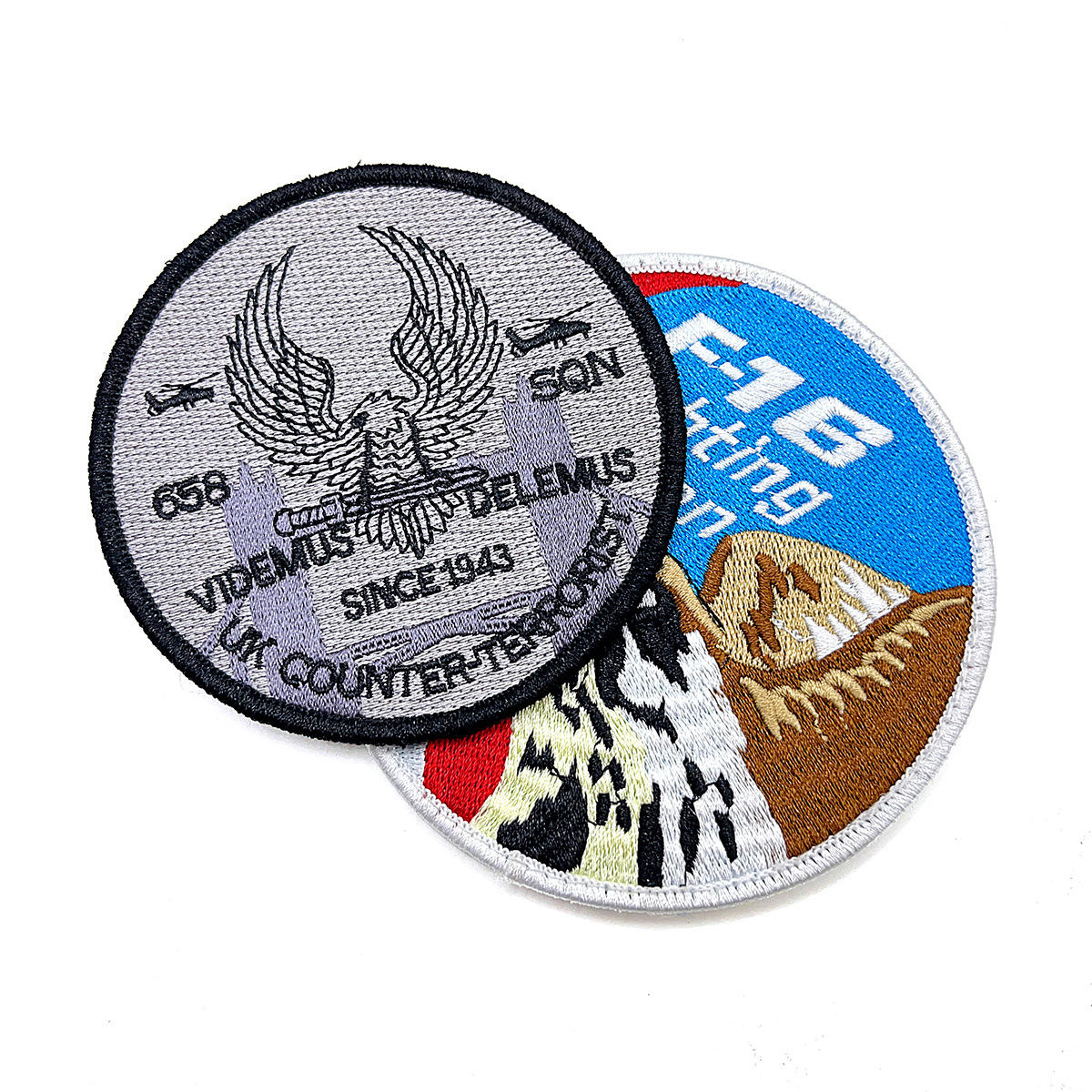
Construction should follow artwork complexity. Buyers often select embroidery first because it is familiar, then discover that thin type, narrow gaps, or small icon details lose clarity. Send vector artwork where possible and ask the supplier to identify areas that need enlargement, simplification, or a different production method.
| Patch type | Recommended use | Reason for selection | When not to choose it |
|---|---|---|---|
| Embroidered uniform patches | Bold logos, traditional badges, team identifiers, and recognizable emblems | Embroidery adds thread texture and has a familiar uniform appearance. | Do not use it for artwork dominated by very small lettering or tightly packed fine lines unless the supplier confirms legibility. |
| Woven name patches | Employee names, job titles, serial identifiers, and detailed text | High-density yarn weaving can present fine text and small graphic details more clearly than a heavily stitched design. | Do not select woven construction only for a raised, heavily textured emblem; embroidery may better suit that visual requirement. |
| Heat transfer patches | Artwork requiring printed color transitions or fine graphic detail | The printed method can suit artwork that is difficult to reproduce in thread. | Do not approve based only on a screen proof. Confirm the finished transfer on the selected garment material. |
| PVC uniform patches | Outdoor gear, tactical styling, bags, and designs requiring molded dimension | PVC soft rubber supports molded shapes and defined raised areas. | Do not use it where a flat, low-profile, traditional textile badge is required. |
| Chenille patches | Letterman styles, sports recognition, and heritage-inspired apparel | Chenille provides a plush, high-profile appearance. | Do not select it for fine technical logos, small text, or uniforms that need a restrained corporate appearance. |
For example, an embroidered chest logo with large lettering can be a suitable choice for a maintenance team. If the same program needs individual surnames in smaller type, use a separate woven name patch rather than forcing tiny lettering into the embroidered logo. This reduces the risk of blurred identification and also makes employee replacements easier to manage.
Custom Panda offers fine embroidery, woven labels, heat transfer, PVC soft rubber, chenille patches, Velcro backing, and heat seal iron on backing. Buyers can compare these options from one production source rather than rewriting the entire brief for separate suppliers. For traditional sewn insignia, review custom sew on patches when building the RFQ.
Prevent Common Uniform Patch Failures Before Bulk Approval
A supplier quote does not replace a product approval process. Procurement teams should identify likely failure points before the first bulk run, especially when the order will be distributed across multiple locations or uniform sizes.
- Approving artwork at screen size only: A digital proof shows layout, but it may not show how thread density, border width, or small lettering will appear on the finished item. Request a production sample when logo clarity is a purchasing requirement.
- Using one backing for every garment: A backing that works on a flat jacket panel may not work on a sleeve, pocket, stretch fabric, or lined vest. List each garment type and placement in the specification.
- Ignoring garment cleaning instructions: If the uniform provider has washing guidance, include it with the RFQ. This avoids judging patch suitability without the conditions that matter.
- Leaving edge treatment unspecified: If the purchase order says only “embroidered badge,” the supplier may not know whether a merrowed border or laser cut edge is expected. State the finish and confirm it on the proof.
- Combining detailed logos and tiny text: Ask whether text remains readable at the planned finished size. If not, increase the patch size, simplify the art, or use woven construction for the text element.
- Skipping placement instructions: A good patch can still be applied inconsistently. Provide a placement guide for uniform assembly teams, including the garment area and orientation.
- Ordering no contingency quantity: Uniform issue programs need spares for new starters, damaged garments, and replacements. Include extra pieces in the order plan rather than starting a separate urgent run later.
Custom Panda includes 100 bonus pieces with every bulk order, which can help support replacement planning. The company also offers proportional replacement for defects, color mismatch free reprint, and a five-day fast restocking or repair option. These measures support purchasing continuity, but they do not remove the buyer’s need to approve design, construction, and attachment suitability before production.
Build a Supplier Comparison That Goes Beyond Unit Price
Unit cost matters, but it is only one part of the procurement decision. A lower quote can become more expensive if it produces avoidable replacements, inconsistent branding, or delayed uniform issue. Compare suppliers against the same RFQ so differences are visible.
| Supplier comparison point | Question for the supplier | Buying reason |
|---|---|---|
| Sample process | Can you provide a digital or photo sample confirmation before bulk production? | It establishes an approval record for artwork, color, and construction details. |
| Production scope | Can you produce embroidery, woven, heat transfer, and PVC options? | It allows the buyer to match patch construction to the application rather than accepting one default method. |
| Quality controls | How are color, border finish, backing, and attachment defects handled? | It clarifies the remedy process before the purchase order is issued. |
| Lead time | What is the sample lead time and bulk production schedule after approval? | Uniform rollouts require dates that can be planned against garment delivery and distribution. |
| Order flexibility | Are there different minimums for digital items and standard bulk production? | This helps buyers plan pilot quantities and larger replenishment orders. |
Custom Panda is ISO 9001:2015 Quality Management System Certified and Disney FAMA Certified. Its 8,000 m² facility has six production lines and complete embroidery production facilities. For pins, patches, and labels, the stated sample lead time is three days, while bulk production is listed at eight to nine days. These are planning references, not a substitute for confirming the production schedule for a specific design, order size, and shipping destination.
The company states that digital printing and select custom items have no MOQ, while offset printing and standard bulk items have a 1,000-piece minimum for better bulk pricing. Procurement teams should therefore separate a small pilot requirement from the expected repeat volume when requesting pricing.
A relevant production example is Custom Panda’s work for an outdoor gear brand in the United States. The project used heavy-duty embroidered Velcro patches with weather-resistant threads and hook-and-loop backing for hiking backpacks and tactical vests. This supports hook and loop selection where removable identification is needed on compatible gear. It does not automatically establish the same construction as the right answer for office uniforms, food-service apparel, or garments with different maintenance requirements.
Use a Controlled Approval Procedure Before Release
A controlled approval process protects both the buyer and supplier from assumptions. It is especially useful when a uniform distributor is ordering on behalf of several end users.
- Collect the garment data. Obtain fabric information, cleaning guidance, placement location, and a physical garment sample if possible.
- Prepare artwork by patch purpose. Separate permanent company logos from employee names, job roles, or changing unit identifiers.
- Select two suitable constructions. For example, compare embroidery against woven construction where text detail is uncertain, or sewing against hook and loop where replacement needs are expected.
- Request a documented quotation. Include patch size, shape, border style, backing, colors, quantity by design, sample requirement, lead time, shipping terms, and defect remedy terms.
- Approve the proof and sample. Check spelling, logo colors, text spacing, edge finish, backing alignment, and the patch’s appearance on the actual uniform fabric.
- Run a use review. Put the approved sample through the customer’s expected wear and cleaning conditions before authorizing bulk output.
- Release bulk production from the approved version. Keep the proof, sample approval, and purchase order together so later replenishment uses the same specification.
For permanent staff insignia, custom embroidery patches can be a practical starting point when the artwork is bold and the uniform needs a familiar textile badge. For tactical or interchangeable identification, review custom hook and loop patches as a separate sourcing route.
Send your uniform artwork, garment details, target quantity, and attachment requirement to request a patch quotation and sample recommendation.