

Compare Custom Patches Near Me Quotes Before Ordering
The biggest sourcing mistake is assuming the closest supplier has the lowest total cost. Before approving a quote for Custom Patches Near Me, check what is included beyond the visible unit price: artwork work, digitizing, backing, shipping, rush handling, taxes, and the cost of correcting a bad batch.
A nearby print shop may offer easy pickup and a familiar contact. An online factory may offer better production scale, more backing options, and lower per-piece pricing. Neither option wins automatically. The right choice depends on your quantity, artwork complexity, deadline, patch application, and how clearly each supplier defines the finished specification.
For procurement teams, apparel brands, schools, outdoor companies, and event organizers, the goal is not simply to find the cheapest patch quote. The goal is to compare like for like before a purchase order is issued.
Start by Making Every Quote Describe the Same Patch
Conclusion: Do not compare prices until every supplier is quoting the same patch construction. A low quote for a basic sewn patch cannot be compared fairly with a quote for detailed embroidery, Velcro backing, shaped edges, or individual packaging.
This matters because suppliers can use similar product names while pricing different build details. One supplier may include a merrowed border, while another prices a laser-cut edge. One may include a backing, while another may list it as an extra line item. If you only compare the final total, you can select a quote that looks cheaper but delivers a different product.
Use a one-page quote request that gives every supplier the same information:
- Patch type: embroidery, woven, PVC soft rubber, chenille, heat transfer, or faux leather.
- Finished shape: round, rectangle, shield, custom outline, or another defined shape.
- Artwork: attach approved vector art or the highest-quality image available.
- Size: specify the finished width and height in your preferred unit of measurement.
- Color count: identify thread colors, background colors, and any special effects.
- Backing: sew on, heat seal, hook and loop, adhesive, or no backing.
- Border: merrowed, cut edge, embroidered edge, or borderless shape.
- Quantity: request pricing at the actual order quantity and any planned reorder quantity.
- Packaging: bulk packed, individually bagged, or packed by kit.
- Delivery location and deadline: state whether the deadline is a receiving date or an event date.
Choose wholesale embroidered patches when thread texture and familiar apparel styling matter more than very small printed details. This suits uniforms, workwear, school apparel, and club merchandise. It is not the best fit when the design includes tiny text, photographic art, or tightly spaced color gradients; woven or printed patch construction may be more suitable in those cases.
At Custom Panda, patch options include fine embroidery, woven labels, heat transfer, PVC soft rubber, chenille, Velcro backing, and heat-seal iron-on backing. Giving all bidders the same construction request prevents a supplier from quietly substituting a simpler option to reach a lower headline price.
Build a Landed Cost Comparison Before Choosing Local or Online
Conclusion: Compare the landed cost, not the quoted piece price. Landed cost is the amount your organization expects to pay to receive usable patches at the required location and date.
The table below separates confirmed costs, estimated costs, and unknown costs. This distinction matters. An estimate is not a confirmed charge, and an omitted cost is not automatically zero.
| Cost component | Local supplier review | Online supplier review | How to classify it |
|---|---|---|---|
| Unit price | Confirm price per patch at your exact quantity and specification. | Confirm price per patch at your exact quantity and specification. | Confirmed only when stated in writing. |
| Setup charges | Ask about artwork, digitizing, screens, dies, or sample charges. | Ask whether design work, digitizing, and revisions are included. | Unknown until itemized. |
| Shipping charges | May be zero for customer pickup, but ask about local delivery. | Check whether shipping is included and confirm destination coverage. | Confirmed only when shipping terms are written. |
| Rush fees | Ask whether the deadline requires premium production or delivery. | Ask whether expedited production or transport changes the quote. | Unknown until deadline is accepted. |
| Pickup savings | Potential saving if pickup is available and your team already travels nearby. | Usually not applicable because delivery is required. | Estimated unless travel cost and staff time are calculated. |
| Rework exposure | Ask who pays if the delivered patch differs from the approved proof. | Ask for defect handling and replacement terms before ordering. | Unknown unless documented. |
A practical calculation is:
Landed cost = unit price total + setup + shipping + rush fees + taxes or duties where applicable + pickup cost or delivery handling + expected correction cost.
Pickup is not always free. A buyer should include staff time, fuel, vehicle use, parking, and the risk of a second trip if an order is incomplete. Pickup savings are real when a local supplier is on an existing route and the finished order has been inspected before leaving. They do not apply when the collection trip requires dedicated travel or when your receiving team is in another city.
Online sourcing is often stronger for larger quantities because manufacturing capacity can spread setup and production costs across more pieces. It may be less suitable for an immediate same-day need that requires physical collection, unless the supplier has ready stock that matches the order. Never assume that “free shipping” means a faster delivery date or that it applies to every revision or replacement shipment. Request the shipping terms in the quote.
Compare Lead Time Against the Date You Actually Need
Conclusion: Work backward from the date patches must be received, sorted, and ready for use. Do not use the event date as the supplier’s delivery target.
A complete timeline has several stages: artwork review, digital proof approval, sampling when requested, production, freight, receiving inspection, and distribution. A quote can appear fast if it mentions only manufacturing time while leaving proof approval and shipping undefined.
Custom Panda provides photo or digital sample confirmation before production. For pins, patches, and labels, the stated sample lead time is 3 days. Bulk production is stated as 8 to 9 days, and U.S. shipping is stated as 5 to 6 business days. These are planning facts, not a replacement for confirming the delivery date on your specific quote.
Use this procedure:
- Write the date your team needs patches in hand.
- Reserve time for receiving, counting, and sorting by recipient, size, or location.
- Set an internal deadline for proof approval and ensure the decision maker is available.
- Ask each supplier for a written production start date after approval.
- Ask for the stated transport method and delivery estimate to your address.
- Identify the cost and timing change if the proof needs revision.
- Choose the supplier that can meet the required date with a reasonable buffer, not the supplier offering the shortest unsupported statement.
For a school team ordering letter patches before a uniform handout, build in time for distribution after delivery. For a trade show giveaway, the patches must arrive before booth packing begins. For a retail brand, include receiving and quality checks before inventory is made available for sale.
Custom Panda operates an 8,000 m² facility with 6 production lines and complete embroidery production facilities. The company also offers 5-day fast restocking or repair and proportional replacement for defects. Those terms can reduce recovery risk, but they do not remove the need to approve artwork promptly or confirm the delivery plan before payment.
Choose the Patch Material and Backing Based on Use Conditions
Conclusion: The patch should be selected for its application first and its appearance second. A backing that works on a promotional tote may fail on a washed uniform, outdoor pack, or heavy jacket.
| Patch option | Best suited for | Reasoning | When it may not apply |
|---|---|---|---|
| Embroidered patch | Uniforms, clubs, workwear, and jackets | Thread adds texture and clear visual separation for bold logo elements. | Fine lettering and tiny artwork details may lose clarity. |
| Woven patch | Detailed logos and small text | Woven construction can present smaller visual detail than standard embroidery. | It does not provide the raised thread texture some brands expect. |
| PVC patch | Outdoor gear and tactical applications | Soft rubber construction suits designs needing shaped molded detail. | It may not match traditional heritage apparel styling. |
| Chenille patch | Varsity apparel and bold letter designs | Plush texture creates a strong visual presence on heavy garments. | It is not the preferred choice for tiny text or dense artwork. |
| Faux leather patch | Denim, headwear, and premium casual goods | Embossed or debossed branding gives a material-focused appearance. | It is not the first choice for multicolor artwork. |
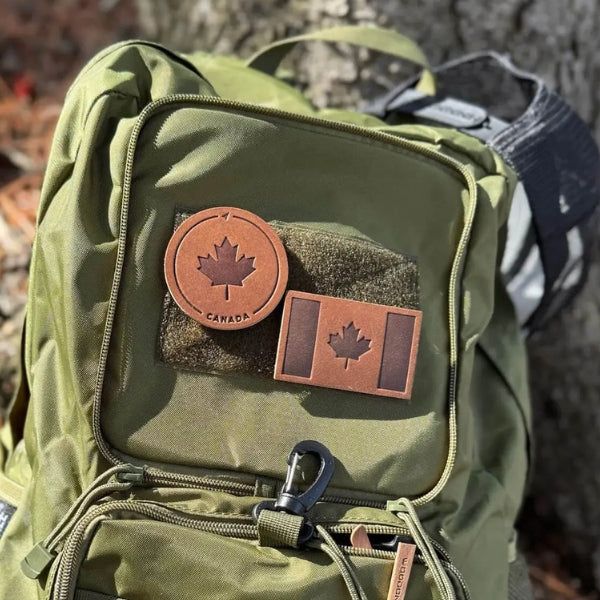
For removable applications, request custom hook & loop patches. They suit gear, uniforms, and items where identification changes by role, event, or location. They are not the right choice if the patch must lie completely flat without a mating panel or if the finished product will be repeatedly washed without confirming the backing system.
For permanent garment attachment, consider custom iron on patches only when the fabric and care process support heat-seal attachment. Heat seal can save application time for suitable garments. It should not be assumed suitable for every fabric, textured material, or high-wash application without testing.
A real use case shows why this step matters. For an outdoor gear brand in the United States, Custom Panda manufactured heavy-duty embroidered Velcro patches using weather-resistant threads and hook-and-loop backings for hiking backpacks and tactical vests. That construction fit equipment requiring removable identification. It would not automatically be the right construction for a luxury denim collection or a lightweight fashion garment.
Find Hidden Quote Gaps Before They Become Purchase Order Problems
Conclusion: The lowest quote should be rejected or clarified when it leaves essential deliverables undefined. Ambiguity is not a saving.
Use this buyer checklist before comparing final totals:
- Does the quote state the patch size and finished shape?
- Does it name the patch material and border treatment?
- Does it identify the backing and whether it is included?
- Does it state artwork, digitizing, proof, sample, and revision charges?
- Does it confirm the quantity being shipped rather than only the quantity ordered?
- Does it list packaging requirements and carton labeling needs?
- Does it state the production timing after proof approval?
- Does it state shipping terms and the destination address?
- Does it explain how defects, color concerns, loose backing, or frayed borders are handled?
- Does it identify the approval process before bulk production begins?
At Custom Panda, every bulk order includes 100 bonus pieces. The company also offers a color mismatch free reprint and proportional replacement for defects. These points should be compared against the local supplier’s written terms, rather than treated as general market practice.
For brands that need a material-focused look, custom leather patches can be a better fit than embroidery. A premium denim line in Italy used embossed faux-leather patches with debossed logos and antique edges designed to withstand industrial stonewashing and daily wear. That example supports faux leather for demanding denim use, but it does not prove that every leather-style patch will suit every washing process. Request a sample when laundering, abrasion, or heavy wear is involved.
Use a Weighted Score Instead of Picking the Lowest Total
Conclusion: Score each quote on cost, specification match, delivery confidence, proof control, and corrective support. This prevents a small price difference from outweighing a larger supply risk.
A simple internal scorecard can assign points to the areas that affect your order:
- Specification match: Does the supplier quote every requested detail without substitutions?
- Landed cost clarity: Are unit price, setup, shipping, rush fees, and pickup savings separated?
- Timing confidence: Is the timeline tied to proof approval and delivery location?
- Proof control: Will you approve a digital or photo sample before production?
- Quality support: Are replacement and defect terms documented?
- Communication: Can your buyer reach a real person for approval questions?
A local supplier may score highest when pickup is genuinely convenient, a physical sample is needed quickly, and the order is small. An online factory may score highest when you need repeatable bulk production, multiple patch options, documented proof approval, and shipping to a distributed location.
Custom Panda is ISO 9001:2015 Quality Management System Certified and Disney FAMA Certified. For buyers comparing overseas and domestic options, these confirmed qualifications can be included in supplier due diligence alongside the actual product proof, production timing, and landed quote.
Send your artwork, quantity, backing requirement, and required in-hand date to request a like-for-like patch quote.