

Custom Product Labels Proof Questions to Ask Before Ordering
The most expensive label mistake is the one you approve yourself. A misspelled ingredient, a barcode that will not scan, or a white ink panel that shows the bottle through it all survive the “looks fine” glance and show up only when 5,000 rolls arrive. With custom product labels, the proof is your last cheap checkpoint. After that, every error is a reprint conversation.
This guide is for buyers whose artwork is finished and who now need to confirm it will print correctly. It covers what a proof must show, which questions to put in writing before the purchase order, and how to tell a real answer from a vague one.
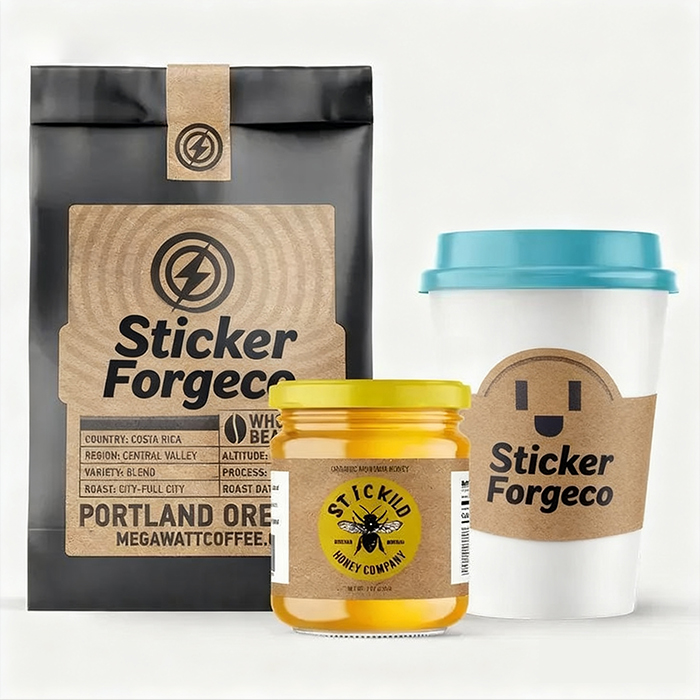
What a Final Proof Must Show Before You Approve It
A proof is not a preview of your artwork. It is a record of what the factory will make. If the proof lacks any item below, ask for a revised version before signing. Do not approve and “assume it’s covered.”
- Die line and final size. The cut shape, corner radius and dimensions should be shown against your artwork, not as a separate file.
- Bleed and safe zone. You should be able to see where artwork extends past the cut and where text stops short of it.
- Every line of copy, unaltered. Ingredients, net weight, warnings, batch fields and addresses all need to be readable at final size.
- Barcode or QR code at actual size. A tiny code on a screen tells you nothing about scanning.
- Named colors. Brand colors should be referenced by a specific color code, not “the blue from the logo.”
- Material and finish callout. Face stock, lamination, adhesive type and any foil should be listed on the proof or the order sheet.
Our production flow includes photo or digital sample confirmation before production starts. Use that step as a real review gate, not a formality. Once bulk production begins, the 8 to 9 day bulk lead time leaves little room to fix things.
Pre Production Questions on Bleed, Barcode Readability, Color, Copy and Materials
This is the section to copy into your order email. Each question below is one a buyer should have answered in writing before a purchase order is issued, along with the honest limits of what any supplier can promise.
| Topic | Question to ask | What a good answer includes | Limit to accept |
|---|---|---|---|
| Bleed | What bleed and safe zone does my shape and size require, and does the proof show them? | A die template with bleed and safe margins marked, and your artwork checked against it | Small cutting shifts on roll labels are normal in die cutting, so keep text and logos inside the safe zone rather than near the edge |
| Barcode readability | Can the barcode be checked at final size, on the real material, with my scanner type? | A printed sample you can scan, or a proof where the code is at 100% size with clear quiet space | A screen proof cannot guarantee scanning. Only a physical sample scanned in your workflow can |
| Color tolerance | How is my brand color matched, and what happens if it misses? | A specific color reference, a sample comparison, and the reprint terms in writing | Screen colors never match print exactly, and coated versus uncoated stock shifts the result. We offer a free reprint for color mismatch, so confirm how that is assessed on your order |
| Copy approval | Who is responsible for text accuracy, and is the proof text editable only by me? | Clear statement that copy is approved by you, with any factory edits flagged in the proof | The supplier prints what you approve. Regulatory wording, such as food or supplement claims, remains your responsibility |
| Material confirmation | Is the face stock, adhesive and finish on my proof what I actually need for the surface and environment? | Named material, lamination and adhesive, plus a note about the surface (glass, HDPE, cold storage, oil exposure) | A material suits stated conditions only. Extreme cold, heat or chemical contact should be tested on a sample first |
Bleed: where artwork goes wrong most often
Full-color backgrounds that stop exactly at the cut line leave white slivers when the blade shifts slightly. Extend the background past the line and keep critical content well inside it. If your proof shows no bleed area at all, the file has not been prepared for production yet.
Barcode readability: test the object, not the picture
Black bars on white are safest. Reversed codes, codes over a gradient, or codes on a clear film with weak white ink can fail at the till. Ask for a physical sample and scan it with the same device your warehouse or retailer uses. If you ship with direct thermal labels for shipping & barcodes, remember that a printed code and a thermally printed code behave differently, so test the one you will actually use.
Color tolerance and copy approval
Ask for a color callout rather than describing it. Then read every line aloud against your master document. Typos in small print are the commonest slip, and they pass because people read the headline and skim the rest. Have a second person who did not write the copy sign off. That is the whole point of copy approval.
Material Confirmation by Use Case
Many “print errors” are really material errors. A beautifully printed label that peels in a cold room or smears under oil is still a failed order. Our label range offers wide substrate choices, BOPP lamination, UV resistant inks and custom foil stamping colors, so the proof should name which combination you chose.
| Situation | Material direction to confirm | Why | When it does not fit |
|---|---|---|---|
| Bottles exposed to water or condensation | Waterproof custom synthetic labels | Film face stock does not soften when wet like uncoated paper | Very low surface energy plastics may still need an adhesive check on a sample |
| Clear “no label” look | Clear custom BOPP labels | Transparent film lets the container show through | Needs sufficiently opaque white ink under any light text, so ask to see white ink on a sample |
| Natural, handmade look | Custom kraft labels | Uncoated texture suits food, candles and craft goods | Dark or saturated brand colors can look muted on kraft |
| Hand written fields (dates, batch numbers) | A surface that accepts markings | Glossy lamination can reject pens | If you write by hand, confirm the finish before approving |
One real example: for an Australian natural health supplement brand, we delivered metallic foil stamped roll labels on matte BOPP film with scratch proof lamination for a high end shelf presence. The finish and lamination were part of the specification from the outset, which is exactly the level of detail your proof should carry. In another case, a Spanish children’s clothing line received organic cotton wash care labels printed with skin safe, fade resistant inks built to survive repeated industrial washing. Different product, same principle: confirm the material for the real-life use.
Common Proofing Mistakes That Lead to Reprints
- Approving from a phone screen. Small text and thin lines look fine at thumb size. Zoom to 100% or print the proof at actual size.
- Skipping the physical sample. A digital proof cannot show ink opacity, adhesion or finish. Our sample lead time is 3 days, which is short enough to fit before your production slot.
- Leaving material vague. “Waterproof” is not a spec. Ask for the named face stock and lamination.
- Edge-hugging text. Anything near the die line risks being clipped or looking off-center.
- Verbal approvals. If a change was agreed on a call, it is not real until it is on the revised proof.
- Single reviewer. The person who wrote the copy reads what they meant, not what is printed.
Worked Example: A Label Review Before the Purchase Order
Consider an illustrative scenario. A buyer has final artwork for a skincare tube label with a QR code, a reversed logo and a pale brand blue. The purchase order is about to go out.
- Request a digital proof showing die line, bleed and QR code at 100% size.
- Confirm in writing the color reference for the blue and ask how a mismatch would be handled.
- Name the material, such as a waterproof film with the intended finish, and the tube surface it will stick to.
- Order a sample. At a 3 day sample lead time, scan the QR code, flex the tube, wet the label and check the reversed logo for fill-in.
- Have a second reader check every line of copy, then sign off the revised proof.
- Issue the purchase order referencing that approved proof version.
This adds a few days and removes the most common sources of reprints. The step that fails most often is step 4, because teams treat the digital proof as the sample.
Order Terms That Affect How You Plan Proofing
| Item | Terms | Planning note |
|---|---|---|
| Sample lead time | 3 days for pins, patches and labels | Build sample review into your schedule before the PO |
| Bulk production | 8 to 9 days | Late proof changes push the production start |
| U.S. shipping | 5 to 6 business days | Add this to your launch date calculation |
| Minimum quantity | No MOQ for digital printing and select custom items. 1,000 units minimum for offset printing and standard bulk items | Digital runs suit test batches. Bulk offset gives better unit pricing |
| Bulk bonus | 100 bonus pieces with every bulk order | Use extras for in-house adhesion and scan tests |
Our facility is ISO 9001:2015 certified, runs six HP digital label presses and has been producing since 2012. Certification does not replace your proof check, but it does mean your approved file is the document the production floor works from. If you need to compare formats, our custom labels printed in bulk page and the premium product labels on rolls page list the available options.
If your artwork is ready, send it with your size, quantity, surface and use conditions. We will return a proof for review and can ship a sample first, so you can approve your custom product labels with a scanned code and a tested material rather than a screen image.