

Custom Product Labels Supplier Verification With Proofs
The costly mistake in label sourcing is approving a bulk run from a flat PDF and a photo of someone else’s work. Six weeks later the labels curl in a cold chain, the adhesive creeps, or the brand red prints a shade off. Custom product labels only perform when the substrate, adhesive, ink and finish are proven together on your container, not in a catalogue. This guide gives brand owners and procurement teams a way to qualify a supplier with physical evidence before signing off.
Throughout, I separate three things: what you should demand from any supplier, what custom panda can document from its supplied facts, and what you still have to confirm yourself for your own product.
What a Proof Package Should Contain Before Bulk Approval
A good supplier answers material questions with samples and written specifications. A weak one answers with adjectives such as “waterproof” or “durable”. Ask for these five items on every new SKU.
| Proof item | What it tells you | Reject the supplier if |
|---|---|---|
| Physical sample on the named substrate | Whether print, finish and die-cut edge hold up on the real face stock | They send only a generic swatch book |
| Adhesive named for your surface and temperature | Whether it grips glass, HDPE, PET or coated carton at your fill and storage temperatures | “Permanent adhesive” is the only description |
| Rub, scratch and wet-handling check done by you | Whether ink and lamination survive handling, shipping friction and condensation | They discourage you from testing the sample |
| Color confirmation against your brand reference | Whether brand colors match on the actual material, not on a screen | Color is signed off on a monitor only |
| Written reprint and defect terms | Who pays when the bulk run does not match the approved proof | Terms are verbal or vague |
Run the sample on your own container, with your own product, in your own conditions. A label that passes on a clean desk tells you very little about a bottle that sweats in a refrigerator.
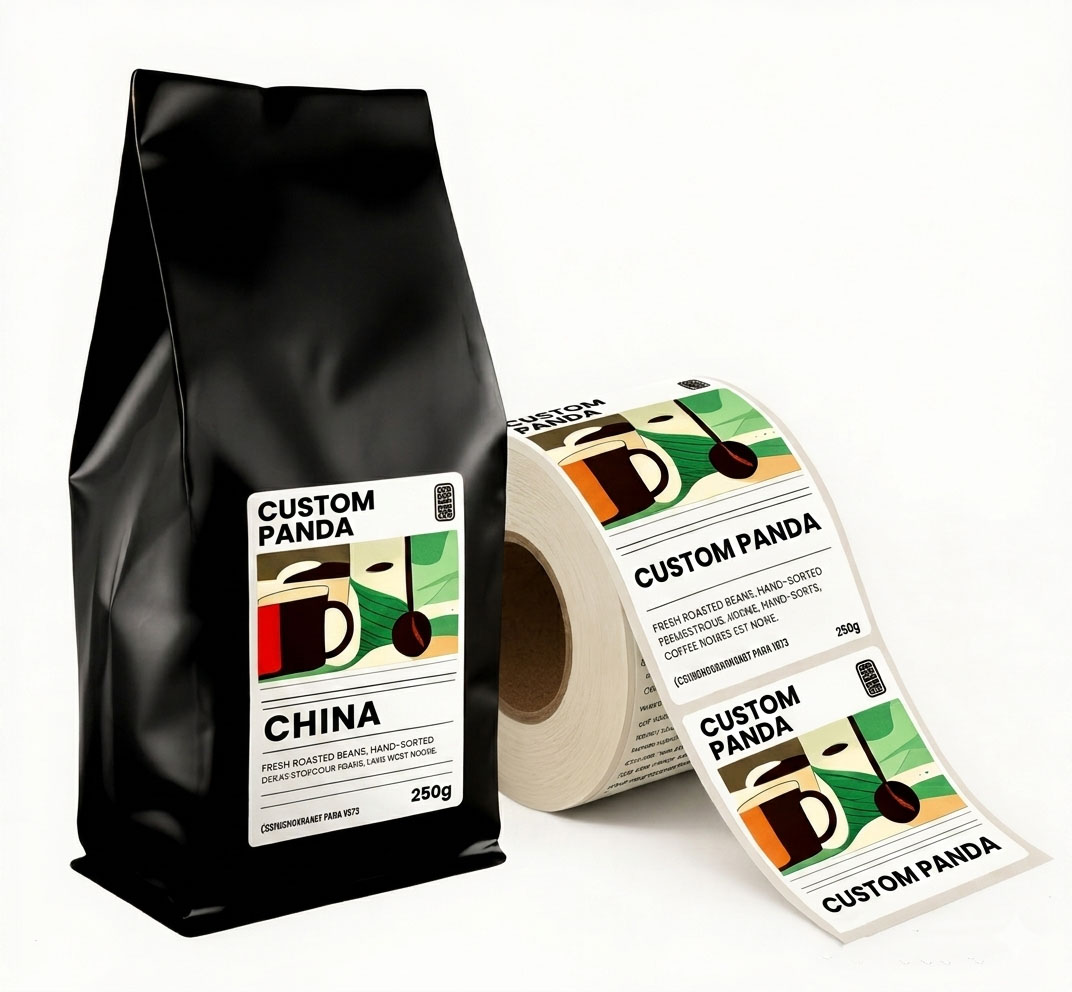
Where Paper, BOPP, Vinyl and Textured Stocks Fail
Every label material has a boundary. The point of a proof is to find out whether your use case sits inside or outside it. The table below gives the typical failure pattern for each stock under moisture, oil, abrasion and refrigeration. Treat it as a checklist of what to test, not as a performance guarantee for any specific product.
| Stock | Moisture / condensation | Oil and chemicals | Abrasion | Refrigeration |
|---|---|---|---|---|
| Uncoated or kraft paper | Absorbs water, wrinkles, lifts at edges | Oil wicks through and stains the print | Surface scuffs and fibers show | Fails when bottles sweat; best kept for dry goods |
| Coated paper (gloss or matte) | Survives brief splashes, not sustained wetting | Oil can darken the face and soften the coating | Moderate; gloss shows scratches, matte shows rub marks | Risky without a moisture-resistant laminate |
| BOPP film | Strong against water; edge lift is the usual issue on curved bottles | Good with the right ink and laminate; check on greasy surfaces | Good when laminated; unlaminated print can rub off | Generally suitable if the adhesive is rated for low temperature application |
| Vinyl | Strong; conforms well to squeezable and curved surfaces | Depends on adhesive and ink; plasticizer migration can be a long-term concern | Strong | Check adhesive grade; not every vinyl adhesive bonds on cold, damp surfaces |
| Textured or embossed stock | Texture traps moisture and dirt | Oil collects in the grain | Raised texture wears first and the print breaks up | Texture can reduce contact area, weakening adhesion on cold surfaces |
Two practical conclusions. First, the face stock rarely fails alone; adhesive and surface energy of the container cause most field failures, especially on cold, damp or oily containers. Second, textured stocks give a premium feel but trade away durability, so use them where the product stays dry and lightly handled.
If your product lives in refrigerated or wet conditions, review options such as oil & waterproof labels for bottles & cosmetics or heavy duty vinyl labels alongside film options. For dry, craft-style goods, custom kraft labels remain a sound choice, within the limits above.
A Step-by-Step Proof Sequence You Can Require
This is a buyer-side sequence. Ask any supplier, including us, to work through it with you.
- Write the spec sheet first. List container material, shape and diameter, fill temperature, storage temperature, exposure to water or oil, and expected shelf life.
- Request digital or photo confirmation. Check artwork, die-line, color references and barcode or text size before any material is printed.
- Order physical samples on the shortlisted stocks. Compare at least two substrate options, not one.
- Apply them to real containers. Let them cure for the time your line would allow, then test.
- Test under your actual conditions. Put filled units in the fridge or freezer, wet them with condensation, rub the print with a dry and a damp cloth, and apply a drop of your own product on the surface.
- Record the results. Photograph edge lift, ink transfer and color shifts at 24 hours and again at one week.
- Approve one written specification. Face stock, laminate, adhesive and ink should be named in the approval, so the bulk run can be compared against it.
Limit: this sequence will not replace regulatory review. If your label carries food-contact, safety or compliance requirements, confirm those separately with the relevant authority or your compliance advisor. Nothing supplied here establishes regulatory approval for any market.
What custom panda Can Document and What You Still Confirm
Based on the supplied company facts, custom panda is an ISO 9001:2015 certified supplier of labels, pins and patches, established in 2012, with an 8,000 m² facility, six production lines and six HP digital label presses. Daily label capacity is stated at over 1,000,000. Those facts help most with two buyer concerns: consistency across repeat orders and the ability to run substrate options in parallel.
On materials, the brief lists a wide substrate selection, BOPP lamination, UV-resistant inks and custom foil stamping colors. These map to specific proof questions: does the laminate scratch, does the ink fade under light, and does the foil color match your reference?
Two supplied customer cases show how these questions play out:
- Australia: metallic foil-stamped roll labels for a natural health supplement brand, using matte BOPP film with scratch-proof lamination. The proof priority is the rub test on the foil and laminate, because that is where a premium shelf look fails first. For similar film formats, see clear custom bopp labels.
- Spain: organic cotton printed wash-care labels for an eco-friendly children’s clothing line, using skin-safe, fade-resistant inks that survive repeated industrial washing cycles. The proof priority is wash and fade testing before approval, not after.
These cases show scope, not a promise that every substrate performs identically in your application. The supplied facts do not include test reports, so ask for your own sample, and request any written specifications you require for your file.
Cooperation Terms to Agree Before the Bulk Run
Use the supplied terms as a baseline and write the rest into your purchase agreement.
| Term | Supplied fact | Still to agree |
|---|---|---|
| Minimum order | Digital printing and select items have no MOQ; offset and standard bulk items start at 1,000 units, with better pricing at higher quantities | Which process your SKU falls under |
| Sample timing | 3 days for labels, pins and patches | Sample quantity, substrate options and who bears freight |
| Bulk production | 8-9 days; U.S. shipping 5-6 business days | Start date counted from proof approval, and delivery terms for your country |
| Proof confirmation | Photo or digital sample confirmation before production | What counts as approval, and who signs it |
| Quality remedies | Free reprint for color mismatch, proportional replacement for defects, 5-day fast re-stocking or repair | The tolerance for color mismatch and how defects are documented |
| Bonus pieces | 100 bonus pieces with every bulk order | Confirmation on your quote |
Design assistance and live human support are also part of the supplied service points, which helps when a die-line or substrate choice needs adjusting after the first sample. Target markets include the United States, Australia, the United Kingdom, France and South Africa, but that tells you where orders ship, not where any approval applies.
Common Mistakes When Approving Label Proofs
- Approving on screen only. A monitor cannot show laminate gloss, white ink opacity on clear film or foil tone.
- Testing on a different container. Surface energy and curvature change adhesion. Always use the real bottle, jar or tube.
- Skipping the cold or wet test. Condensation causes peeling that room-temperature trials never reveal.
- Leaving adhesive unnamed. If it is not on the written spec, you cannot hold anyone to it.
- Judging at one hour. Adhesive creep and ink migration show up after days, so check at 24 hours and one week.
- Choosing texture over function. Embossed stocks feel premium but fail faster under oil and abrasion.
Buyer’s Checklist Before You Release the Order
- Spec sheet written with container, temperature range and exposure conditions.
- At least two substrate samples tested on your real containers.
- Moisture, oil, rub and refrigeration checks documented with photos.
- Brand color checked against a physical reference on the final material.
- One written specification naming stock, laminate, adhesive and ink.
- Reprint, replacement and re-stocking terms confirmed in writing.
- MOQ and process (digital or offset) confirmed for your quantity.
For high-volume repeat runs, a custom printed roll labels format is worth testing on your applicator early, because roll tension and unwind direction are easier to fix at sample stage than on a production line.
Send Your Spec for a Proof-Backed Quote
If you are comparing suppliers, send us your container type, storage conditions, quantity, artwork and brand color references. We will recommend substrate options to sample and quote against the proof you approve.