

How to Source Custom Security Label Pins for Guard Uniforms
The expensive mistake in pin sourcing is rarely the unit price. It is releasing artwork to a factory before anyone has confirmed that the design is yours to use. A rejected shield, a client who disputes a logo, or a rank pin that resembles a government badge can force a full remake of a 1,000-piece run. If you buy custom security label pins for guard uniforms, a few checks before production protect your budget and your contract.
This guide is for security firms and uniform distributors preparing specifications and supplier quote requests. It covers what to define in the RFQ, which approvals to collect first, how pin processes differ, and which supplier facts to verify.
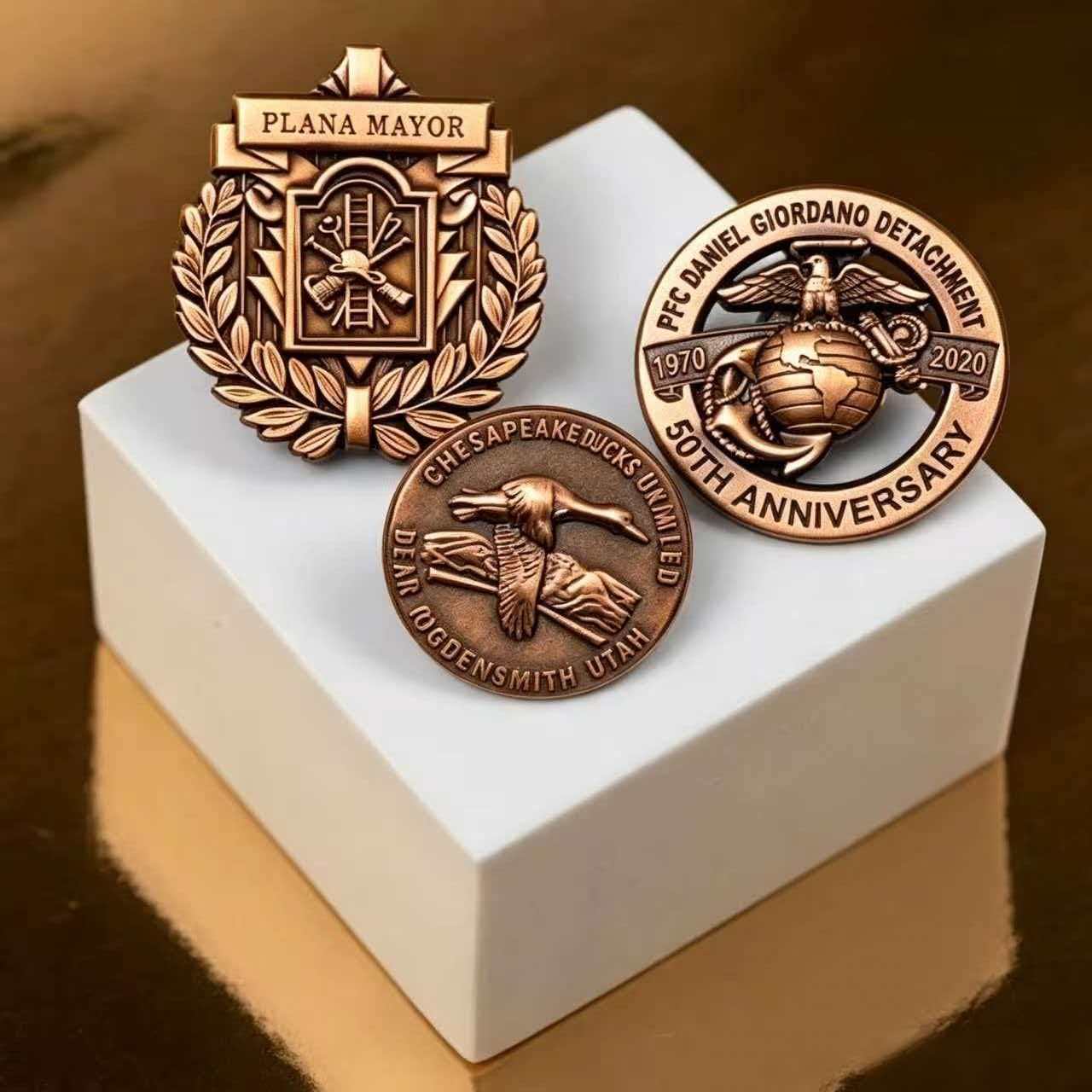
What to Define Before You Request a Quote
A vague RFQ gets vague quotes. Suppliers will price the cheapest interpretation of your request, and you will not see the gap until samples arrive. Put these fields in writing:
| Spec field | What to state | Why it matters |
|---|---|---|
| Pin function | Company ID, rank, post, or service-years pin | Rank pins often need several variants (one per level), which changes setup and quantity splits. |
| Base metal | Zinc alloy, brass, or iron | Metal choice affects weight, plating behavior, and how well the pin holds up on a daily-wear jacket. |
| Process | Hard enamel, soft enamel, die struck, offset printed, 3D cast, or laser engraved | Each process handles fine text and color differently (see the comparison below). |
| Plating | Gold, silver, nickel, antique, or dual plated | Plating must match your uniform hardware so the pin does not clash with buttons or badges. |
| Backing | Butterfly clutch, military clutch, or other attachment | Loose or unstable pin backs are a known failure point on uniforms, so specify it. |
| Color references | Pantone codes for every fill | Without codes, "navy" is a guess, and brand-guideline mismatches follow. |
| Quantity tiers | Your trial quantity and your full contract quantity | Lets the supplier quote both without a second round. |
Ask for a photo or digital sample confirmation before production starts. It is the cheapest point at which to catch a wrong color or a misspelled rank title.
Verify Authorization Letters, Insignia Ownership, and Restricted-Design Approval Before Releasing Artwork
Do this before any file goes to the factory. A supplier can produce what you send, but it cannot tell you whether you may wear it. Treat the three items below as gates, not paperwork.
| Check | What to collect | The risk behind it |
|---|---|---|
| Authorization letter | A signed letter from the contracting client or your own management confirming the order, quantity, and design use | Distributors often order for a guard company they do not own. If the end client later rejects the pin, you hold the inventory and the bill. |
| Insignia ownership | Proof that the logo, crest, or emblem belongs to the ordering party or is licensed to it | Reused client logos and inherited crests are common. An ownership dispute after delivery means a recall, not a discount. |
| Restricted-design approval | Written clearance from the licensing body or client for any design that resembles police, military, or government symbols | Rules on lookalike insignia differ by jurisdiction. A pin that is fine in one region may draw a compliance complaint in another. |
| Rank and title accuracy | A signed-off list of every title, number, and wording variant | Titles like "Officer" or "Supervisor" can carry legal meaning in some regions. Wrong wording is a reprint at your cost, because the factory built what you approved. |
When this does not apply: a generic, non-branded service-years pin with no crest or protected wording carries lower ownership risk. You still want the order authorization. Local requirements vary, so confirm with your licensing authority or client rather than relying on a supplier's opinion.
Keep the signed documents in the same folder as the approved digital proof. If a dispute comes up in month six, you will want one folder that shows who approved what.
Pick the Pin Process That Fits Guard Duty
Guard uniforms mean daily wear, jacket friction, and frequent handling. The process you choose decides how sharp the text stays and how the pin looks after months of use.
| Process | Best for | Limits |
|---|---|---|
| Hard enamel | Polished, flat-surface company ID pins with clean color blocks | Works best with defined color areas; not ideal for photographic detail. |
| Soft enamel | Textured, recessed-color look and tighter budgets | Surface is less smooth; very fine text needs larger pin sizes to stay legible. |
| Die struck | Metal-only rank and service pins with formal appearance | No color fill, so differentiating many ranks relies on shape or engraving. |
| Offset printed | Detailed logos, gradients, small shading | Printed surface is not metal-relief; suits artwork-heavy designs. |
| 3D cast | Dimensional emblems with relief | More complex tooling; thin cut-out details need design review. |
| Laser engraved | Names, numbers, membership pins | Limited to single-tone engraving effects. |
For a main company badge, custom hard enamel pins give a clean, durable face. If budget drives the decision and the artwork is simple, you can order soft enamel pins instead. For rank insignia in plain metal, premium die struck lapel pins match a formal uniform. The dedicated range of custom security guard lapel pins shows common layouts for this use.
Two cases from our production show how process choice follows the use. For an esports tournament in Canada, we made hard enamel pins with polished gold plating and dual-tone colors that people wear on jackets and lanyards. For a Tokyo museum exhibition in Japan, we cast 3D souvenir pins with deep antique bronze relief and cut-out details. Neither is a security order, but both show the same rule. Flat color blocks suit enamel, and relief suits casting.
Supplier Checks for Bulk and Overseas Orders
When you source overseas, you cannot walk the floor. Ask for evidence instead. These are the facts we can state about our own operation, and they are the kind of detail you should request from any supplier:
- Certification: ISO 9001:2015 Quality Management System certified, and Disney FAMA certified.
- Facility: established in 2012, with an 8,000 m² site, 6 production lines, and in-house metal die-casting and embroidery capability.
- Lead times: sample lead time of 3 days for pins, patches, and labels; bulk production of 8 to 9 days; U.S. shipping of 5 to 6 business days. Confirm timing against your specific design and quantity.
- Minimums: digital printing and select custom items have no MOQ. Offset printing and standard bulk items start at 1,000 units, with better pricing at volume. Ask which tier your pin type falls under.
- After-sales terms: free reprint for color mismatch, proportional replacement for defects, 5-day fast restocking or repair, and 100 bonus pieces with every bulk order.
Also ask where your pin type tends to fail. For enamel pins, the usual problems are color bleeding or overflow between cells, unstable pin backs, and blurry fine detail. A supplier who can explain how they control each one is more reliable than one who only promises quality. We also offer free design assistance, which helps when your artwork has thin lines or small text that need adjusting before tooling.
If you order for a specific site type, there are focused ranges too, such as custom campus security pins and custom private security company pins.
A Step-by-Step Sourcing Procedure
- Collect approvals. Gather the authorization letter, ownership proof, and any restricted-design clearance.
- Finalize the spec table. Include metal, process, plating, backing, size, Pantone codes, and quantity tiers.
- Send the RFQ to two or three suppliers. Use the same spec sheet for each so the quotes compare cleanly.
- Request a digital proof. Check text spelling, color assignments, and the outline against your approved artwork.
- Order a physical sample. Test the pin back on the actual uniform fabric, and wear it for a shift or two.
- Approve in writing. Sign off on the proof and sample so any later dispute has a clear reference.
- Release bulk production. Then plan shipping against your deployment date, not the factory finish date.
Steps 4 and 5 are the ones buyers skip when deadlines tighten. They are also the ones that catch problems cheaply. Skipping the physical sample is reasonable only for a repeat order of an unchanged design.
Common Sourcing Mistakes
- Quoting on price alone. Two quotes that differ by 15% may specify different metals, plating, or backings.
- No Pantone codes. The result is a color that nearly matches and still fails the client's brand check.
- Text too small for the process. Fine lettering on a compact soft enamel pin blurs. Increase pin size or switch process.
- Ignoring the backing. A good face on a weak clutch means lost pins within weeks.
- Merging all ranks into one order line. List each variant and quantity separately, or the split will be wrong at delivery.
- Treating the sample as optional. Photo confirmation helps, but it cannot show how the pin sits on thick uniform fabric.
As an illustration, say a distributor is supplying a regional guard firm with a company shield pin plus three rank levels. The sensible approach is hard enamel for the shield, die struck for the rank pins, and one signed authorization from the firm covering all four designs. That keeps the approval trail short, and one proof round covers every variant.
Send Your Artwork and Documents for a Quote
If you are preparing an order of custom security label pins, send us your artwork, target quantity, and the authorization documents you hold. We will return a spec confirmation and a digital proof, and we can ship a physical sample before you commit to bulk.