

Ordering Custom Sew On Patches That Last
Placing a bulk order for patches without confirming your supplier’s production process is a significant risk. You could end up with a shipment of patches that have inconsistent colors, fraying borders, or blurry details that fail to represent your brand professionally. These mistakes not only waste your budget but can also delay product launches or uniform rollouts. Getting the details right before production begins is the only way to ensure the final product meets your standards for durability and appearance.
As a consultant who has spent 12 years on the factory floor, I’ve seen firsthand how small oversights in the proofing and material selection stage lead to major headaches later. This guide answers the most common pre-order questions we receive from B2B clients. We will cover everything from proof approvals and minimum order quantities to material choices that prevent common defects. All production is handled in our 8,000 m² ISO 9001:2015 certified facility, ensuring a quality-managed process from start to finish.
Answering Your Pre-Order Questions (Proof, MOQ, Timeline)
Before committing to a full production run, it’s essential to have clear answers on logistics, quality assurance, and timing. Here is a breakdown of our process, designed to give you transparency and confidence in your order.
- Digital Proof Approval: Before any manufacturing begins, you will receive a detailed digital proof. This is more than just a picture of your design; it's a technical layout showing stitch direction, color separations with Pantone codes, and final dimensions. We provide free design assistance to optimize your artwork for embroidery, ensuring text is legible and fine lines are captured. Your formal approval of this proof is required to start production, guaranteeing you know exactly what you’re getting.
- Minimum Order Quantity (MOQ): For our standard bulk production using offset printing or die-casting, the minimum order is 1,000 units. This volume allows for efficient machine setup and material sourcing, which provides you with the best possible unit price. For certain items made with digital printing, we offer no MOQ, giving you flexibility for smaller projects or test runs.
- Physical Sampling: For large or complex orders, we highly recommend a physical sample. You can see and feel the thread texture, verify color vibrancy in person, and test the patch’s flexibility. Our sample lead time is just 3 days, allowing you to approve a physical product without causing significant delays to your project timeline.
- Color Matching Guarantee: We work with the Pantone Matching System (PMS) to ensure precise color fidelity. Simply provide your brand’s PMS codes, and we will match our threads accordingly. In the rare event of a color mismatch on the final order, we offer a free reprint, giving you complete peace of mind.
- Production & Shipping Window: Once you approve the sample or digital proof, bulk production typically takes 8-9 days. For our clients in the United States, shipping via reliable carriers takes an additional 5-6 business days. This transparent timeline allows you to plan your inventory and marketing efforts effectively. We stand by our quality with a 5-day fast restock/repair policy for any defects.
Choosing the Right Materials and Stitching for Durability
The longevity of a patch depends entirely on the materials used. A patch on a corporate uniform or outdoor gear needs to withstand frequent washing and abrasion, which requires different specifications than a decorative patch on a fashion item. Making the right choices here prevents premature wear and protects your brand’s image.
Here’s a comparison of the most common options for creating durable clothing patches.
| Component | Option A: High Durability | Option B: High Sheen / Specialty | Best Use Case |
|---|---|---|---|
| Thread | Polyester | Rayon | Polyester is best for workwear, tactical gear, and children's clothing due to its colorfastness and resistance to bleach and abrasion. Rayon offers a silky, bright finish for fashion and branding applications. |
| Backing Fabric | Twill | Felt | Twill is a tightly woven, sturdy fabric that serves as a stable base for most custom logo patches. Felt provides a softer, plush background often used for fluffy chenille varsity patches. |
| Border | Merrowed Border | Hot-Cut Border | A merrowed border is a raised, overlocked edge ideal for simple shapes (circles, ovals, squares). It is the most effective way to prevent fraying. A hot-cut border uses a laser to cut and seal the edge, necessary for complex shapes with sharp angles or cutouts. |
Stitch Density and Why It Matters
Stitch density refers to how many stitches are used within a specific area of the design. High stitch count patches have a full, solid appearance with crisp details and a substantial feel. Low-density stitching, a common corner-cutting tactic, can result in the backing fabric showing through the design, making the patch look sparse and cheap. For designs with small text or intricate logos, a high stitch count is non-negotiable for achieving professional clarity.
Common Production Flaws and How to Prevent Them
Even with the right materials, manufacturing errors can ruin an entire batch. Knowing what to look for in a supplier’s process helps you avoid these common pitfalls. As part of our quality commitment, every bulk order includes 100 bonus pieces to cover any minor inconsistencies, but our goal is to eliminate them entirely.
Here is a checklist of common flaws and the preventative measures to discuss with your manufacturer.
-
Defect: Fraying Edges
- Cause: An incorrect border type was used for the patch shape, or the finishing was poorly executed.
- Prevention: For standard shapes, always specify a merrowed border. For complex, die-cut shapes, confirm that your supplier uses a precision hot-knife or laser cutter that properly seals the thread ends. This was a key requirement for an outdoor gear brand in the United States we worked with; their heavy-duty patches needed rugged construction to withstand extreme conditions on hiking backpacks.
-
Defect: Puckering or Gapping
- Cause: The thread tension was too high during embroidery, or an inadequate stabilizer was used, causing the patch to warp and not lay flat.
- Prevention: Always insist on a photo or physical sample of the stitched-out design before approving bulk production. This is a standard step in our process and allows you to catch any puckering issues early.
-
Defect: Low-Resolution Details
- Cause: The artwork contains elements that are too small to be accurately rendered with thread, or the stitch density is too low.
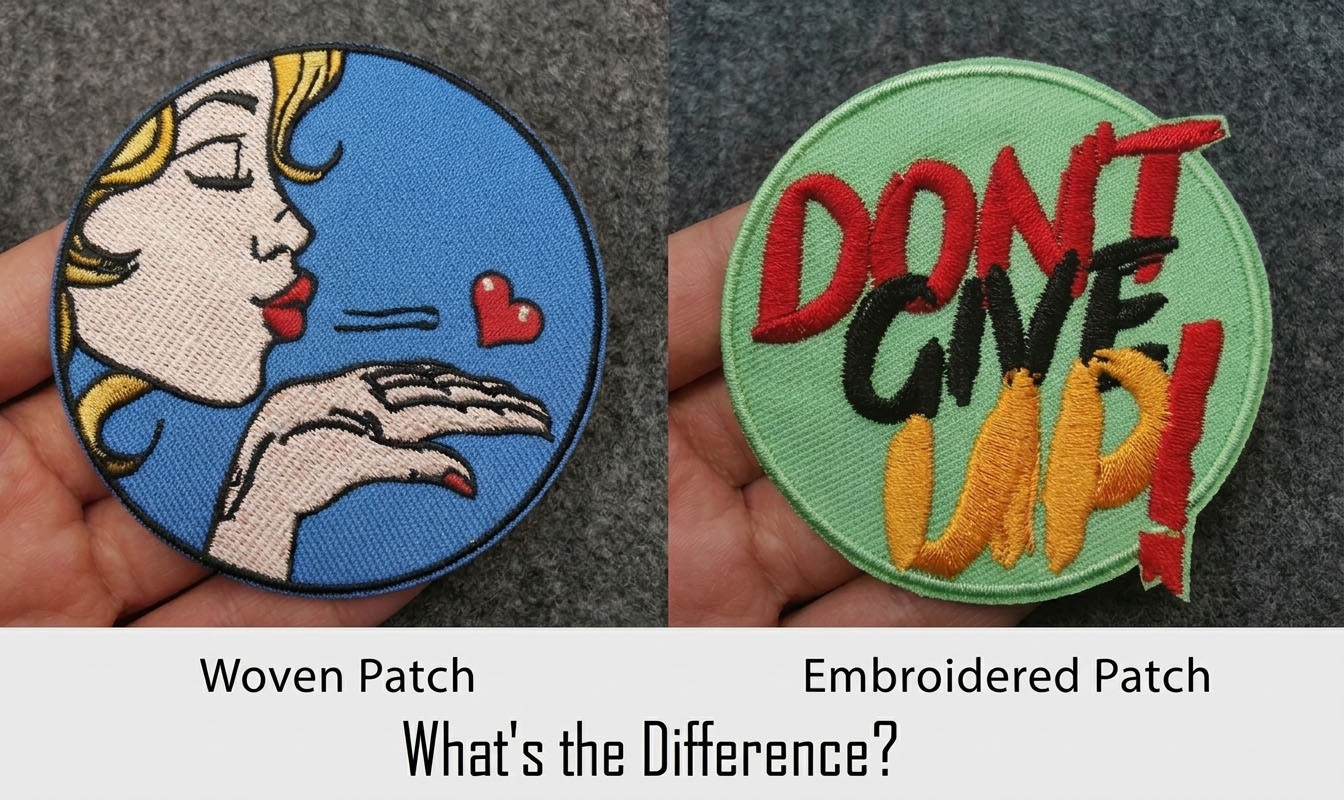
- Prevention: Simplify your design for smaller patches (under 2 inches). For highly detailed artwork, consider wholesale embroidered patches with a higher thread count or switch to a woven patch, which uses thinner threads for finer detail. Our design team can advise on the best production method for your specific art.
Real-World Applications: From Uniforms to Fashion Brands
Sew-on patches are incredibly versatile, serving functional and aesthetic purposes across many industries. Their permanence makes them a trusted choice for long-term branding on apparel and gear. Seeing how other brands use them can provide inspiration for your own project.
Corporate & Workwear: For uniforms and corporate apparel, durability and brand consistency are paramount. Sew on jacket patches are ideal because they cannot peel off like iron-on alternatives, ensuring a professional look that lasts. The focus is on clean logos, legible text, and colors that perfectly match brand guidelines, even after dozens of washes.
Fashion & Denim: High-end apparel brands use patches to add texture, narrative, and a premium feel to their products. For an Italian denim line, we supplied embossed engraved leather patches for hats & jeans designed to withstand industrial stonewashing. This shows how material choice can elevate a brand's aesthetic while meeting demanding production requirements.
Sports & Education: Nothing captures team spirit like a letterman jacket. We recently delivered custom chenille patches to a university sports team in Sweden. Their plush texture, felt backing, and high-density stitching created a bold, classic look that stands out on heavy wool jackets, embodying tradition and achievement.
Choosing the right partner for bulk patch manufacturing means finding a team that understands these different applications and can guide you toward the best materials and techniques. Whether you need weather-resistant emblems for outdoor gear or soft, detailed patches for a clothing line, the right expertise makes all the difference.
Ready to create durable, high-quality patches for your brand? Send us your design for a free quote and digital proof today.