

Plan Smarter Spending When Ordering Custom Event Label Pins for Every Attendance Tier
Before an RFQ goes out, most procurement teams aren't worried about the unit price on the quote sheet. They're worried about what's missing from it. A quantity breakpoint that changes pricing by 30%. A rush fee that only appears after the art is approved. A packaging line item nobody mentioned during the sales call. These gaps are where budgets blow up — and they're exactly what trips up teams ordering custom event label pins for conferences, tournaments, or multi-day expos. Get the cost structure wrong at the planning stage, and you'll either overspend on spares you don't need or run short on badges two hours before doors open.
This guide breaks the cost model into three honest categories: what's confirmed (MOQs, lead times, bonus units), what's typically estimated (unit pricing at scale, packaging add-ons), and what stays unknown until you get a real quote (rush fees, freight surcharges outside the U.S.). Treating all three the same is the mistake that wrecks event budgets.
Why Attendance Tiers Should Set Your Order Quantity, Not the Other Way Around
Procurement teams often lock in a round number — 500, 1,000, 2,500 — before checking how that number interacts with production methods. That's backwards. Pin manufacturing has two distinct paths, and which one applies to your order changes your entire cost curve.
- Digital printing / select custom items: No minimum order quantity. Good fit for small VIP batches, speaker gifts, or last-minute attendee additions.
- Offset printing / standard bulk items: 1,000-unit minimum, but pricing per piece drops meaningfully once you cross that threshold.
If your projected attendance sits at 400–800 people, ordering through the bulk offset path just to "get a better rate" usually backfires — you end up paying for inventory you'll never distribute. Conversely, running a 3,000-attendee conference through no-MOQ digital production forfeits the volume discount built into bulk tiers. Match the production method to the headcount first, then negotiate price.
Where This Breaks Down
This logic doesn't hold for multi-session events where attendance is staggered — a three-day summit with different badges per day, for example. In that scenario, ordering per-day in smaller no-MOQ batches is often cheaper and reduces leftover inventory risk, even if the per-unit price looks higher on paper.
The Per-Attendee Cost Model for Custom Event Label Pins
Here's the framework we recommend building before requesting quotes. It separates confirmed facts from estimates you'll need to verify, and items that are simply unknown until a supplier prices your exact spec.
| Cost Factor | Status | What We Know |
|---|---|---|
| Minimum order quantity | Confirmed | No MOQ on digital/select items; 1,000-unit minimum for offset/standard bulk pin runs. |
| Bonus/spare allowance | Confirmed | 100 bonus pieces included with every bulk order — this covers a basic spare buffer without extra charge. |
| Sample lead time | Confirmed | 3 days for pins, patches, and labels before full production approval. |
| Bulk production time | Confirmed | 8–9 days standard; U.S. shipping adds roughly 5–6 business days on top. |
| Per-unit pricing at scale | Estimated | Drops per piece as order volume rises past the 1,000-unit mark; exact figures require a spec-based quote. |
| Individual packaging (poly bag, backer card) | Estimated | Common add-on for VIP or retail-style distribution; confirm per-unit cost before finalizing budget. |
| Rush production surcharge | Unknown until quoted | Not standardized — depends on how far your deadline compresses the 8–9 day bulk window. |
| Freight outside the U.S. | Unknown until quoted | Shipping timelines and cost vary by destination; U.S. figures above don't apply to Australia, UK, or EU orders. |
A practical way to use this table: multiply your attendance projection by 1.05–1.10 to account for staff, speakers, and no-show replacements — then check whether that number crosses the 1,000-unit MOQ line. If it's close, rounding up to the bulk tier and banking the 100 bonus pieces as true spares is usually the better financial call than ordering twice through digital printing.
Choosing Pin Type and Finish Without Overspending
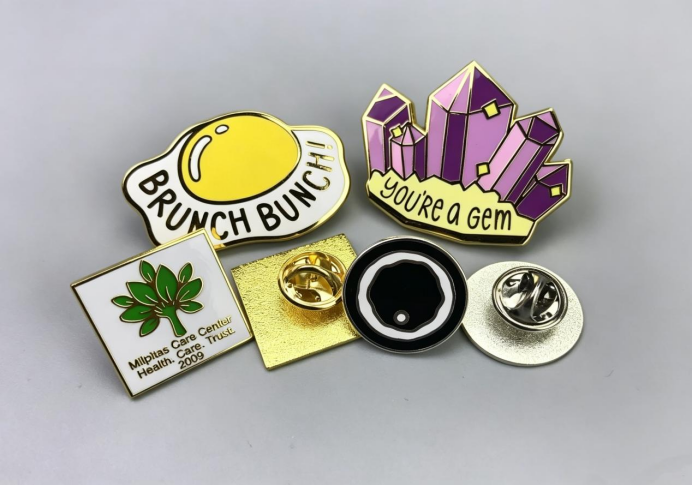
Material and finish choice affects both unit cost and perceived value — attendees notice the difference between a flat printed badge and a dual-plated enamel pin, even if they can't name why.
| Pin Type | Best Fit | Cost Tier | Limitation |
|---|---|---|---|
| Soft enamel pins | Large general-attendee giveaways, logo badges | Lower | Recessed enamel can trap dirt over multi-day use |
| Hard enamel pins | Championship or VIP tiers, lanyard accents | Mid to higher | Longer tooling lead time for complex shapes |
| Offset printed pins | Photo-realistic logos, gradients, small no-MOQ runs | Lower to mid | Not ideal for outdoor or heavy-handling events |
| 3D die-cast pins | Keynote speaker gifts, sponsor-tier swag | Higher | Overkill for mass general-admission distribution |
A common error: choosing hard enamel for the entire attendee list because it "looks premium," then discovering the budget can't cover spares or rush fees. A tiered approach — soft enamel or offset for general admission, custom commemorative event pins in hard enamel for VIP and staff — usually stretches the same budget further than a single uniform spec.
Common Mistakes That Inflate Pin Budgets
- Ordering exact headcount with zero spares. Lost pins, damaged shipments, and last-minute registrations always eat into stock. The 100 bonus pieces included with bulk orders help, but confirm this applies to your specific order tier.
- Skipping the digital sample step. A 3-day sample confirmation catches color mismatches before 5,000 units are produced — skipping it to save time often costs more in reprints.
- Assuming U.S. lead times apply globally. Shipping outside the U.S. — to Australia, the UK, or the EU — needs its own timeline confirmation; don't use the 5–6 business day U.S. figure as a placeholder.
- Mixing finish types across a single batch without planning packaging. If VIP pins need individual packaging and general-admission pins don't, specify this at quote stage, not after production starts.
- Treating rush fees as negotiable after art approval. Rush surcharges are easier to avoid entirely by submitting final art before the bulk production window opens, rather than trying to negotiate them down later.
A Step-by-Step Checklist Before You Request a Quote
- Confirm final attendance projection, then add a 5–10% buffer for staff and replacements.
- Decide whether your headcount crosses the 1,000-unit offset threshold or stays in no-MOQ digital territory.
- Select finish tiers — general admission vs. VIP/staff — and price each separately.
- Request a digital or physical sample and confirm color accuracy before locking the production date.
- Ask explicitly about individual packaging costs if pins will be distributed in sealed bags or on backer cards.
- Build your production and shipping timeline backward from your event date, accounting for the 8–9 day bulk window plus shipping.
- Get rush fee pricing in writing if your timeline is under three weeks out from the event.
Teams managing badge check-in alongside pin distribution often pair this order with custom labels printed in bulk for registration tables or sponsor booths — bundling production runs with one supplier can simplify both timeline tracking and invoicing.
A Worked Example: Scaling Pins for a Multi-Day Tournament
One useful reference point comes from a Canadian esports tournament that needed championship pins for players and fans across a multi-day event. The order used hard enamel construction with polished gold plating and dual-tone color fill, produced for attendees to wear on jackets and lanyards throughout the event. The finish choice mattered here specifically because fans kept the pins as collectibles after the event ended — a cheaper offset print wouldn't have held up to the same handling or perceived value.
For organizers planning something similar, the takeaway isn't "always use hard enamel." It's that finish selection should match how long the pin needs to last and how it's expected to be worn. A single-day internal conference badge doesn't need gold plating; a tournament pin that fans will keep for years does. If your event has a competitive or fan-facing component, custom enamel sports pins for tournaments & fans are worth pricing separately from general staff badges, since the quality bar — and therefore the cost — is different.
Putting the Model to Work
Attendance-tier budgeting for custom event label pins isn't about finding the single cheapest quote. It's about matching production method, finish, and spare allowance to what your event actually needs — then confirming which cost figures are locked in versus which ones still need a quote. The facts that are fixed (MOQ thresholds, bonus units, sample lead times) should anchor your planning. The variables (rush fees, international freight, packaging) need to be asked about directly before you sign anything.
If you're building a quote for an upcoming event and want the attendance-tier math checked against your exact headcount and timeline, send over your projected numbers and target dates — we can map out which production path fits before you commit to a quantity.