

Custom Synthetic Labels Cost Less When You Choose Materials Strategically
Two quotes for the same label job can differ by 20% or more, and most buyers never find out why until the invoice arrives. That's the real risk in sourcing custom synthetic labels: two suppliers quote the same dimensions and quantity, but one has priced a heavier PET face stock with permanent freezer-grade adhesive, and the other used a lighter PP film with standard adhesive. Both meet a printed spec sheet. Only one meets your actual shelf-life and storage conditions. Before you sign a purchase order, you need to know exactly which cost drivers are locked in and which are still assumptions.
This matters more for synthetic substrates than paper, because film-based labels carry a wider price spread depending on resin type, coating, and adhesive chemistry. Getting the material match wrong doesn't just cost you on price — it shows up later as peeling in cold storage, adhesive bleed under heat, or ink that won't stay opaque on a clear bottle.
Why Two Synthetic Label Quotes Rarely Match
Suppliers rarely disclose their build sheet line by line. A quote for 5,000 labels at $0.08 each looks identical to one at $0.11 each until you ask what's inside the price. In our experience quoting for buyers who source custom labels printed in bulk, the gap almost always traces back to five variables: face stock, adhesive grade, roll dimensions, color count, and order volume. Each one moves the number independently, and stacking the wrong combination is how buyers end up paying premium pricing for a spec they didn't actually need.
What Actually Drives Your Landed Cost
Below is a breakdown separating what's confirmed pricing behavior from what's an industry-typical estimate. Treat the estimated ranges as planning guidance, not a quote — actual figures depend on your artwork, roll count, and finish.
| Cost Driver | Impact | Status | Notes |
|---|---|---|---|
| Face stock (PP vs PET vs Vinyl) | Moderate to high | Estimated | PET generally runs higher than PP due to tensile strength and clarity; vinyl sits between the two depending on thickness |
| Adhesive grade | Moderate | Estimated | Freezer-grade, high-temperature, or removable adhesives cost more than standard permanent acrylic |
| Roll dimensions (core size, diameter) | Low to moderate | Estimated | Non-standard core sizes or oversized rolls can add setup and freight cost |
| Color count | Moderate | Confirmed | Digital printing handles unlimited colors with no plate cost; offset requires new plates per color and carries a 1,000-unit minimum |
| Order volume | High | Confirmed | Digital runs have no minimum order quantity; offset runs need 1,000 units minimum but unlock better per-unit pricing at scale |
The volume line is where most buyers leave money on the table. If you're testing a new SKU or running a limited batch, digital printing with no MOQ avoids paying for inventory you don't need yet. Once a design is proven and you're ordering repeatedly, switching to offset at 1,000+ units usually brings the per-label price down — but only if your color count and face stock stay stable across runs, since a spec change forces new plates and resets the pricing advantage.
PP, PET, and Vinyl Face Stock Compared
Material choice is the single biggest lever on both cost and failure risk. Here's how the three common synthetic face stocks stack up for typical B2B use cases.
| Face Stock | Best Fit | Limits |
|---|---|---|
| PP (polypropylene) | Everyday product labels, cosmetics, retail packaging where moderate moisture resistance is enough | Lower tear resistance than PET; not ideal for extended outdoor exposure |
| PET (polyester) | Chemical drums, electronics, industrial equipment tags needing UV and abrasion resistance | Higher material cost; overkill for short-shelf-life consumer goods |
| Vinyl | Outdoor equipment, automotive parts, anything facing repeated flexing or weathering | Heavier and pricier per roll; unnecessary for indoor retail applications |
If your product sits in cold storage or a freezer case, adhesive grade matters as much as face stock — a standard acrylic adhesive can fail from condensation even on a premium PET film. For buyers comparing options across substrates, it's worth reviewing affordable custom pp labels against industrial grade custom pet labels side by side before finalizing artwork, since resizing after tooling adds cost.
Common Sourcing Mistakes That Inflate Reprint Spend
- Choosing face stock by price alone. A cheaper PP label that fails in a freezer application costs more in reprints than the PET version would have upfront.
- Skipping a physical sample. Screen colors and printed colors rarely match on clear or metallic substrates; confirming with a photo or physical sample before production catches this early.
- Locking in offset pricing before volume is proven. Committing to 1,000+ units on an unproven design wastes the flexibility digital printing with no MOQ offers.
- Ignoring white ink opacity on clear labels. Under-specified white ink layers show through on transparent BOPP or PET, making barcodes unreadable.
- Not testing adhesive under real conditions. Lab-condition adhesion tests don't always predict performance in humid warehouses or industrial freezers.
A Step-by-Step Way to Lock In Accurate Pricing Before RFQ
- Define the environment first — cold storage, outdoor, high-heat processing, or standard retail shelf.
- Match face stock to that environment before requesting price (PP, PET, or vinyl), then confirm adhesive grade separately.
- Request a physical or digital sample for color confirmation before committing to a production run.
- Decide your run size honestly — under 1,000 units favors digital, no-MOQ printing; above that, ask for offset pricing tiers.
- Confirm turnaround expectations upfront. Sample lead time typically runs around 3 days, with bulk production following in 8-9 days once artwork is approved.
- Ask what happens if colors don't match the approved sample — a supplier offering free reprint on color mismatch removes a real cost risk from your side.
This sequence works well for buyers ordering custom printed roll labels, premium quality & fast shipping on a recurring basis, since locking specs early avoids re-tooling costs on repeat orders. It applies less cleanly to one-off promotional runs, where speed matters more than long-term material optimization.
Buyer's Decision Checklist Before You Sign the PO
- Is the face stock matched to the actual storage or handling environment, not just the product category?
- Does the adhesive grade account for temperature swings during shipping and use?
- Have you confirmed color count against digital versus offset pricing thresholds?
- Is your order volume realistic for the MOQ tier you're quoting against?
- Has a sample been approved in writing before bulk production starts?
- Does the quote include terms for reprint or replacement if defects appear?
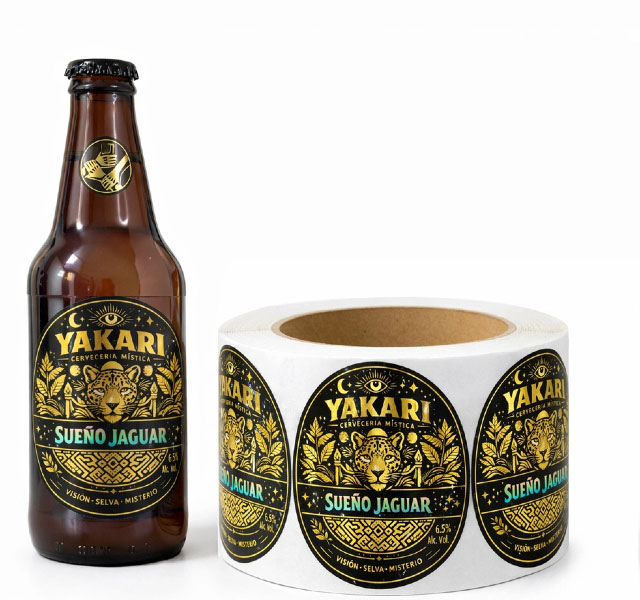
Manufacturing capacity also affects how confidently a supplier can hold these terms. Facilities running ISO 9001:2015 certified quality systems, with dedicated digital label presses across multiple production lines, are generally better positioned to hold consistent color and adhesive specs across repeat orders than smaller shops without formal process controls. As one reference point, a supplement brand in Australia sourcing foil-stamped roll labels needed matte BOPP film combined with scratch-proof lamination to hold up on retail shelves — a material pairing decided before production, not adjusted after the fact.
When Synthetic Isn't the Right Call
Not every application needs a synthetic face stock. If your product sits on a dry retail shelf indoors, has a short sale cycle, and never touches moisture, a standard paper label often costs less and performs the same. Synthetic substrates earn their price premium specifically under moisture, chemical exposure, or repeated handling — cold chain foods, bath products, outdoor gear tags, or anything requiring waterproof performance. For dry-goods packaging without those pressures, it's worth comparing against custom kraft labels or standard paper stock before defaulting to film.
Every bulk order also comes with 100 bonus pieces included as standard, plus proportional replacement if defects turn up in a batch — details worth confirming are included in writing before your first production run, not assumed after the fact.
If you're weighing face stock and adhesive options for an upcoming run, send over your product specs and storage conditions for a sample quote — it's easier to correct a material mismatch on paper than after 5,000 units are printed.