

Smart Material And Backing Choices Lower Custom Patches For Hats Costs
Getting a low per-unit quote on custom patches for hats feels like a win — until the real invoice arrives. Sewing labor, minimum reorder quantities, and a mold charge for PVC tooling can push landed cost 20-40% above what the initial quote sheet suggested. Procurement teams comparing suppliers usually anchor on the price-per-piece line and skip the backing type, the attachment method, and what happens at reorder number three. That's the gap that quietly erodes margin on a 5,000-cap program.
This guide breaks down what actually drives cost across the four backing types most buyers request for headwear — embroidered, woven, PVC, and faux-leather — and where the real savings (or hidden fees) sit over a multi-year reorder cycle.
Why the Unit Price on a Quote Sheet Is Not the Real Cost
A patch quote typically covers stitching or molding only. It rarely itemizes:
- Digitizing or mold tooling fees, charged once but amortized differently depending on reorder frequency
- Attachment labor — sew-on requires a stitching station at the cap factory; heat-seal or Velcro can be applied in-house by the buyer with a heat press
- Minimum order quantities that force overbuying just to hit a price break
- Reorder lead time, which affects whether you can restock mid-season without a stockout
On bulk offset or standard production runs, a 1,000-unit minimum is standard across most patch categories, while digital printing and select items carry no MOQ — useful for testing a design before committing to a full production run. Sample turnaround typically runs 3 days for pins, patches, and labels, with bulk production completing in 8-9 days once artwork is approved. Building that lead time into a reorder plan matters more than the sticker price once you're managing multiple SKUs across a retail season.
Five-Year Total Cost Comparison for Hat Patch Backings
The table below separates what's confirmed by production facts, what's a reasonable industry estimate, and what genuinely depends on your artwork and quantity. Treat the "estimated" rows as planning ranges, not fixed prices — always confirm with a photo or digital sample before locking a PO.
| Cost Factor | Embroidered | Woven | PVC | Faux-Leather |
|---|---|---|---|---|
| Setup / tooling | Estimated: one digitizing fee, reused on reorders | Estimated: loom setup fee, reused on reorders | Estimated: mold charge, highest upfront of the four | Estimated: die-cutting tooling, moderate upfront |
| Attachment labor | Confirmed: available with sew-on, heat-seal iron-on, or Velcro backing | Confirmed: same backing options as embroidered | Confirmed: usually heat-press applied, less sewing labor needed | Confirmed: often stitched or riveted onto the cap panel |
| Reorder MOQ | Confirmed: 1,000-unit minimum on standard bulk runs | Confirmed: same 1,000-unit minimum | Confirmed: same 1,000-unit minimum | Confirmed: same 1,000-unit minimum |
| Detail / logo legibility | Best for fine text under 6mm; texture adds a premium look | Best for gradients and photo-like detail; flatter surface | Best for bold cartoon-style logos; raised 3D effect | Best for debossed wordmarks; premium retail feel |
| 5-year reorder economics | Unknown: depends on design complexity and order cadence | Unknown: depends on thread colors and reorder frequency | Unknown: mold reuse lowers cost after year one if design stays fixed | Unknown: material sourcing cost can shift with tanning input prices |
The pattern worth remembering: PVC carries the steepest tooling cost in year one, but if your logo doesn't change, that mold gets reused for free on every reorder afterward — often making it cheaper than embroidery by year three for high-volume programs. Embroidered and woven patches have lower upfront tooling but scale labor cost with stitch density, so a highly detailed design stays expensive on every single reorder, not just the first one.
Matching Backing Type to Hat Material and Use Case
Backing choice should follow the cap's fabric and how the wearer treats it — not just aesthetics.
- Velcro or hook-and-loop backing — fits swappable-logo programs, tactical or outdoor caps, and any buyer who needs to update branding seasonally without re-ordering the whole hat. This mirrors a case built for an outdoor gear brand where weather-resistant embroidered custom hook & loop patches were made rugged enough for hiking backpacks and tactical vests. It does not apply well to thin, structured dress caps where a hook panel would show through.
- Heat-seal iron-on backing — lowest attachment labor cost, good for flat-brim caps with a smooth crown panel. It struggles on textured fabrics like corduroy or ripstop where the adhesive can't bond evenly.
- Sew-on embroidered or woven — the most wash-durable option for uniform caps and team merchandise; recommended when the hat goes through repeated commercial laundering. Skip it if your production timeline can't absorb the extra sewing step at the cap assembly stage.
- Faux-leather patches — suited to premium retail or denim-adjacent headwear lines wanting a debossed, embossed look. A denim brand case used embossed faux-leather patches with antique edges designed to survive industrial stonewashing — a good signal for how this material holds up under repeated abrasion. Not a fit for budget promotional giveaways where unit cost needs to stay minimal.
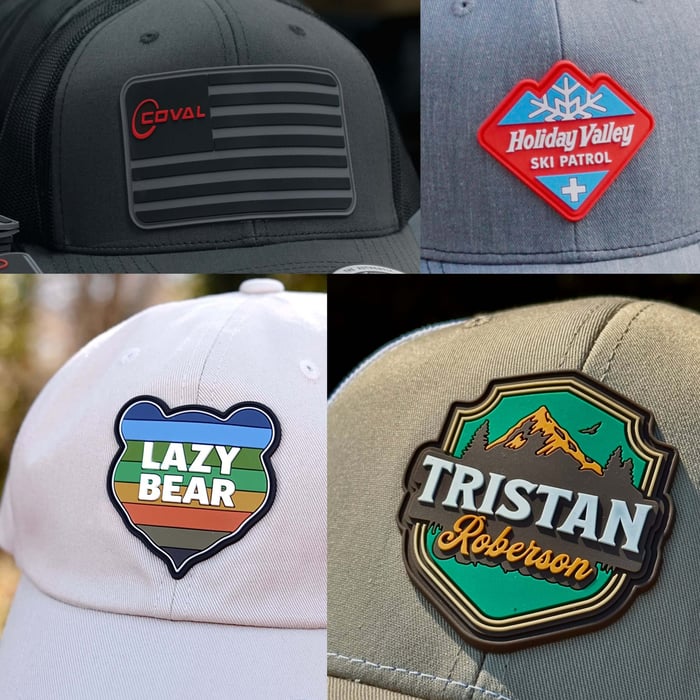
For buyers exploring texture-forward branding, fluffy fluffy chenille varsity patches or classic wholesale embroidered patches both work well on structured caps with a flat crown, while raised 3d tactical pvc patches tend to suit curved-brim or performance caps needing a weatherproof surface.
A Worked Example: 5,000-Unit Trucker Hat Program
A mid-size apparel brand ordering 5,000 trucker caps with a two-color logo faced this decision: embroidered sew-on versus PVC with Velcro backing. Here's how the comparison played out in practice:
- Sample confirmation stage — both options were confirmed with a photo/digital sample before bulk production started, avoiding a costly reprint after the fact.
- Bulk production ran 8-9 days once artwork was locked, with U.S. shipping adding roughly 5-6 business days on top.
- Embroidered sew-on required an added sewing step at the garment factory, adding labor cost per unit but delivering higher wash durability for a cap expected to see daily outdoor wear.
- PVC with Velcro backing let the brand swap seasonal logo variants onto the same cap without reordering the whole unit — useful since this brand refreshes designs quarterly.
- Every bulk order included 100 bonus pieces, effectively covering QC rejects or VIP giveaways without a separate line item.
The brand chose PVC for its flagship line and embroidered sew-on for a limited run meant to survive frequent washing — a split decision driven by wear pattern, not just price.
Common Mistakes That Quietly Inflate Patch Costs
- Skipping the pre-production sample — a color mismatch caught after bulk production means a reprint; catching it beforehand with a photo or digital sample avoids that cost entirely.
- Ignoring stitch density on fine text — embroidery under 6mm text height often blurs; woven or offset-printed methods hold small text better.
- Choosing Velcro on a low-profile dress cap — the hook panel shows through thin fabric and looks unfinished.
- Ordering below the 1,000-unit bulk threshold repeatedly — digital printing with no MOQ is better suited to small or test runs; forcing a small quantity into offset pricing wastes budget.
- Not budgeting for reorder lead time — a 5-day fast re-stocking window for repairs or proportional replacement only helps if you've planned your retail calendar around it, not after a stockout.
Buyer's Decision Checklist Before Submitting an RFQ
- Confirm which backing (sew-on, Velcro, heat-seal iron-on) matches your cap fabric and wearer use case.
- Ask whether your quantity qualifies for offset pricing (1,000-unit minimum) or should stay on digital printing with no MOQ.
- Request a photo or digital sample before bulk production, not after.
- Clarify what happens on defects — proportional replacement and color mismatch reprints should be spelled out in writing.
- Check if bonus pieces are included with your bulk order to cover QC loss.
- Verify the facility's quality certification; an ISO 9001:2015-certified and Disney FAMA-certified production line is a reasonable baseline for consistency across large runs.
Where Labels Fit Into a Full Headwear Branding Order
Hat patches rarely travel alone on a purchase order. Brands ordering headwear often bundle in hang tags, care labels, or box labels for retail packaging. If your program also needs custom labels printed in bulk or woven neck tags for an apparel line sold alongside the caps, it's worth quoting both in the same RFQ — freight and setup often consolidate better that way. For headwear specifically, buyers sourcing patches direct from a dedicated custom hat patches supplier tend to get faster turnaround than splitting patches and labels across two vendors.
The cheapest quote on paper is rarely the cheapest patch over five reorders. Match the backing to how the cap gets worn and washed, confirm MOQ tiers before committing artwork, and lock a sample approval step into every production run. That combination — not the unit price alone — is what actually controls your real landed cost on custom patches for hats.
Ready to compare backing options for your next headwear run? Send over your logo file and target quantity for a quote, or request a sample first to confirm color and stitch detail before bulk production starts.