

Roll Planning Is the Smartest Way to Lower the Cost of Custom Soap Labels
Here's the mistake we see most often: a soap maker orders exactly the roll quantity they need for this quarter, pays a one-time die charge, then reorders six months later only to find the price per unit has gone up, the design needs reprinting, and half the previous roll sat unused in a damp storage closet. None of that shows up on the first invoice. It shows up over the next two or three reorders. Before you send an RFQ for custom soap labels, it pays to map out how order frequency, roll size, and storage actually interact — because the sticker price on a single order rarely tells the full story.
This isn't a theoretical problem. Soap brands scaling from farmers' market tables to wholesale accounts typically reorder labels four to twelve times a year. Each of those reorders carries its own set up cost, shipping timeline, and risk of holding stock that outlives a packaging redesign. Getting the roll quantity right the first time is the single biggest lever you have over total label spend.
Why Roll Quantity Decisions Drive Your Unit Cost
Printing method determines your floor price more than almost anything else. Digital label printing carries no minimum order quantity, which is useful for a new scent line or a seasonal bar you're testing before committing. Offset printing, on the other hand, usually requires a 1,000-unit minimum but rewards larger runs with a lower per-unit cost — the classic trade-off between flexibility and price efficiency.
- Under 1,000 units: Digital printing is your only practical option, and there's no MOQ penalty for ordering small batches while testing new SKUs.
- 1,000 to 5,000 units: Offset printing starts to make sense if the design is locked and won't change for at least two reorder cycles.
- 5,000+ units: Offset becomes clearly cheaper per unit, but only if you have the storage space and sales velocity to use the stock before any formula or branding change.
The catch: committing to a large offset run locks you into that design. If your soap bar's scent or packaging changes before the roll is used up, you're left with unusable inventory — a far more expensive mistake than paying a slightly higher digital unit price.
The Five-Year Cost Model: Order Frequency, Roll Quantity, Die Charges, and Storage
Most quote comparisons stop at "price per thousand labels." That number alone can't tell you what a label program costs over several years of reordering. A proper model separates what's confirmed, what you need to estimate from your own operation, and what genuinely can't be known until you request a quote.
| Cost Driver | Confirmed Fact | What You Must Estimate or Request |
|---|---|---|
| Printing MOQ | Digital printing: no MOQ. Offset printing: 1,000-unit minimum. | Per-unit pricing at your specific quantity and finish — request a quote. |
| Production & shipping time | Sample lead time: 3 days. Bulk production: 8-9 days. U.S. shipping: 5-6 business days. | Your own buffer stock needed to cover lead time between reorders. |
| Die / tooling charges | Applies to processes like foil stamping and custom die-cut shapes. | Exact die cost depends on label shape and foil color count — unknown until design is finalized. |
| Reorder protection | Color mismatch gets a free reprint. Defects are replaced proportionally. Every bulk order includes 100 bonus pieces. | How often your specific substrate or ink combination triggers a reprint — varies by storage conditions. |
| Storage cost | Not applicable from supplier side — this is entirely on your end. | Your warehouse rate per square meter, plus any climate control needed for condensation-prone soap storage. |
Here's how to use it: multiply your expected number of reorders over five years by the unit price at your typical order size, add any die charges each time the design changes, then add the carrying cost of unsold inventory sitting in your storage room. A brand reordering small digital batches eight times a year pays more per label but near-zero storage cost. A brand running two large offset batches a year pays less per label but needs space — and risk tolerance — to hold six months of stock at a time. Neither is automatically cheaper; it depends on your sales velocity and how often your artwork changes.
Worked Example: Scaling From 500 to 10,000 Units
A small-batch soap brand starts with 500 digital labels per SKU, no MOQ required, while testing three scent variations. Two scents sell well; one is discontinued. At that point, switching the two winners to an offset run of 2,000 units each makes sense — the design is validated, and the 1,000-unit minimum is already cleared with room to spare.
By year two, if monthly sales exceed 1,500 bars per scent, a 5,000-unit offset order lowers the per-label cost further, but only if there's dry, climate-stable storage for roughly three months of inventory. If storage is tight or humidity is a concern — a real issue for soap stored near production floors — staying on more frequent, smaller offset runs of 2,000 to 3,000 units often works out cheaper in total once you factor in the risk of adhesive failure or curling from sitting in a damp stockroom.
Common Roll Planning Mistakes That Inflate Label Spend
- Ordering offset minimums before the design is final. A locked-in 1,000-unit run becomes dead stock the moment you change your scent lineup or rebrand.
- Ignoring substrate behavior in storage. Labels that peel from condensation in cold storage, or adhesive that softens under heat, cost far more in replacements than the few cents saved choosing a cheaper material.
- Skipping a digital sample run. A photo or digital proof confirmed before bulk production catches color mismatches before they become a 5,000-unit problem instead of a 50-unit one.
- Treating die charges as one-time. Every redesign — new shape, new foil color, new logo lockup — can trigger a new charge. Lock your artwork before committing to a large run.
- Not accounting for bonus units. Bulk orders typically include 100 extra pieces, which slightly changes your real reorder point — factor that into your inventory count instead of ordering too early.
Choosing Substrate and Finish to Avoid Soap Label Failures
Soap packaging faces conditions most labels don't: cold storage condensation, handmade soap's natural oils bleeding through, and handwritten batch numbers that need to stay legible. These are solvable with the right substrate choice rather than trial and error.
| Scenario | Recommended Approach | Why |
|---|---|---|
| Cold storage or humid warehouse | Waterproof film with BOPP lamination | Resists peeling from condensation, unlike uncoated paper stock |
| Natural or oil-based soap bars | Oil-resistant synthetic substrate | Prevents adhesive bleeding and surface staining from natural oils |
| Batch numbers or expiry dates written by hand | Uncoated matte finish on part of the label | Holds ink or pen markings where gloss laminate would smudge |
| Rustic or farmers' market branding | Kraft paper stock | Matches handmade aesthetic while still supporting UV-resistant ink |
Kraft stock works well for rustic branding but isn't inherently waterproof — if your soap sees any shelf condensation, pair it with a laminate layer or move to custom kraft labels finished with a protective coating rather than raw uncoated kraft. For bars sold in cold storage or humid retail environments, a waterproof labels for cosmetics option holds up better than standard paper stock over a multi-month shelf life. Clear packaging, increasingly common for bath bombs and soap sets, usually calls for clear custom bopp labels with opaque white ink underprint, since thin white layers on clear film tend to let background color bleed through.
A Buyer's Decision Checklist Before Submitting Your RFQ
- Is your artwork final, or will it likely change within the next 6 months? If uncertain, stay on digital printing with no MOQ.
- Do you have dry, stable storage for the roll quantity you're considering? If not, reduce order size even if the unit price is higher.
- Will your soap sit in cold storage, humid retail, or near direct sun? Match substrate accordingly instead of defaulting to standard paper.
- Have you requested a photo or digital proof before bulk production? This step catches color mismatches before they multiply across thousands of units.
- Does your quote show die charges separately from unit price? If not, ask — redesigns later will cost more than expected.
- Are you ordering frequently enough to benefit from a manufacturer's fast sample turnaround (3 days) and bulk production window (8-9 days), or would consolidating orders reduce total shipping and handling?
Brands sourcing for specialty retail shelves face a similar roll-planning question even outside soap — a supplement brand we've worked with needed metallic foil-stamped roll labels with scratch-proof lamination for retail shelf presence, which meant locking the design early to justify a larger offset run rather than reprinting every quarter. The same logic applies to soap labels sold through boutique retailers: decide early whether your design is "retail final" before committing to volume pricing.
For brands managing several SKUs across custom bath bomb labels, bar soap wrappers, and gift sets, a mixed approach often works best — digital printing for seasonal or limited-run items, offset for your core evergreen line sourced through custom printed roll labels on a predictable reorder schedule. This keeps storage lean while still capturing volume pricing where it matters.
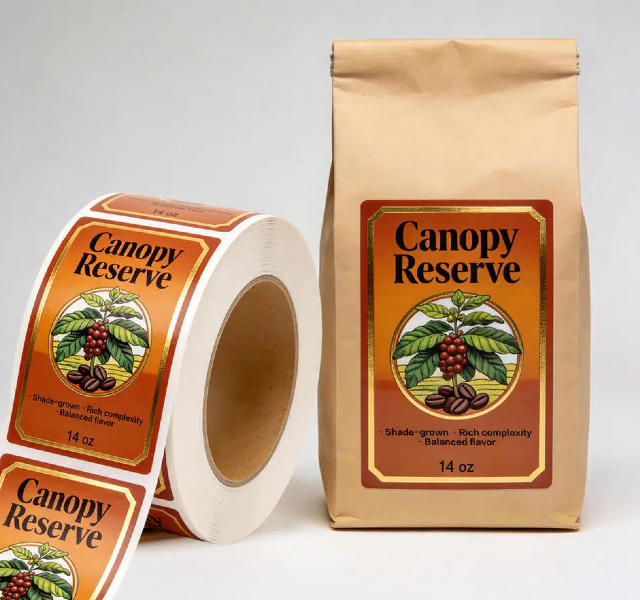
A facility's production capacity also affects how reorders fit your calendar. Operations running digital presses alongside offset lines can usually turn a sample around in a few days and move to bulk production within roughly a week and a half, which shortens the buffer stock you need to carry between orders. That matters directly in the five-year cost model above — shorter lead times mean you can order smaller, more frequent batches without risking stockouts, shifting the math away from large storage-heavy runs toward leaner, more flexible reordering for custom artisan soap bar labels and similar small-batch products.
If you're planning your next reorder and want help weighing digital versus offset for your specific volume, send over your current label artwork and expected order frequency — a quote that breaks out unit price, die charges, and lead time separately makes the five-year math a lot easier to run.