

Die Struck Pins Backing and Finish Guide
The mistakes buyers regret most appear after the cartons arrive. The backing slips off a jacket within a week. The antique finish reads muddy next to the logo on your sample deck. Nobody asked about either in the quote. With die struck pins, backing and plating are the two decisions that change how a pin wears and looks, so they deserve specific answers before you release a purchase order. Below are the questions that settle those choices, in the order I would ask them.
I’m Alin, and I have spent 12 years in custom merchandising and manufacturing. Most of the backing and finish problems I have dealt with came from details nobody confirmed at the quoting stage.
Which backing fits garments, bags, and uniforms?
Short answer: use a butterfly clutch for jackets and lapels, a screw back for bags, hats, and high-turnover uniforms, a safety pin for knits and lanyards, and a magnet only where you cannot pierce the fabric. The matrix below shows the reasoning and where each option falls short.
| Backing | Garments | Bags | Uniforms | Limits |
|---|---|---|---|---|
| Butterfly clutch | Best fit for blazers, wool coats, and denim jackets | Fine on canvas totes and straps | Good for collars and lapels worn daily | Can loosen with repeated movement. The post must be long enough for the fabric thickness. |
| Magnet | Suits silk, fine knits, and shirts you do not want to pierce | Weak choice. Thick bag material stops the two halves meeting. | Works for front-of-house staff on thin fabric | Heavy pins can slip or pull the fabric. Wearers with implanted medical devices should check first. |
| Safety pin | Good for knits, felt, scarves, and ribbons | Works on webbing and thick straps | Suits temporary event or volunteer wear | Looks less premium. A heavy pin can swivel or tip forward. |
| Screw back | Overkill for thin garments, because it needs a hole | Strong choice for leather and backpack panels | Good where pins are lost often or must stay put, such as rank or security wear | Slower to fit. Not suited to fabrics where a visible hole is a problem. |
Two variables change the answer more than the garment type does: pin weight and how long the pin stays on. A small, light pin worn once at a conference rarely needs more than a clutch. A heavy pin on a daily uniform needs a secure option, and the decision should rest on that rather than on unit cost.
Ask for the backing to be shown on the digital proof, along with the placement. Loose or unstable pin backs are a failure mode we watch for during production checks. Your uniform lapel pins should also be confirmed against the actual garment, not just a spec line. Backing availability can differ by design and size, so confirm it at the quote stage.
What finishes can I request, and how do they change the look?
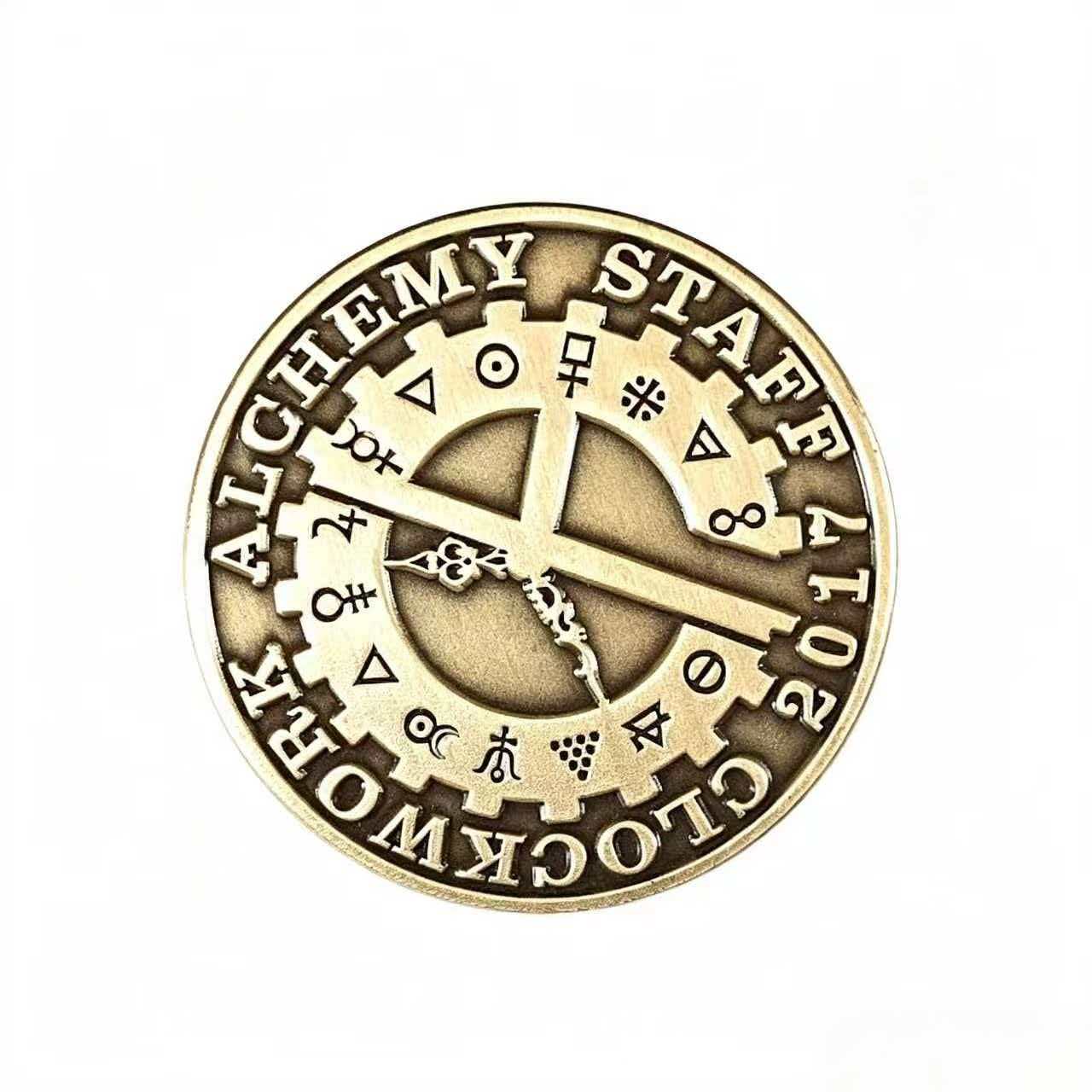
Die struck pins are stamped from a metal die, so the design is carried by raised and recessed metal. Without enamel, the plating does most of the visual work. Material options we work with include zinc alloy, brass, and iron, and plating choices include polished gold and dual-plated finishes. Which one suits your artwork depends on how much detail the design carries.
| Finish direction | Look | Best for | Watch for |
|---|---|---|---|
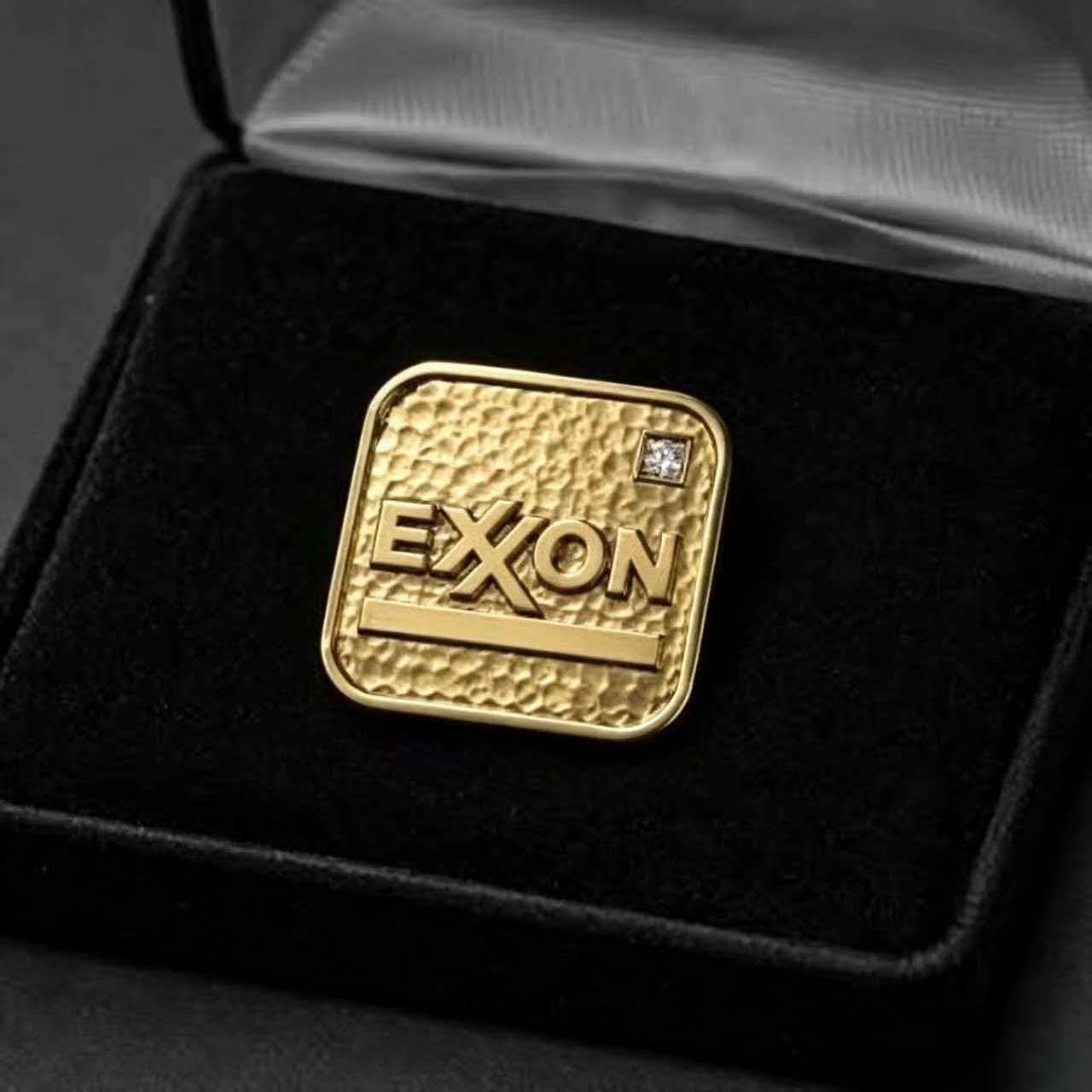
| Polished gold plating | Bright, reflective, formal | Awards, tournaments, executive wear | Fingerprints show. Fine detail can look flat if the relief is shallow. |
| Antique bronze or aged finish | Dark recesses, lighter high points | Heritage, museum, and souvenir designs | Needs enough relief depth. On shallow art the contrast disappears. |
| Dual plated finishes | Two metal tones on one pin | Logos with a clear foreground and background | Plating boundaries must follow the raised lines in the artwork. |
Two real cases show how this plays out. For an esports tournament in Canada, we produced hard enamel pins with polished gold plating and dual-tone colors, worn on jackets and lanyards. For a Tokyo museum exhibition in Japan, we made 3D cast lapel pins with deep antique bronze relief and cut-out details. The second case is 3D cast rather than stamped, but it illustrates the same point: the finish was chosen to match the depth of the modeling.
Can die struck pins match my brand colors?
Only partly. A metal pin without enamel can match metal tones, not a Pantone-style brand color. If your logo depends on exact color fills, a different construction is the better answer. Compare premium hard enamel pins for brands, or consider offset printing for gradients and photographic detail.
If your design is mostly metal with one or two accent colors, ask for a combined approach and a proof before production. We confirm a photo or digital sample before production starts. If a color comes out mismatched, our policy is a free reprint. That is a company term, not a general industry rule, so check that it is written into your order confirmation.
When die struck is the wrong choice
- Your logo uses more than two or three solid brand colors.
- The artwork has hairline text smaller than the stamping die can hold cleanly.
- You need a glossy, glass-smooth surface across color areas.
What are the most common backing and finish mistakes?
- Choosing the backing last. Backing affects pin size, weight, and where the post sits. Decide it with the artwork.
- Using a magnet on a heavy pin. The pin droops or falls. Reserve magnets for light pins on thin fabric.
- Ignoring fabric thickness. A short post on a wool coat will not seat a clutch properly.
- Approving a finish from a screen photo only. Screens exaggerate contrast. Ask for a physical sample if the finish carries the design.
- Specifying antique plating on shallow art. There is not enough relief to show the dark and light contrast.
- Skipping the wear test. Pin a sample onto the real garment or bag and move around for a day.
How do I confirm everything before placing the order?
- Define the wear case. Note the garment or bag type, fabric thickness, and whether the pin is worn daily or once.
- Pick the backing from the matrix above. If two options fit, choose the more secure one for heavy or long-wear pins.
- Choose the finish for the artwork depth. Match polished plating to crisp detail and antique plating to deep relief.
- Request a digital proof showing backing and placement. Check the post position against the design’s center of gravity.
- Order a physical sample for finish-critical designs. Our sample lead time is 3 days for pins, patches, and labels.
- Wear-test the sample. Use the real fabric and the real bag.
- Release bulk production. Bulk production runs 8 to 9 days, and U.S. shipping takes 5 to 6 business days.
What is company policy and what is general advice?
Everything in the matrix and the finish table is general guidance. It applies whichever supplier you use. The terms below are specific to us.
- Quality system: our facility is ISO 9001:2015 certified and Disney FAMA certified. It was established in 2012 and covers 8,000 m² with six production lines and complete metal die-casting facilities.
- Proof before production: photo or digital sample confirmation comes first.
- Defects and color issues: proportional replacement for defects, free reprint for color mismatch, and 5-day fast re-stocking or repair.
- Bonus quantity: every bulk order includes 100 extra pieces.
- Minimum quantity: digital printing and select custom items have no MOQ. Offset printing and standard bulk items start at 1,000 units, with better pricing at higher quantities. Because it varies by item, confirm the MOQ for your pin type in the quote.
Delivery speed in a single case is not a promise for every order, so treat the lead times above as the standard schedule and ask for a dated plan if you have an event deadline.
What details should I send to get a firm quote?
A firm answer on backing and finish needs five inputs: the artwork file, the target size, the quantity, the garment or bag type with fabric thickness, and your preferred metal color or plating. Without the fabric detail I can only suggest a backing from the matrix. Without the artwork, I cannot judge whether polished or antique plating will read well. Browse premium die struck lapel pins for reference styles, then send your artwork and wear case for backing and finish advice, and request a sample so you can test the pin on the real garment.