

How to Choose Custom Jewelry Labels for Earring Cards
You’ve perfected your jewelry design and selected beautiful earring cards. The final touch is a branded label. But what seems like a simple step is where many brands stumble. Ordering a batch of stunning labels only to watch them peel, lift at the edges, or leave residue is more than just frustrating; it undermines your product’s perceived value right at the point of sale. The biggest sourcing risk isn’t print quality—it’s adhesive failure on your specific packaging.
As a custom merchandising specialist, I’ve seen this happen countless times. A brand invests in premium, coated cardstock or elegant velvet boxes, but the adhesive on their custom jewelry labels isn’t formulated for those surfaces. The result is a compromised customer experience before the product is even unboxed. This guide will walk you through the technical decisions needed to source labels that not only look professional but also perform perfectly on the unique surfaces used in jewelry packaging.
Matching Label Stock and Adhesive to Your Jewelry Packaging
The single most important factor for jewelry label success is compatibility between the adhesive and the surface it’s applied to. Jewelry packaging often uses materials with low surface energy (LSE), like coated paper cards and plastic bags, or textured surfaces like velvet boxes. Standard adhesives are designed for high surface energy (HSE) materials like plain paper or metal and will fail to bond properly to LSE surfaces, causing the dreaded “edge lift” or outright peeling.
Choosing the right combination is a technical decision. Here’s a breakdown of how to match materials to common jewelry packaging types to ensure a permanent, professional bond.
| Packaging Surface | The Adhesion Challenge | Recommended Label Material | Recommended Adhesive Type |
|---|---|---|---|
| Coated or Laminated Earring Cards | The smooth, glossy, or matte coating creates a low surface energy (LSE) plane that repels standard adhesives, leading to lifting at the corners. | BOPP (Polypropylene), PET (Polyester), or Vinyl. These film-based stocks are flexible and conform well to the card. | High-Tack Permanent Acrylic. This adhesive is engineered to “wet out” and flow into the microscopic valleys of LSE surfaces, creating a much stronger bond than general-purpose adhesives. |
| Velvet or Flocked Boxes | The fibrous, uneven texture provides very little surface area for a standard adhesive to grip. The label only makes contact with the tips of the fibers. | Thin, flexible paper or a highly conformable BOPP. A rigid label will “bridge” over the fibers and fail to stick. | Aggressive, High-Tack Permanent. You need a thick, soft adhesive that can flow around the fibers to maximize contact and create a mechanical bond. |
| Poly Bags or Cellophane Wraps | These flexible plastic surfaces are classic LSE materials. They are also non-porous and can flex or stretch, which can break a weak adhesive bond. | BOPP or Vinyl. The flexibility of these materials allows the label to move with the bag without peeling off. | Permanent Rubber-Based or an Aggressive Acrylic. Rubber-based adhesives offer high initial tack, while acrylics provide better long-term stability and resistance to UV light. |
Key Material and Finish Choices for a Premium Look
Once you’ve solved for adhesion, you can focus on aesthetics. The material and finish of your labels communicate your brand’s quality. A flimsy paper label can make high-quality jewelry feel cheap, while a well-chosen synthetic stock with a premium finish reinforces its value.
Selecting the Right Label Substrate
The base material of your label affects its look, feel, and durability.
- Paper: An economical choice that offers a classic, natural feel. It’s ideal for brands with an eco-friendly or rustic aesthetic. Custom kraft labels, for example, provide an excellent organic look. However, paper is not resistant to moisture or oils and can tear easily, making it less suitable for products that will be handled frequently.
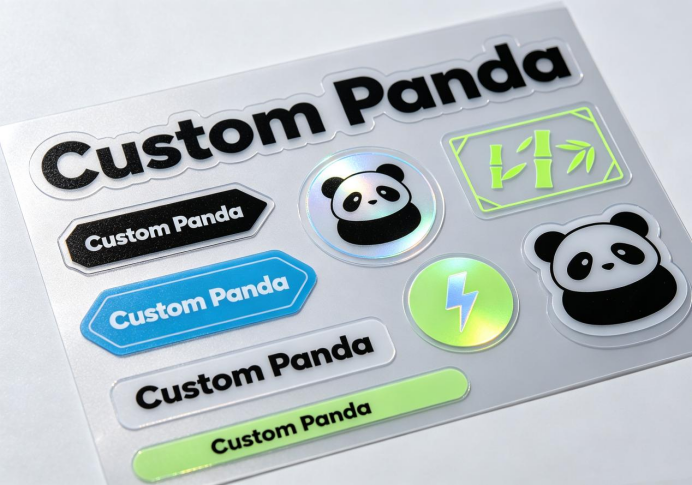
- BOPP (Biaxially-Oriented Polypropylene): This is a versatile and popular choice. As a plastic film, BOPP is waterproof, oil-resistant, and tear-resistant. It’s available in white, clear, and metallic silver bases, making it adaptable to almost any design. Clear custom bopp labels are perfect for a “no-label” look that lets your packaging show through.
- PET (Polyester): For ultimate durability, PET is the top choice. It offers superior resistance to heat, chemicals, and abrasion. While often more expensive, its resilience makes it a great option for luxury jewelry brands where maintaining a pristine appearance is essential.
Finishes and Embellishments that Add Value
The finish is what takes a simple label and turns it into a powerful branding tool.
- Lamination: A thin protective film applied over the printed label. A matte lamination offers a sophisticated, non-glare finish, while a gloss lamination makes colors appear more saturated and vibrant. We often use scratch-proof lamination, similar to what we produced for an Australian health supplement brand, to ensure premium product labels on rolls maintain their high-end look through shipping and handling.
- Foil Stamping: Adding metallic or colored foil is one of the most effective ways to signify luxury. Custom foil jewelry labels can be produced in classic gold and silver or a wide range of custom colors to perfectly match your brand identity.
- Opaque White Ink: When printing on clear or metallic label stock, a base layer of highly opaque white ink is essential. Without it, your colors will look translucent and washed out. Our facility’s HP digital label presses excel at laying down a solid, bright white layer, ensuring your brand colors are accurate and bold.
Avoiding Common Sourcing Mistakes with Jewelry Labels
Over my 12 years in manufacturing, I’ve seen brands make the same preventable mistakes when ordering labels. Avoiding these pitfalls will save you time, money, and the headache of receiving a bulk order you can’t use. Our ISO 9001:2015 certified quality management system is designed to catch these issues, but being an informed buyer is your best defense.
Here are the most common errors to watch out for:
- Mistake 1: Focusing Only on Price, Not Adhesive. The most frequent failure. A cheap label is worthless if it falls off your earring cards. Always define your application surface (e.g., “coated 18pt cardstock”) and ask your supplier to recommend and guarantee the right adhesive.
- Mistake 2: Illegible Text due to Poor Resolution. Jewelry labels often contain very small text for material information (e.g., 925 Sterling, 18k Gold Plated). Low-resolution printing will render this text blurry and unreadable, damaging your brand’s credibility. Our digital presses ensure crisp, sharp details even at tiny font sizes.
- Mistake 3: Inaccurate Color Matching. Your brand’s specific shade of blue or pink is part of its identity. A label that is “close enough” isn’t good enough. To prevent this, always provide Pantone (PMS) color codes. We stand by our work with a color mismatch free reprint policy to ensure your brand standards are met.
- Mistake 4: Not Getting a Production Sample. A digital proof shows you layout and spelling, but it can’t tell you how the label feels, how the foil reflects light, or—most importantly—how well it sticks to your packaging. With our 3-day sample lead time, you can test a physical label on your actual earring cards before committing to a bulk order of 1,000,000+ units.
A Practical Checklist for Your Jewelry Label RFQ
To get an accurate quote and the right product, you need to provide your manufacturer with clear specifications. A detailed Request for Quote (RFQ) eliminates guesswork and reduces the risk of errors. Use this checklist to prepare your next inquiry.
- Quantity: Total number of labels required. Specify if you need pricing for multiple tiers (e.g., 1,000, 5,000, 10,000). We offer no MOQ on many digitally printed items, but our best pricing starts at 1,000 units for offset jobs.
- Dimensions: Provide the exact width and height in millimeters or inches. For non-rectangular shapes, a vector dieline is necessary. Our Free Design Assistance can help if you’re unsure how to create one.
- Material (Substrate): Choose from Paper, White BOPP, Clear BOPP, Silver BOPP, PET, or Vinyl.
- Finish: Specify None, Gloss Lamination, Matte Lamination, or a specific type of Foil Stamping.
- Adhesive: State the required performance (e.g., Permanent, Removable, High-Tack for LSE surfaces).
- Application Surface: This is critical. Clearly describe the packaging: “Matte laminated earring card,” “velvet-lined gift box,” or “clear polypropylene bag.”
- Artwork: Note whether your artwork is print-ready (preferably in vector formats like .AI, .PDF, or .EPS) or if you need design help.
- Format: How do you want the labels delivered? On rolls for machine application or in individual sheets for hand application? If on rolls, specify the core size and unwind direction.
Providing this level of detail allows a supplier to quote accurately and manufacture a product that performs as expected. It transforms the conversation from a simple price inquiry into a technical consultation, ensuring you get the perfect custom jewelry labels for your brand.
Ready to get a label that sticks and shines? Submit your design for a free quote and a personalized material recommendation from our experts.