

How to Source Custom Candle Labels for Wax and Heat
Choosing the wrong label for your candle is a costly mistake. A label that bubbles from the vessel’s heat, smudges from wax residue, or peels in a humid bathroom instantly cheapens your brand’s image. Before you place a bulk order, it’s essential to understand which materials and adhesives can handle the unique challenges of a candle’s lifecycle—from production and shipping to the final burn. Getting this wrong leads to customer complaints and wasted inventory.
As a manufacturing consultant, I’ve seen countless brands struggle with sourcing custom candle labels that perform. The problem often starts with selecting a generic label material that isn’t tested for heat, oil, or curved surfaces. Our ISO 9001:2015 certified facility produces over a million labels daily, and we’ve learned that candle labeling requires a specific set of material properties to succeed. This guide breaks down the technical choices you need to make to ensure your labels look as good on the customer’s shelf as they do in your design files.
Material Showdown: When Paper, BOPP, and Vinyl Labels Fail
Not all label materials are created equal, especially when exposed to a candle’s environment. Heat from the flame, oils from fragrance, and the shape of the vessel can cause common materials to fail. Understanding these breaking points is the first step in sourcing a durable label.
Here’s a direct comparison of where standard materials fall short for candle applications.
| Failure Point & Scenario | Standard Paper Labels | BOPP (Polypropylene) Labels | Vinyl Labels |
|---|---|---|---|
| High Heat Exposure (Vessel heats up during burning) |
Prone to discoloration (yellowing), bubbling, and adhesive failure. The paper can become brittle and crack. | Generally heat-resistant but can shrink or warp if not properly rated. Standard BOPP may not suffice for long burn times. | Excellent heat resistance. Less likely to shrink or bubble, making it a reliable choice for glass and tin vessels. |
| Oil & Wax Residue (Spills during pouring or handling) |
Absorbs oils and wax, causing permanent stains and smudging the print. Lamination offers some protection, but the edges are still vulnerable. | Inherently resistant to oil and water. Spills can be wiped off without damaging the label or print, especially with lamination. A top choice for durability. | Highly resistant to oils and chemicals. The surface is non-porous and easy to clean, protecting the design and brand integrity. |
| Curved Vessel Application (Applying to round jars or tapered containers) |
Stiff and likely to “flag” or lift at the edges. Does not conform well to tight curves, creating wrinkles and gaps. | Flexible and conforms well to most curves, providing a smooth, painted-on look. Ideal for standard round candle jars. | Very flexible and conformable. The best option for complex curves, spheres, or highly tapered vessels where other materials would wrinkle. |
| Condensation & Humidity (Candle is stored/used in a bathroom) |
Weakens, wrinkles, and peels easily. The ink may run if not laminated, and the paper itself can disintegrate over time. | Completely waterproof. It will not absorb moisture or peel due to condensation, making it perfect for products in humid environments. | Fully waterproof and weatherproof. Offers maximum protection against moisture, ensuring the label remains securely adhered. |
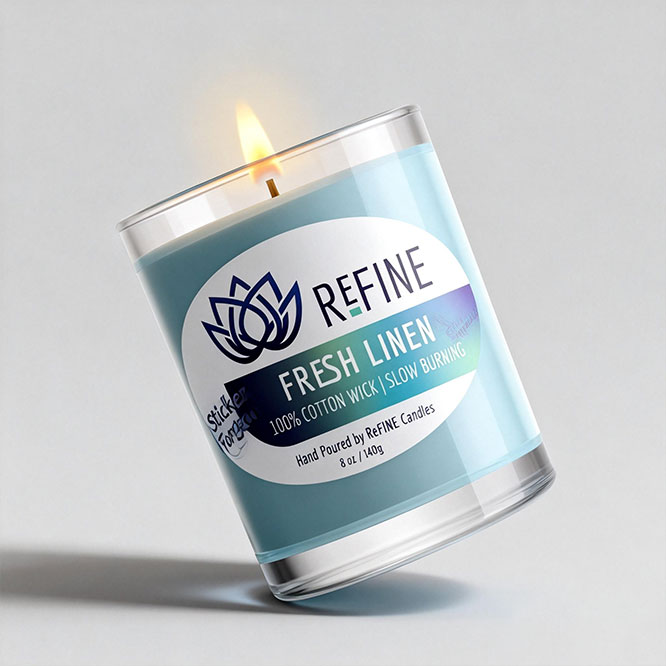
For most premium candle brands, clear custom bopp labels or white BOPP offer the best balance of performance, appearance, and cost. They resist heat and oil while conforming smoothly to glass jars. For ultimate durability on unique shapes or high-end products, vinyl is the superior choice.
Adhesive Integrity: The Unseen Factor in Label Performance
The best label material in the world will fail if the adhesive isn’t right for the job. Candle vessels present two key challenges: surface energy and temperature fluctuation. A slick, smooth glass jar has low surface energy, requiring a strong initial tack. The vessel also heats and cools, causing expansion and contraction that can break an adhesive’s bond.
When sourcing your labels, ask potential suppliers about these adhesive properties:
- Adhesive Type: For candles, a permanent, acrylic-based adhesive is the standard. It provides a strong, long-lasting bond on glass, metal, and ceramic surfaces. Avoid removable adhesives, as they lack the bonding strength to handle temperature changes.
- Temperature Resistance: Specify that the label will be used on a candle. The adhesive needs a high service temperature range to prevent it from softening and “bleeding” from under the label when the candle is lit. This oozing effect attracts dust and ruins the clean edges of your design.
- High Tack Formulation: For powdered or frosted glass vessels, a standard permanent adhesive may not be enough. A “high tack” or “aggressive” adhesive creates a stronger initial bond on textured or low-energy surfaces, preventing the edges from lifting.
One of the most common issues we solve for clients is labels peeling off in cold storage or during winter shipping. This happens when a general-purpose adhesive becomes brittle at low temperatures. A supplier experienced with waterproof custom jar labels for food & candles will stock adhesives formulated for a wide temperature range, ensuring performance from a cold warehouse to a customer’s warm home.
Finishes and Embellishments That Create a Luxury Feel
The tactile and visual quality of your label communicates your brand’s value before the customer even smells the fragrance. Simple printing is functional, but premium finishes are what make a product stand out on a crowded retail shelf. Our work with an Australian health supplement brand on metallic foil-stamped roll labels showed how a high-end finish can elevate a product’s perceived value.
Consider these popular options for luxury candle labels:
- Lamination (Matte vs. Glossy): Lamination is a thin protective film applied over the printed label. It’s not just for looks; it makes the label scratch-proof and fully waterproof.
- Matte Lamination: Offers a soft, elegant, non-reflective finish. It’s excellent for sophisticated, minimalist designs and hides fingerprints well.
- Glossy Lamination: Creates a shiny, high-impact look that makes colors appear richer. It’s great for grabbing attention but can show glare and fingerprints.
- Foil Stamping: This process uses heat and pressure to apply a metallic or pigmented foil to the label surface. It’s perfect for logos, borders, or text that needs to shine. We offer a wide range of custom foil colors beyond the standard gold and silver to perfectly match your brand guidelines.
- Embossing/Debossing: Embossing raises a part of the design, while debossing presses it down. This creates a 3D texture that adds a tactile element, inviting customers to touch the product. It works especially well on thicker materials like textured paper or certain vinyls.
With our advanced HP digital label presses, we can combine these techniques, such as applying a metallic foil over a premium custom matte labels finish for a striking contrast.
A Manufacturer’s Checklist for Sourcing Your Labels
Choosing a supplier is as important as choosing your materials. A reliable manufacturing partner acts as a line of defense against costly production errors. Before committing to an order, ensure your supplier meets these critical checks.
Common Sourcing Mistakes to Avoid
- Ignoring Proofs: Never skip the digital proofing step. This is your last chance to catch typos, color discrepancies, or alignment issues. We provide digital sample confirmation on every order before bulk production begins to prevent these errors.
- Not Requesting Material Samples: A material can look and feel different in person. Always ask for a sample pack to test the substrate and adhesive on your actual candle vessel. We can dispatch label samples in just 3 days.
- Focusing Only on Price: The cheapest option often uses inferior adhesives or low-resolution printing, leading to the exact performance issues you want to avoid. Look for a balance of competitive pricing and quality guarantees. We offer a color mismatch free reprint policy and proportional replacement for defects.
- Misunderstanding MOQs: Some suppliers have high minimum order quantities (MOQs). Our digital printing has no MOQ, making it ideal for startups or seasonal scents, while offset printing for larger runs starts at 1,000 units for better bulk pricing.
- Poor Communication: Slow responses or automated answers are red flags. You need a partner you can reach easily. We provide live human support to answer technical questions quickly.
A good supplier makes the process smooth. With free design assistance and fast production, your labels can be ready in days, not weeks. Plus, for every bulk order, we include 100 bonus pieces to cover any application mishaps, giving you peace of mind.
Selecting the right label is a technical decision that has a direct impact on your brand’s success. By focusing on the right heat-resistant material, a temperature-stable adhesive, and a quality-focused supplier, you can ensure your candles look professional from first light to final burn.
If you need help selecting the perfect material and finish for your candle line, our team is ready to provide a custom quote and material samples.