

How to Source Custom Tea Labels for Tea Pouches
The most expensive mistake in label sourcing is found after the order ships: a label that lifts at the pouch corner, wrinkles over the gusset, or arrives on a roll your applicator can't feed. For private label tea brands, custom tea labels are often the only branded surface on a stand up pouch, so a failure there reaches the shelf directly. This guide covers what to check before you request a quote, so the sample you approve matches the pallet you receive.
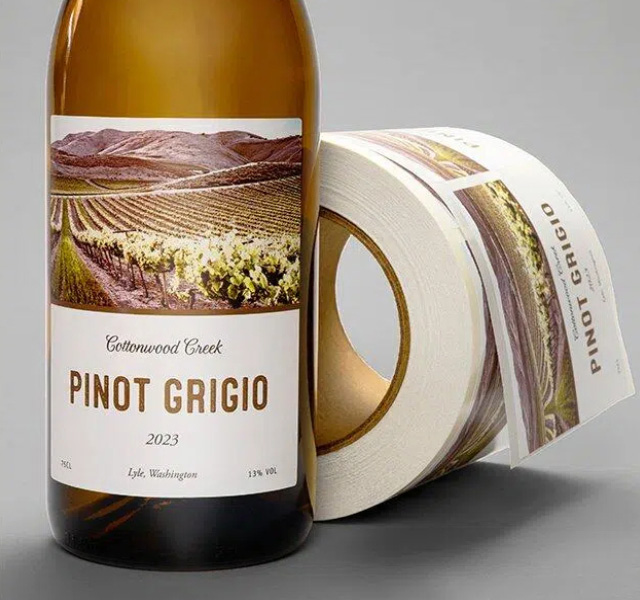
Where Tea Pouch Labels Go Wrong
Most failures trace back to specifying the label in isolation. A buyer approves artwork on a flat proof, then applies it to a flexible, slightly textured pouch film that flexes every time someone picks it up. Our factory team sees the same patterns repeatedly with pouch projects, and the common mistakes below are easy to prevent.
- Approving on a flat proof only. A pouch flexes, a proof doesn't. Always ask for a physical or photo sample applied to your actual pouch.
- Placing the label over a seal or zipper. Labels crossing a heat seal or zip track lift first because the surface is uneven.
- Choosing finish by looks alone. Glossy laminate shows fingerprints and scuffs on a pouch that gets handled in retail. Matte hides them but can dull dark colors.
- Ignoring roll direction. If the unwind direction doesn't match your applicator, the artwork applies upside down or sideways.
- Treating brand color as approximate. Tea brands rely on muted, earthy palettes where small shifts are very visible. Ask how color is verified before production.
A Sourcing Checklist for Matching Label Adhesive, Finish, and Roll Format to Stand Up Tea Pouches
Use the table below as your RFQ outline. Each row names what to specify and the risk if you skip it. Send it with your pouch spec and you will get quotes that are comparable.
| Check item | What to specify | Risk if missed |
|---|---|---|
| Pouch surface | Film type (kraft paper outer, matte film, metallized, clear window), plus any texture or coating | Adhesive that bonds to smooth film may not hold on textured kraft, and the reverse also applies. This is the top cause of edge lift. |
| Adhesive type | Permanent for retail pouches; say so explicitly. Ask for a trial on your pouch sample. | Weak tack peels at corners when the pouch is squeezed. Overly aggressive adhesive can tear thin paper pouches if someone relabels. |
| Face material | Paper, kraft, or BOPP film, chosen for flexibility and moisture exposure | Stiff material resists the pouch curve and pops off. Uncoated paper can mark from handling. |
| Finish | Matte, gloss, or soft touch lamination; foil accents if needed | Wrong finish scuffs in shipping cartons or hides fine type on dark artwork. |
| Label size and placement | Dimensions that sit on the flat panel, clear of the zipper, seal and gusset fold | Wrinkling, air bubbles, or labels covering tear notches and tamper features. |
| Roll format | Winding direction, core size, roll diameter limit, labels per roll, and gap spacing for your applicator | Machine jams, misapplied labels, and rolls that don't fit your dispenser. Hand application is more forgiving but slower. |
| Color and proof | Brand color reference and a photo or digital sample confirmation step | Color drift between runs, which shows up when two batches share a shelf. |
| Storage and shipping conditions | Humidity and temperature the labeled pouches will see in transit | Moisture can make adhesive creep or paper curl before the tea ever sells. |
One limit worth stating: this checklist assumes a standard dry tea pouch. If you pack tea with a high-oil content (some flavored blends), or ship to humid ports, test adhesive and face material under those conditions before committing to a full run.
Choosing Face Material and Finish for Tea Pouches
Face material decides how the label looks and how it flexes. The options below are the ones tea brands compare most often. The clear custom bopp labels and custom kraft labels categories sit at opposite ends of the look spectrum, so they make a useful starting comparison.
| Option | Best for | Reasoning | Limits |
|---|---|---|---|
| Matte BOPP film with lamination | Premium retail pouches, handled often | Film flexes with the pouch and the laminate protects against scuffs. | Costs more than plain paper; dark solids can look flat without a foil or spot accent. |
| Kraft paper | Natural, organic, or artisan positioning on kraft pouches | Matches the earthy look and works well with one or two ink colors. | Absorbs moisture more readily; fine detail and bright colors print less sharply on kraft. |
| Clear BOPP | The "no label" look on matte or colored pouches | Only the printed design shows, so the pouch becomes the canvas. | Needs opaque white ink behind light colors; it also shows air bubbles and dirt on application. |
| Foil stamped accents | Gift or limited edition lines | Metallic detail signals premium quality at shelf distance. | Not worth it on fine, thin text; the foil can fill small details. |
Our label range includes wide substrate options, BOPP lamination, UV resistant inks and custom foil stamping colors, so you can match any of these without changing supplier. For an example of the pairing in practice, we supplied metallic foil stamped roll labels to an Australian natural health supplement brand, using matte BOPP film with scratch proof lamination for a high end shelf look. That is a supplement case, not tea, but the same material logic applies to a premium pouch. It is one customer result, not a guarantee for every project.
Roll Format and Application: What to Send Your Supplier
Roll format is where many first-time buyers lose time. If you apply by hand, almost any sensible roll works. If you use a semi-automatic or automatic applicator, the specifications must match your machine. Follow these steps.
- Check your applicator manual for core size, maximum roll diameter and unwind direction. Do not guess.
- Measure the flat panel of your pouch after filling, not empty. A filled stand up pouch bulges and shrinks the usable flat area.
- Decide the label shape. Rectangles and rounded rectangles apply easily; die cut shapes with sharp points can lift at the tips on a curved pouch.
- Request a short sample roll and apply it to real, filled pouches. Check corners after 24 hours.
- Record the approved specs (material, adhesive, finish, winding direction) and attach them to every reorder.
If your pouch is the main package, review how flexible pouch labels are specified, and consider custom printed roll labels for machine application. For multi-format ranges, tin and box lines can follow the same artwork system using loose leaf tea tin labels and tea gift box labels. The same roll rules apply.
MOQ, Lead Time and Cost Drivers You Can Plan Around
Pricing and timing depend on printing method, so ask for both quotes. Based on our standard terms:
| Factor | Digital printing | Offset printing |
|---|---|---|
| Minimum order | No MOQ on select custom items | 1,000 units minimum on standard bulk items |
| Best fit | New blends, seasonal pouches, test launches | Core SKUs with stable artwork and larger volumes |
| Pricing | Higher per unit at volume | Better pricing for bulk quantities |
Sample lead time is 3 days. Bulk production runs 8-9 days, and U.S. shipping takes 5-6 business days. We run 6 production lines, including 6 HP digital label presses, in an 8,000 m² facility with an ISO 9001:2015 certified quality management system, and capacity is over 1,000,000 labels per day. Rough planning: if you need labeled pouches on a retail shelf, count backward from your fill date with sample approval, production and transit each included. Rushing sample approval is the most common cause of missed launch dates.
Questions to Put to Every Supplier Before You Request a Quote
Use this buyer's checklist to compare suppliers on equal terms.
- Will you apply a sample to my actual pouch and send photos before production?
- What happens if the printed color doesn't match my brand reference? We offer a free reprint for color mismatch.
- How are defective labels handled? We offer proportional replacement for defects, and 5-day fast re-stocking or repair.
- Is there a design team to check artwork against the label size and pouch placement? We provide free design assistance and live human support.
- Is shipping included? We offer free shipping; confirm the terms for your destination and order size.
- Are there extras on bulk orders? Every bulk order from us includes 100 bonus pieces, useful for application tests and spoilage.
Also decide whether you need supporting formats. Tea ranges often add tea bag hang tags and organic tea certification labels. Ordering them together keeps color consistent across the line. For broader volume needs, our custom labels printed in bulk page covers the wider range.
Worked Example: Matching a Label to a Kraft Stand Up Pouch
Say a private label brand packs 100 g loose leaf in kraft stand up pouches with a zip top, and wants a premium natural look. The practical route: choose a matte BOPP face with matte lamination and one foil accent on the brand name, a permanent adhesive confirmed on the kraft pouch, and a rectangular label sized to the flat lower panel, below the zipper. Order a digital sample first. Apply it to filled pouches and check corners after 24 hours. If it holds, scale to offset for the core SKU and keep digital for seasonal blends.
This does not apply if the pouch is very glossy or heavily coated, where adhesive adhesion needs a different test, or if your artwork depends on tiny foil text. In both cases, tell the supplier early so the sample can test the actual risk.
Ready to compare? Send us your pouch specification and artwork, and we'll prepare a sample of your custom tea labels on the material you choose, with photo confirmation before bulk production. You can also ask our team for selection advice on adhesive and finish.