

How to Source Die Struck Pins for Uniform Orders
Uniform pin orders can go wrong long before production starts. A procurement team may approve an attractive quote, then find that the pin feels too light, the attachment is unsuitable for the garment, or the artwork proof does not show the details that disappear after stamping. Those issues are expensive when the order is tied to staff uniforms, a recognition program, or a scheduled event.
Die Struck Pins are a practical choice for organizations that need a formal metal appearance, raised and recessed artwork, and a finish that works with logos, rank marks, service awards, or membership symbols. Before sending an RFQ, buyers should define the metal construction, finish, attachment, proof approval process, quantity plan, and delivery window. A supplier comparison based only on unit price misses the factors that determine whether the finished pins are suitable for daily uniform wear.
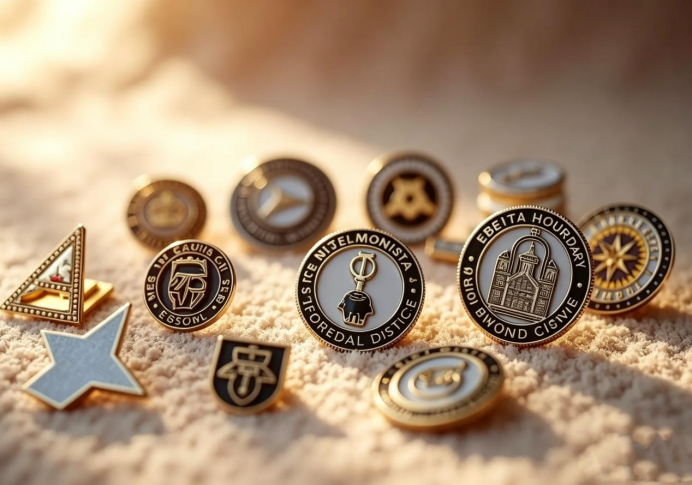
Match the Pin Construction to the Uniform Program
Start with the job the pin must perform. A formal staff insignia, a long service award, and a retail promotional item may all use a metal pin, but their priorities differ. The right construction should support the uniform fabric, brand style, expected wearing frequency, and replacement policy.
Die struck production forms raised and recessed areas in metal. The contrast can come from polished surfaces, textured recessed fields, or an antique metal finish. This route fits logos with strong linework, lettering, shields, crests, seals, and other designs where metal relief should remain visible without relying on large color areas.
| Production option | Best fit | Visual result | Cost direction | When it is not the best choice |
|---|---|---|---|---|
| Die struck metal pin | Formal uniforms, service recognition, membership insignia | Raised metal artwork with recessed details | Depends on metal, finish, shape, and order quantity | Not ideal when the artwork depends on photographic images or color gradients |
| Soft enamel pin | Promotions, sports groups, bold color logos | Colored enamel sits below raised metal lines | Depends on color count and design complexity | Not the first option for a fully metal, traditional insignia appearance |
| Hard enamel pin | Corporate gifts, awards, polished branded merchandise | Smooth enamel surface with a refined finish | Usually requires more finishing work than soft enamel | May not suit a design intended to show unfilled metal relief |
| Offset printed pin | Fine artwork, portraits, gradients, detailed illustrations | Printed color image on a metal base | Depends on printed area and finishing choices | Less suitable when stamped depth is the main design feature |
Recommendation: choose a die struck construction when the organization needs an authoritative, metal forward look and the artwork can be understood through relief, linework, and finish contrast. Choose offset printing instead when fine tonal variation is nonnegotiable. For color filled corporate symbols, compare premium hard enamel pins with soft enamel before finalizing the specification.
The material should also be named in the RFQ rather than left as “metal.” Custom Panda works with zinc alloy, brass, and iron for pins. Ask the supplier which material is proposed for the design and why. A detailed shape, a design with cutouts, and a plain round recognition emblem can have different manufacturing needs. Do not approve a quote that lists only a finish name without confirming the base material and production method.
Build an RFQ That Suppliers Can Quote Consistently
A useful RFQ allows suppliers to quote the same scope. If one factory includes a second attachment and another prices only one, the lowest total may not represent the same product. Procurement teams should provide a controlled brief with the information below.
- State the use case. Specify whether the pin is for security staff, hospitality uniforms, school personnel, executive recognition, volunteers, or a limited event. This determines whether appearance, retention, replaceability, or presentation packaging takes priority.
- Attach usable artwork. Provide vector artwork when available. If the logo contains small lettering or fine lines, ask the supplier to identify elements that may need adjustment for stamped production. Do not assume a screen image shows production ready detail.
- Define the visible finish. Identify whether the desired surface is polished, textured, antique, dual plated, or another approved finish. State if recessed areas must remain darker than raised areas.
- Specify attachment requirements. Identify the garment type and whether the wearer moves actively during a shift. Include the required backing type, quantity of posts, and any safety restrictions.
- State the quantity and reorder plan. Separate the first order quantity from likely replenishment demand. A supplier can then explain MOQ, setup assumptions, and whether the mold can support repeat orders.
- Set the approval gate. Require a digital or photo sample for approval before bulk production. List who can approve artwork, metal finish, backing placement, and packaging.
- State the delivery destination. Shipping requirements affect the schedule. For United States orders, Custom Panda states a shipping window of 5 to 6 business days after dispatch planning, so buyers should include that stage in their event calendar.
For a uniform rollout, add a clear acceptance statement. For example: “Artwork, finish, post position, backing type, and quantity must match the approved proof.” This is stronger than writing “high quality required,” because the factory and the receiving team can inspect the same points.
Organizations ordering multiple branded items can also keep the visual system aligned. A pin presentation card or uniform kit may use related custom labels printed in bulk for identification, stock control, or department allocation. That approach is useful when each uniform issue needs a SKU, employee category, or reorder reference.
Supplier Qualification Checklist for Uniform Pin Orders
Supplier approval should test manufacturing control, not just artwork style. Use this checklist before releasing a purchase order. Each point addresses a common risk that becomes more visible once pins are distributed across a workforce.
| Qualification check | What to ask | Why it matters | Risk if skipped |
|---|---|---|---|
| Metal thickness | Ask the supplier to state the proposed metal thickness in the quote and proof documentation. | Thickness affects perceived weight, edge feel, and how the pin sits on a uniform. | A pin may feel insubstantial, bend more easily, or differ from the approved expectation. |
| Mold approval | Require an artwork proof that identifies relief areas, recessed fields, cutouts, borders, and post placement before the mold is made. | The mold controls the visible metal design. Artwork changes after mold approval can disrupt schedules and create avoidable cost. | Text may be unclear, lines may merge, or the final form may not match the brand mark. |
| Backing security | Confirm backing type, number of posts, placement, and intended garment use. Request this information in the proof. | Attachment selection affects stability on jackets, shirts, lanyards, and heavier fabrics. | Loose or unstable pin backs can cause loss, garment damage, and replacement work. |
| MOQ | Ask for the minimum order quantity by process, finish, and design, plus the terms for repeat orders. | MOQ changes the real landed cost and can affect whether a pilot order is practical. | The buyer may commit to excess inventory or discover that replenishment is uneconomical. |
| Production lead time | Ask for separate timing for proof approval, sample production, bulk production, and shipping. | A single “lead time” figure can hide the stages that determine the actual delivery date. | The pins may miss uniform issue dates, recognition events, or onboarding schedules. |
Conclusion: approve suppliers that answer each item in writing and show the same details in their proof process. This approach is especially suitable for annual uniform contracts or multi location programs, where one early specification error repeats across many units. It may be less necessary for a simple, low risk giveaway, but it remains good purchasing practice whenever the pin represents an organization on staff apparel.
Custom Panda provides photo or digital sample confirmation before production, which gives buyers a defined approval point. Pin, patch, and label samples are listed with a 3 day lead time, while bulk production is listed at 8 to 9 days. These stated stages should be incorporated into the procurement schedule rather than treated as an all inclusive delivery date.
Choose Backings Based on Fabric, Movement, and Replacement Risk
Backing security deserves its own review. A pin worn briefly at a conference has a different attachment requirement from a pin worn through repeated shifts. The right question is not simply “Which backing is standard?” It is “What garment will carry this item, and what happens if it detaches?”
- Single post construction: fits simple, smaller designs where rotation is not likely to affect the look. It may not be sufficient for a wider emblem or a badge that must remain level on an active uniform.
- Multiple post construction: helps control rotation and distributes the attachment across the back of the piece. It suits wider designs, shield shapes, and pins where orientation is part of the identity. Confirm post positions on the proof.
- Clutch style backing: can suit general uniform distribution where staff need a familiar attachment method. Ask the supplier to confirm the supplied backing and whether it is appropriate for the garment fabric.
- Locking style backing: should be considered when loss prevention is more important than quick removal. Confirm that staff can use it safely and that the organization has a replacement procedure.
A practical scenario is a hotel group issuing logo insignia to front desk staff and managers. The design must face upright, employees wear the item through full shifts, and replacements create administrative work. The buyer should request post placement in the artwork proof, compare a single post against multiple posts, and test the selected backing on the actual jacket or shirt fabric. Do not decide from a loose sample alone.
For organizations that also need identification products, compare custom metal badges when the item must serve more like a name badge or a larger visible credential than a lapel insignia. Pins are generally better for compact recognition and branding; a badge format may fit better when readability at a distance is the priority.

Control Artwork Proofs Before the Mold Is Released
The artwork proof is the buyer’s best control document. It should show more than the front logo. Ask for a view that identifies the shape, finish areas, raised versus recessed details, attachment location, backing selection, and any text. If the design is expected to have an antique appearance, ask how the contrast between raised and recessed areas will be represented.
Use the following proof review sequence:
- Compare the logo spelling, legal marks, dates, and department names against approved brand files.
- Check whether small text has enough visual separation from borders and other relief elements.
- Confirm that the outer shape follows the intended silhouette and does not leave unwanted metal areas.
- Review the back view for post quantity and placement, particularly for wide or asymmetric artwork.
- Confirm the selected metal and finish in writing.
- Approve only after internal stakeholders agree on appearance and wearability.
Do not use the proof merely to approve color. In a metal relief design, the relationship between raised and recessed areas is often the defining visual feature. If a buyer needs several recognition tiers, such as five year, ten year, and leadership awards, request separate proofs for each version. Small text or date changes can alter how the design stamps.
For formal programs with a commemorative feel, organizations may also compare die struck custom challenge coins for milestone awards. Pins are easier to wear as a uniform marker; coins are generally better suited to presentation, collection, or a more substantial recognition moment.
Plan Quantity, Timing, and Quality Protection Before Ordering
Quantity planning should cover initial issuance, replacements, new hires, and contingency stock. Ordering exactly the current headcount can create a second purchasing cycle soon after delivery. However, do not overbuy without checking how likely the uniform design, logo, or staff structure is to change.
For standard bulk items, Custom Panda lists a minimum order quantity of 1,000 units, while digital printing and selected custom items can have no MOQ. Because pin construction, finish, and artwork affect production planning, ask for MOQ confirmation on the specific pin quotation rather than applying a general rule to every order.
The company operates an 8,000 m² facility with 6 production lines and complete metal die casting and embroidery production facilities. It is ISO 9001:2015 certified and Disney FAMA certified. These are useful supplier trust signals for procurement teams that need documented manufacturing capability, but certification should not replace product specific proof approval or incoming inspection.
Quality protection should also be discussed before payment terms are finalized. Custom Panda offers a color mismatch free reprint, proportional replacement for defects, 5 day fast restocking or repair, and 100 bonus pieces with every bulk order. Buyers should still document what constitutes a defect, retain the approved proof, and inspect delivered cartons promptly. This is most relevant for branded uniform programs where consistent appearance matters across departments.
For a quote that can be compared fairly, submit your artwork, target quantity, finish preference, backing requirement, delivery destination, and required arrival date for premium die struck lapel pins.