

How to Optimize Roll Specifications for Your Custom Tea Labels
Your unit price for tea labels might look competitive, but are you accounting for the hidden costs of application downtime and material waste? Overlooking roll specifications is one of the most common and expensive mistakes I see brands make. An improperly specified roll can bring your entire production line to a halt, wasting time, money, and perfectly good product. Before you place your next bulk order for Custom Tea Labels, it's essential to understand how these technical details directly impact both your budget and operational efficiency.
As a specialist who has spent over a decade on the factory floor, I’ve seen how a simple mismatch in core size or roll direction can cause major headaches. In our ISO 9001:2015 certified facility, we produce over a million labels daily, and we know that getting the specs right from the start is the key to a smooth, cost-effective process. This guide will walk you through the critical roll specifications you need to confirm before you sign off on a quote.
Matching Label Materials to Your Tea Packaging
The first step is selecting a substrate and finish that protects your product and represents your brand. Tea is packaged in various containers—tins, resealable pouches, glass jars, and paperboard boxes—and each has unique labeling requirements. A label that works beautifully on a rigid tin may fail completely on a flexible pouch.
Consider the environment your product will face. Will it be exposed to moisture from condensation, friction during shipping, or direct sunlight on a retail shelf? For example, a natural health brand in Australia came to us for metallic foil-stamped roll labels. We combined a matte BOPP film with scratch-proof lamination to create a high-end look that could withstand the rigors of shipping and retail handling. Using UV-resistant inks and durable laminations prevents fading and scuffing, ensuring your packaging looks pristine from warehouse to consumer.
Buyer's Decision Checklist for Tea Label Materials
Before you request a quote, use this checklist to clarify your technical needs. Having these answers ready will speed up the process and ensure you get an accurate price for a label that performs.
- Packaging Type: Is your container rigid (tin, glass) or flexible (pouch)? Flexible packaging requires a label material with more give to prevent wrinkling.
- Surface Texture: Is the surface smooth, textured, or porous? Kraft paper boxes and certain matte-finish tins require a stronger adhesive for a secure bond.
- Storage and Use Conditions: Will the product be refrigerated or stored in a humid environment? If so, you'll need oil & waterproof labels for bottles & cosmetics made from synthetic materials like BOPP or vinyl.
- Desired Aesthetic: Are you aiming for a rustic, natural look or a premium, luxury feel? Custom kraft labels are excellent for organic brands, while foil stamping and embossed finishes create a more elegant appearance.
- Application Method: Will labels be applied by hand or by an automated applicator? Machine application has precise requirements for roll direction and label gaps, which we'll cover next.
The Cost Analysis: How Roll Specs Impact Your Bottom Line
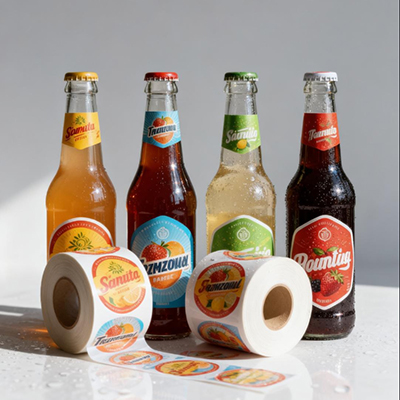
The specifications of the label roll itself are just as important as the label's design. These factors determine how efficiently your labels can be applied and can significantly influence your total cost. For brands using automated or semi-automated labeling machines, getting these details right is non-negotiable. Mismatched specs mean the rolls you ordered are unusable.
Here’s a breakdown of how each specification affects your budget and operations. We offer both high-volume offset printing for orders over 1,000 units and no-MOQ digital printing, allowing you to choose the most cost-effective method for your scale.
| Specification | Impact on Unit Cost & Waste | Operational Recommendation |
|---|---|---|
| Label Size & Gap | A smaller gap between labels (e.g., 2mm vs. 4mm) fits more labels onto a single roll, slightly reducing material cost per label. However, if the gap is too tight for your machine's sensor, it can lead to misapplication and wasted products. | The industry standard is a 3mm gap, which works with most applicators. Confirm your machine's sensor requirements before requesting a non-standard gap. |
| Roll Outer Diameter (OD) | Larger OD rolls hold more labels, meaning fewer roll changes during a production run. This minimizes machine downtime and labor costs. It can also reduce the per-label shipping cost. | Measure the maximum roll diameter your labeling machine can accommodate. Ordering the largest possible roll saves significant time in a high-volume production environment. |
| Core Inner Diameter (ID) | This has no direct impact on unit price but is operationally critical. If the core doesn't fit your machine's spindle, the entire roll is useless. This is a 100% waste scenario. | The most common core sizes are 1 inch (25.4mm) and 3 inches (76.2mm). Always confirm your equipment's required core ID before ordering custom printed roll labels, premium quality & fast shipping. |
| Unwind Direction | Incorrect unwind direction makes machine application impossible without manually re-rolling, which is slow and costly. There is no price difference, but the operational cost of a mistake is high. | Your machine's manual will specify the required unwind direction (e.g., #1 through #8). Provide this number to your label manufacturer to ensure compatibility. Our free design assistance includes confirming these technical specs. |
| Order Volume | For bulk orders (1,000+ units), offset printing offers a much lower per-unit cost. For smaller or multi-version runs, digital printing has no minimum order quantity and avoids plate setup fees, making it more economical. | Analyze your inventory needs. If you have many different tea varieties, digital printing is ideal. For a single, high-selling product, bulk offset printing will provide the best price. |
Preventing Common Tea Label Failures
A beautiful label is useless if it fails in the field. Over the years, I’ve troubleshot every issue imaginable, from adhesives failing in cold storage to ink smudging on contact with essential oils. These problems are almost always preventable by selecting the right materials and communicating clear requirements to your manufacturer.
Here are some of the most frequent failures we help clients avoid:
- Problem: Peeling in Humid or Cold Conditions. Standard paper labels with an all-purpose adhesive will absorb moisture from condensation, causing them to wrinkle and peel off. This is a common issue for iced teas or products stored in commercial refrigerators.
- Solution: Use a synthetic substrate like BOPP, vinyl, or PET with a freezer-grade adhesive. These materials are inherently waterproof and the specialized adhesive maintains its bond at low temperatures.
- Problem: Colors Don't Match Brand Guidelines. A slight color shift can cheapen your brand's appearance and create inconsistency across your product line. This often happens when brand colors are not specified using a universal standard.
- Solution: Always provide Pantone (PMS) color codes for your brand's critical colors. At Custom Panda, we offer a color mismatch free reprint guarantee and provide photo or digital samples for confirmation before bulk production begins.
- Problem: Scuffing and Fading During Transit. Labels on tea tins and boxes can rub against each other during shipping, causing ink to scuff and the design to become illegible. Unprotected paper labels are especially vulnerable.
- Solution: Apply a protective lamination. A matte or gloss BOPP lamination acts as a durable, scratch-proof layer that seals the ink and protects the label from moisture and abrasion.
- Problem: Inability to Write "Best By" Dates. Many tea companies need to hand-write or stamp batch codes or expiration dates. High-gloss or heavily coated labels will cause ink to bead up and smudge.
- Solution: Choose an uncoated paper stock or a matte laminate finish. For a premium look that is still writable, you can request a "varnish-free" window in a specific area of the label.
Proven Quality for Global Brands
Choosing the right manufacturing partner is crucial for getting reliable, high-quality results. Our facility is not only ISO 9001:2015 certified for quality management but also holds Disney FAMA certification, demonstrating our commitment to ethical production standards. We leverage advanced equipment, including 6 HP digital label presses, to deliver precise, consistent results for brands worldwide.
This commitment to quality is why brands trust us with their packaging. For an eco-friendly children's clothing brand in Spain, we produced organic cotton printed labels with skin-safe, fade-resistant inks that held up to repeated industrial washing. The same principles of durability and material science apply to creating premium Custom Tea Labels that must endure shipping, stocking, and daily use.
Whether you need a simple, elegant label for a single-origin oolong or a brightly colored, durable label for a line of herbal iced teas, the fundamentals remain the same: match the material to the application, specify your roll requirements clearly, and partner with a manufacturer who understands the technical details. With a sample lead time of just 3 days and bulk production in 8-9 days, we can help you get your product to market quickly without compromising on quality.
Ready to eliminate waste and get the right label for your tea brand? Submit your design for a free quote, and our team will help you optimize your roll specifications.