

Getting Custom Hat Patches Right for Your Brand
Ordering a bulk run of hats for your brand, team, or event should be straightforward. But a small detail—the patch—can make or break the entire project. Sourcing custom hat patches without a clear plan often leads to disappointing results: embroidered logos that fray after a few wears, iron-on patches that peel at the corners, or leather that looks cheap. These aren't just aesthetic problems; they reflect poorly on your brand's quality standards and result in wasted inventory. This guide cuts through the noise to focus on the key decisions that prevent these costly mistakes, ensuring the patches you order are a perfect match for your headwear and your brand's reputation.
From material selection to the right attachment method, every choice impacts the final product's durability and appearance. Getting it right from the start saves you time, money, and the headache of dealing with a defective order.
Choosing the Right Patch Material for Your Hat Style
The material of your patch defines its texture, detail resolution, and overall feel. Matching the material to your hat’s purpose and your brand’s image is the first step toward a professional result. A rugged outdoor brand and a premium fashion line will require very different patch styles to communicate their message effectively.
Here’s a breakdown of the most common materials and their best applications:
| Patch Material | Best For | Limitations | Real-World Example |
|---|---|---|---|
| Embroidered | Bold logos, classic and athletic brands, uniforms, and merchandise with a textured, three-dimensional feel. | Not ideal for designs with very fine text or complex color gradients due to thread limitations. | We manufactured heavy-duty embroidered patches for hats and gear for a U.S. outdoor brand, using weather-resistant threads to ensure they held up on hiking backpacks. |
| Woven | Highly detailed artwork, intricate text, and photorealistic designs. The thinner threads allow for much higher resolution than embroidery. | Lacks the raised, textured feel of embroidery, presenting a flatter, smoother surface. | An independent luxury knitwear brand in the UK used our high-density woven labels to achieve a detailed logo that was soft enough not to irritate skin. |
| Faux Leather | Premium, rustic, and minimalist branding. Perfect for lifestyle brands, denim, and high-end promotional caps. | Color options are typically limited to natural tones like tan, brown, and black. Intricate color work is not possible. | For an Italian premium denim line, we supplied custom leather patches with a debossed logo designed to withstand industrial stonewashing. |
| PVC / Soft Rubber | Modern, tactical, and outdoor brands. They are waterproof, durable, and can be molded into 2D or 3D designs. | The material is heavier and less flexible than fabric patches, making it unsuitable for very lightweight or unstructured hats. | Ideal for brands needing rugged, easy-to-clean pvc patches for caps that can handle mud, rain, and heavy use without fading or cracking. |
| Chenille | Varsity, collegiate, and retro-style branding. The fuzzy, towel-like texture creates a bold, nostalgic statement. | The nature of the material makes it unsuitable for small, detailed designs. It's best for large letters, mascots, and simple shapes. | A Swedish university sports team ordered fluffy chenille varsity patches from us for their letterman jackets, featuring high-density stitching that made the logo stand out. |

The Critical Sourcing Checklist Before You Order
A successful order is built on clear communication with your manufacturer. Before you request a quote, use this checklist to define your requirements. Answering these questions upfront prevents miscommunication and ensures you get exactly what you envision. Each point addresses a common area where orders go wrong.
-
1. Does the Patch Type Match Your Design's Complexity?
Why it matters: Forcing a highly detailed logo into a standard embroidered patch will result in a blurry, unreadable mess. The manufacturing method must support your artwork's resolution. The risk is ending up with a product that fails to represent your brand clearly. For fine lines and small text, a woven or printed patch is a much safer choice. -
2. Is the Attachment Method Suited for the Hat's Use?
Why it matters: The backing determines how the patch is applied and how well it stays on. An iron-on backing is convenient for promotional giveaways but may fail after repeated washing. For workwear or premium apparel, a sew-on application is the most durable solution. Using the wrong backing risks having your branding fall off, literally. We've seen this happen, which is why we offer rugged hook-and-loop backings for gear that needs versatility, like for the outdoor brand we worked with in the United States. -
3. Does the Patch's Stiffness Match the Cap's Panel Shape?
Why it matters: Hats come in two main styles: structured and unstructured. A structured cap (like a trucker or baseball hat) has a stiff front panel that can support a firm patch, such as PVC or thick embroidery. An unstructured "dad hat" is soft and requires a flexible patch to avoid awkward bunching and distortion. The risk is an ill-fitting patch that looks cheap and unprofessional. -
4. Have You Confirmed the Minimum Order Quantity (MOQ)?
Why it matters: Many manufacturers enforce a high MOQ (e.g., 500 or 1,000 units), which is a significant investment if you're testing a new design. The risk is being stuck with hundreds of units of a product that doesn't sell. At Custom Panda, we offer no MOQ for select digitally printed or custom items, giving you the flexibility to order smaller batches and validate your design first. -
5. Will You Approve a Proof Before Full Production?
Why it matters: On-screen colors rarely translate perfectly to physical thread or ink. Without a proof, you are gambling on color accuracy. The risk is receiving a bulk order where the patch's primary color clashes with your brand guidelines. We eliminate this risk by requiring photo or digital sample confirmation before any bulk production begins. It's a simple step that prevents costly errors.
Attachment Methods Decoded: Which Backing is Best?
The backing of your patch is just as important as the front. It dictates application method, permanence, and the types of fabric it can be applied to. Choosing the wrong one can lead to patches that are difficult to apply or fail to adhere long-term.
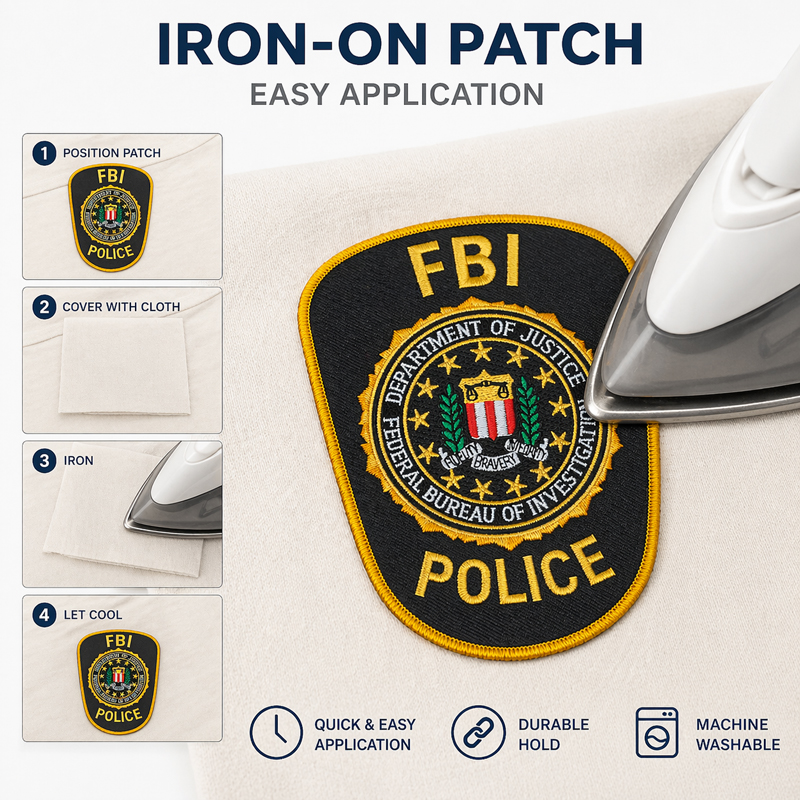
Iron-On (Heat Seal)
This is one of the most popular options due to its ease of application. A thin layer of industrial-grade adhesive on the back is activated by the heat and pressure of an iron or heat press.
- Best For: Quick application on cotton and polyester fabrics, promotional items, and retail apparel.
- Avoid On: Nylon, leather, and other heat-sensitive materials that could be damaged by high temperatures. While convenient, its bond can weaken after dozens of machine washes.
Sew-On
As the name implies, these patches have no adhesive and are designed to be stitched directly onto the garment. This is the most traditional and durable attachment method.
- Best For: Heavy-duty applications like workwear, uniforms, denim jackets, and any item that will undergo frequent, rigorous washing.
- Considerations: Application requires time and either a sewing machine or manual labor, which can increase the final cost if you are not applying them yourself.
Velcro (Hook and Loop)
This two-part system features the "hook" side on the patch and a separate "loop" side that is sewn onto the hat. It allows patches to be easily removed or swapped out.
- Best For: Tactical gear, uniforms, bags, and any situation where modularity is needed. It's a favorite for military and airsoft gear. We've produced many custom Velcro patches for brands needing this exact functionality.
- Considerations: The backing adds thickness and rigidity to the patch. The loop-side piece must be expertly sewn onto the hat for a secure fit.
Common Production Pitfalls and How to Prevent Them
Years on the factory floor have shown me the same few mistakes that buyers make, regardless of their industry. Here are the most frequent issues and how our process at our ISO 9001:2015 certified facility helps you avoid them.
-
Submitting Low-Resolution Artwork.
A blurry JPEG or a screenshot will always produce a blurry patch. The equipment needs clean lines to create a crisp final product.
Prevention: Always submit your artwork in a vector format (.AI, .EPS, or .SVG). If you don't have a vector file, our team provides free design assistance to convert your logo and ensure it's production-ready. -
Choosing the Wrong Border for a Complex Shape.
A "merrowed" border is the standard stitched edge you see on most patches. However, it can only be applied to simple shapes like circles and rectangles. Trying to merrow a shape with sharp, inward-pointing corners will cause the thread to bunch up and fray.
Prevention: For complex or die-cut shapes, choose a "hot-cut" or "laser-cut" border. This method uses heat to seal the edges, creating a clean, flat border that follows your custom shape precisely without risk of fraying. -
Ignoring Color Matching Standards.
Describing a color as "sky blue" or "forest green" is subjective. Your idea of sky blue might be completely different from the manufacturer's.
Prevention: Provide Pantone (PMS) color codes for your design. This universal system ensures everyone is working from the same standard. As part of our guarantee, we offer a free reprint for any color mismatches against approved proofs, giving you complete peace of mind. -
Failing to Account for Text Size.
Tiny text is a common issue with embroidered patches. Letters that are too small or thin will become illegible when stitched with thread.
Prevention: Ensure any text on an embroidered patch is at least 4-5mm high. If your design requires smaller text, a woven patch is the better option, as it can capture much finer detail.
By thinking through these material, backing, and design details upfront, you move from simply buying a commodity to strategically sourcing a component that enhances your brand. The right patch feels like an integral part of the hat, not an afterthought.
If you need help specifying the right patches for your next bulk hat order, our experts are ready to assist. Contact us for a quote and a free design proof.