

Sourcing Custom Oil Labels That Prevent Costly Leaks and Product Damage
There's nothing more damaging to a brand than a product failing on the shelf. For brands selling oils—whether it's essential oils, CBD tinctures, or gourmet olive oil—the label is often the first point of failure. An oil-stained, peeling, or smudged label doesn't just look unprofessional; it suggests a low-quality product inside and can lead to lost sales and returns. Sourcing the right custom oil labels isn't about aesthetics alone; it's a technical decision that protects your product integrity and brand reputation.
Choosing the wrong material or adhesive means subjecting your product to almost certain failure. Oil inevitably creeps, drips, or smears during filling and customer use. A standard paper label will absorb it, while a weak adhesive will quickly lose its bond, causing the label to lift at the edges or slide off completely. As a specialist with 12 years in manufacturing, I've seen firsthand how getting these details wrong at the quoting stage leads to costly reprints and logistical headaches. This guide outlines the technical checkpoints to ensure your labels perform flawlessly from production to the end customer's hands.
Choosing the Right Material: Why Standard Paper Labels Fail
The single most common mistake in sourcing labels for oily products is defaulting to paper-based materials. While cost-effective for dry goods, paper is fundamentally incompatible with oils and liquids. It acts like a sponge, wicking oil from the container's surface, which leads to discoloration, ink smudging, and eventual disintegration. To create durable, professional-looking labels, you must use a synthetic film.
Synthetic materials are non-porous plastics that create an impenetrable barrier against oils and water. This ensures your design remains crisp and the label stays securely bonded to the container. The three most common materials for high-performance labeling are BOPP, Vinyl, and Polyester. Each offers distinct advantages depending on your specific product and application environment.
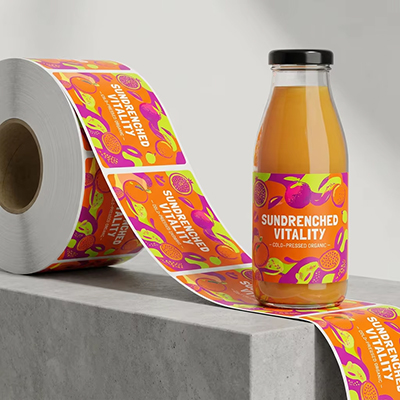
Material Comparison for Oil-Resistant Labels
Selecting the correct film is a balance of performance, appearance, and cost. Here is a breakdown of the top choices for oil-based products:
| Material | Key Features & Benefits | Best For |
|---|---|---|
| BOPP (Biaxially-Oriented Polypropylene) | Highly flexible, making it ideal for squeezable bottles or tight-radius containers. Excellent moisture and oil resistance. Available in white, clear, and metallic finishes. It's the most common and cost-effective choice for consumer products. | Essential oils, cosmetic serums, food products (dressings, sauces), and general wellness products. The Australian natural health supplement brand we worked with used matte BOPP film with scratch-proof lamination to achieve a premium retail presence. |
| Vinyl (PVC) | Extremely durable, flexible, and resistant to UV light, chemicals, and abrasion. Thicker and more rigid than BOPP, it offers superior longevity for demanding applications. | Industrial lubricants, automotive products, outdoor equipment, and any container exposed to harsh weather or frequent, rough handling. |
| Polyester (PET) | The most durable option, offering exceptional resistance to high temperatures, chemicals, and abrasion. It is more rigid than BOPP and Vinyl, making it best for flat or large-diameter surfaces. | Engine oil, chemical drums, high-temperature applications, and products requiring long-term durability in extreme industrial environments. It's also ideal for premium industrial grade custom pet labels on electronics. |
The Sourcing Checklist for Leak-Proof Oil Bottle Labels
Getting the material right is only the first step. To create a truly reliable label, four components must work together: the facestock (material), the adhesive, the container, and the protective laminate. Use this checklist when preparing your request for a quote to ensure your supplier understands your exact performance requirements.
-
1. Facestock vs. Oil Type: Not all oils are equal. Some, like citrus or mint essential oils, contain aggressive compounds that can interact with certain plastics over time.
- Why it matters: An incompatible facestock can become brittle or discolored.
- Sourcing Action: Inform your supplier of the exact type of oil in your product. While BOPP is an excellent all-around choice, a particularly aggressive oil might require Polyester (PET) for maximum chemical resistance.
-
2. Adhesive Performance & Surface Energy: This is where most labels fail. Oil that seeps under the label edge will attack and break down a standard acrylic adhesive. Furthermore, many plastic containers are made from Low Surface Energy (LSE) plastics like HDPE, which are notoriously difficult for adhesives to grip.
- Why it matters: Weak or mismatched adhesive leads to "flagging" (edge lifting), bubbling, or complete label failure.
- Sourcing Action: Specify a permanent, high-tack, oil-resistant adhesive. Inform your manufacturer if your bottles are LSE plastic so they can use a specially formulated adhesive. Never assume a "general purpose" adhesive will work.
-
3. Container Shape & Label Dimensions: Small, cylindrical containers like 10ml dropper bottles create significant tension on a label. If the material is too stiff or the adhesive isn't strong enough, the label's "memory" will cause it to lift off the tight curve.
- Why it matters: A poor fit leads to immediate application problems and long-term failure.
- Sourcing Action: For small-diameter containers, use a highly flexible material like BOPP. Consider a full wrap-around design where the label overlaps itself by a few millimeters. This mechanical lock provides extra security against flagging.
-
4. Lamination & Ink Protection: The printed surface must be protected. Without a protective layer, oil drips and even finger smudges from oily hands can cause the ink to smear or scratch off, ruining your branding.
- Why it matters: Unprotected ink compromises the label's appearance and legibility, making your product look cheap and used.
- Sourcing Action: Always request a protective laminate. We use BOPP lamination in either a gloss or matte finish to seal the UV-resistant inks, ensuring your design stays perfect. This is particularly important for premium custom cosmetic labels where brand perception is paramount.
Common Sourcing Mistakes That Lead to Label Failure
Beyond the technical specifications, several process mistakes during sourcing can result in a failed label order. Avoiding these common pitfalls will save you time, money, and frustration.
- Focusing Solely on Price Per Label. Sourcing the cheapest possible "oil proof sticker paper" is a false economy. A low-quality label that fails in the field will cost far more in returns, reputational damage, and rush-job replacements than you saved upfront. A professional label manufacturer will ask about your application, not just your quantity.
- Forgetting Environmental Conditions. Your product isn't just used at room temperature. It may be stored in a cold warehouse, shipped in a hot truck, or used in a steamy bathroom. These temperature and humidity swings can cause adhesives to fail. We often see clients with labels peeling in cold storage due to condensation—a problem solved by specifying a freezer-grade or all-temp adhesive.
- Skipping the Sample Phase. A digital PDF proof only confirms your artwork's layout. It cannot tell you how the material feels, how the colors will render on a metallic vs. white substrate, or how well the label will stick to your actual bottle. At our ISO 9001:2015 certified facility, we provide photo and digital sample confirmations before any bulk production begins. This prevents costly mismatches. Our color mismatch free reprint guarantee offers an additional layer of security.
- Vague or Incomplete Specifications. Simply asking for "10,000 labels for oil bottles" is not enough. A quality supplier needs details. Provide your container material (glass, PET, HDPE), exact dimensions, application method (hand or machine), and storage/use conditions. The more information you provide, the better the final product will be. Our free design assistance includes helping you finalize these technical specs.
Quality Control and Supplier Reliability
The technical aspects of the label are critical, but so is the capability of the manufacturer producing them. When vetting a supplier for your business, look for concrete evidence of their quality and reliability.
First, check for quality management certifications. An ISO 9001:2015 certification is a key indicator that the factory has established and follows strict processes for quality control, production consistency, and continuous improvement. It shows a commitment to professional standards that goes beyond a simple sales pitch.
Second, evaluate their production capacity and technology. A modern facility with advanced equipment, like the 6 HP digital label presses we operate, can ensure color accuracy, crisp printing, and fast turnaround times. With a daily capacity exceeding 1,000,000 labels, we can handle both small-batch runs and large-scale orders without compromising on quality. This flexibility is supported by our No MOQ policy for digital printing, allowing brands of all sizes to access professional-grade custom printed roll labels.
Finally, understand their support and warranty policies. What happens if there's a defect? A reliable partner will stand behind their work. We offer proportional replacement for any defects and even include 100 bonus pieces with every bulk order to cover any minor issues during application, ensuring you always get the quantity you paid for.
By combining a technically sound label specification with a well-vetted, capable supplier, you can confidently source custom labels that enhance your product and protect your brand.
Ready to source oil labels that perform under pressure? Contact our team for a material consultation and a no-obligation quote on your project.
</body>