

How to Source Custom Product Labels That Won't Fail on the Shelf
Ordering a massive run of custom product labels only to watch them peel, fade, or scuff before a customer even touches them is a costly mistake. I've seen it happen too many times. A brand invests in a beautiful design, but the label fails in a refrigerated case due to condensation, or the adhesive bleeds under warehouse heat. The result is always the same: damaged inventory, lost sales, and an urgent, expensive reprint.
The key to avoiding this is a disciplined sourcing process. Before you even request a quote, you need to define the technical specifications that ensure your labels survive their entire lifecycle—from your production line to the customer's home. Getting this right a manufacturer who can meet those exact needs is the difference between a successful product launch and a logistical headache.
Material and Finish: Matching Substrate to Product Environment
The first decision in sourcing labels is the material, which is dictated entirely by your product's use case and environment. A label for a dry goods box has vastly different requirements than one for a shower gel bottle. This choice breaks down into two main categories: paper and synthetics.
Paper-Based Labels
Paper is an excellent, cost-effective choice for products in dry, stable environments. Think coffee bags, cardboard boxes, and candle jars. Materials like custom kraft labels offer a rustic, organic aesthetic that resonates with artisanal and eco-conscious brands. However, their primary weakness is a lack of resistance to moisture and oils. An uncoated paper label will quickly degrade if exposed to condensation or product leakage.
Synthetic Labels (BOPP, PET, Vinyl)
For any product that may encounter moisture, friction, or chemicals, synthetic substrates are non-negotiable. These materials provide the durability modern retail environments demand.
- BOPP (Biaxially Oriented Polypropylene): This is the most common material for oil & waterproof labels for bottles & cosmetics. It's highly resistant to water and oils, making it perfect for beverages, cosmetics, and food jars. For an Australian health supplement brand, we used a matte BOPP film with a scratch-proof lamination to create a premium, fingerprint-resistant finish that held up to handling on retail shelves.
- PET (Polyester): When you need maximum durability, PET is the answer. It offers superior resistance to heat, chemicals, and UV exposure, making it ideal for industrial applications, electronics, and outdoor products.
- Vinyl: Known for its flexibility and weather resistance, vinyl is a great choice for products with squeezable containers or those intended for long-term outdoor use.
Protective Finishes and Embellishments
The finish not only protects the printed artwork but also enhances your brand's perceived value.
- Lamination: A thin protective film applied over the label. A glossy finish makes colors pop, while a matte finish provides a sophisticated, non-glare look that resists scuffs.
- Foil Stamping: Applying metallic foil to specific areas of your design adds a touch of luxury that helps products stand out. We offer a wide range of custom foil colors beyond the standard gold and silver.
- UV-Resistant Inks: Essential for any product that will sit on a store shelf under fluorescent lights or near a window. These inks prevent fading and ensure your branding remains crisp and true to color for longer.
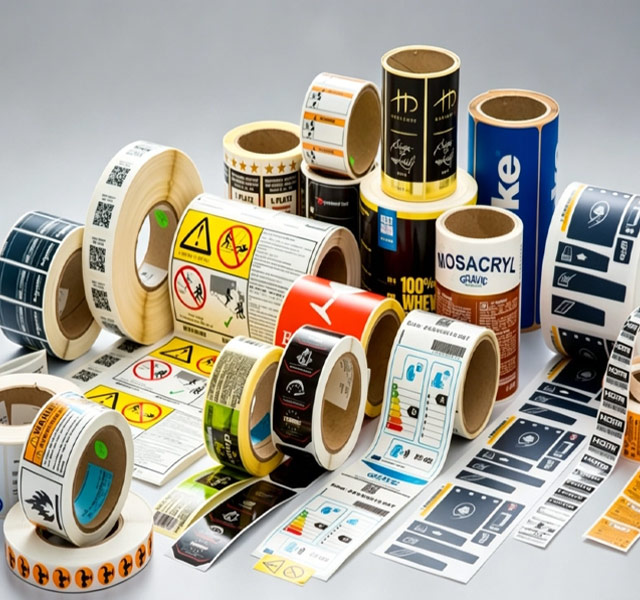
The Pre-RFQ Sourcing Checklist for Flawless Labels
Sending a vague request to a supplier is the fastest way to get an inaccurate quote and a subpar product. Use this checklist to define your exact needs. Answering these questions internally first will save you from costly back-and-forth communication and production errors.
This isn't just about getting a price; it's about preventing failure. Each point below addresses a common issue I've seen derail a project.
| Requirement to Define | Why It Matters (The Sourcing Risk) |
|---|---|
| Label Format | Risk: Production Line Jamming. Do you need labels on rolls or in sheets? If on rolls, you must specify the core diameter (e.g., 3 inches), maximum outer diameter, and winding direction (how the label comes off the roll). The wrong specs will make the roll incompatible with your automatic applicator, leading to costly downtime. |
| Adhesive Type | Risk: Label Failure. A standard permanent adhesive will fail in a freezer. Specify if you need permanent, removable, or a specialty adhesive like freezer-grade or repositionable. Mismatching the adhesive to the surface energy of your container (e.g., glass vs. certain plastics) or its environment is a leading cause of peeling. |
| Surface Finish & Lamination | Risk: Brand Damage. An unlaminated label on a product that is handled frequently will scuff and scratch during shipping and on the shelf, making your product look old and cheap. Specify a matte or gloss lamination to protect the ink and control the final look. |
| Application Method | Risk: Wasted Labels and Labor. Are you applying by machine or by hand? Machine application has strict requirements for roll size and label spacing. Hand application is more forgiving but can be inconsistent. Informing your supplier ensures they format the labels correctly for your process. |
| Quantity & MOQ | Risk: Budget Mismatch. Be clear about your volume needs. At Custom Panda, we use digital printing for runs with no minimum order quantity (MOQ), which is perfect for startups or seasonal products. For larger orders (typically 1,000+ units), offset printing provides a lower cost per label. Understanding this helps you choose the right production method for your budget. |
Avoiding Common and Costly Label Production Mistakes
Beyond the technical specs, a few common process errors can compromise your final product. Here are the most frequent issues I help clients resolve, often after they've had a bad experience elsewhere.
Mistake 1: Relying on Vague Color Specifications
Describing a color as "our brand's sky blue" is a recipe for disappointment. The color you see on your computer screen (RGB) will not look the same when printed (CMYK). To ensure consistency across all your marketing materials, always provide Pantone Matching System (PMS) color codes. This is the universal standard for print. We take this so seriously that we offer a color mismatch free reprint guarantee, but providing PMS codes from the start ensures accuracy on the first run.
Mistake 2: Forgetting the Container's Shape and Material
A beautiful label is useless if it doesn't conform to the container. A rigid paper label will wrinkle and lift off a curved bottle. A squeezable tube requires a flexible label material, such as BOPP or vinyl, that can move with the container without peeling. Furthermore, the adhesive must be matched to the container's surface. Adhesives that bond well to glass may not work on low-surface-energy (LSE) plastics like polyethylene.
Mistake 3: Submitting Low-Resolution Artwork
Nothing cheapens a product faster than a pixelated logo or fuzzy text. For the best results, all artwork, especially logos and text, should be in a vector format (.ai, .eps, .pdf). Vector files can be scaled to any size without losing quality. If your design includes photographic elements, ensure they are at least 300 DPI at the final print size. If you're unsure, our team offers free design assistance to check your files for technical issues before production begins.
Mistake 4: Skipping the Sample Confirmation Step
Committing to a full production run of 50,000 custom printed roll labels without seeing a final version is an unnecessary risk. A sample allows you to test the material, adhesive, and color in your real-world environment. We provide photo or digital sample confirmation before every bulk run, and our standard sample lead time is just 3 days. This small step provides complete peace of mind and prevents costly errors.
How Production Capacity and Certifications Impact Your Supply Chain
When sourcing custom product labels for retail, especially for a growing brand, your supplier's capabilities are as important as their product quality. You need a partner who can scale with you and adheres to international standards.
Our 8,000 m² facility is equipped with six HP digital label presses, giving us a daily capacity of over 1,000,000 labels. This means we can handle high-volume orders with a typical bulk production lead time of just 8-9 days, ensuring your supply chain keeps moving without bottlenecks. For every bulk order, we also include 100 bonus pieces to cover any minor application loss.
More importantly, our operations are built on a foundation of quality and ethics.
- ISO 9001:2015 Certified: This certification isn't just a logo on a website. It represents a rigorous Quality Management System that governs every step of our process, from order entry to final shipment. It's your assurance of consistency, traceability, and a commitment to continuous improvement.
- Disney FAMA Certified: For brands selling into major retail channels, ethical sourcing is critical. Being Disney FAMA (Facility and Merchandise Authorization) certified demonstrates that our facility meets high international standards for safe and ethical labor practices.
These certifications provide tangible proof of reliability. For example, when we worked with an eco-friendly children's clothing line in Spain, our ability to produce skin-safe, fade-resistant organic cotton wash-care labels that complied with their strict safety standards was paramount. Our certified processes ensured we could deliver a product that was both high-quality and responsibly made.
If you're ready to spec your next label project, send our team your requirements for a detailed quote and a complimentary artwork review.