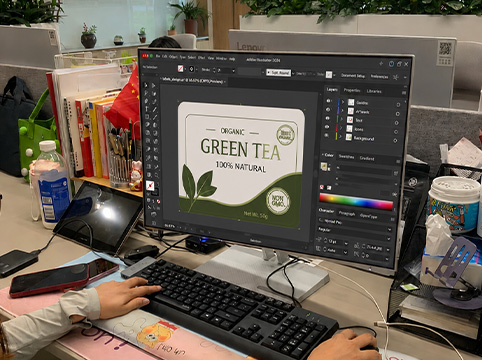
Verify Custom Tea Labels Suppliers With Brew-Steam Tests
A flawless artwork proof tells you nothing about what happens when a tin leaves a cold warehouse, sits in a humid retail aisle, and ends up next to a steaming kettle. Buyers who approve production on a PDF proof alone often find out about lifting corners, smeared ink and fading colors only after the pallets arrive. If you are comparing suppliers of custom tea labels, ask each one for a physical sample and put it through a short, repeatable test before you sign off.
This article gives procurement teams that test, plus the acceptance criteria and the supplier questions that go with it. I have spent 12 years on the manufacturing side of custom merchandise, and the same pattern repeats: the failures that cost money are visible within an hour of a well-designed sample test.
Why Artwork Proofs Miss the Failures That Matter
A proof confirms layout, spelling and approximate color. It does not confirm how the substrate, ink, laminate and adhesive behave together on your container. Tea packaging is unusually demanding for four reasons:
- Steam and moisture exposure. Tins, pouches and gift boxes are handled in kitchens, cafés and tasting rooms.
- Temperature swings. Cold storage followed by a warm shelf creates condensation under and on the label surface.
- Handling friction. Labels on stacked tins rub against cartons and fingers.
- Brand-critical color. Tea brands often rely on deep greens, earth tones and metallic foil, and these shift easily between presses and substrates.
The limit of any sample test: it checks the sample, not the production run. That is why the test below is paired with written acceptance criteria that also apply to the bulk order.
A Brew-Steam, Condensation, and Rub-Test Protocol for Tea Label Samples
Run this on labels applied to your real container, not on a flat sheet. Apply the labels, then let them rest for 24 hours so the adhesive can set. The parameters below are practical starting points, not an industry standard. Agree on final values with each supplier and apply the same ones to every shortlisted sample so the comparison is fair.
| Test | How to run it | Suggested pass criteria | Failure it exposes |
|---|---|---|---|
| Brew-steam | Hold the labeled tin, pouch or tag about 10 cm above a freshly boiled cup or kettle spout for 60 seconds, then touch the label while it is warm and again after it cools. | No edge lift, bubbling, ink softening or visible color shift against an untested control sample. | Weak adhesion, uncoated paper absorbing moisture, ink that is not sealed. |
| Condensation | Chill the labeled container (a refrigerator works), move it to a warm room, and observe for 30 minutes as droplets form. | No lifting, wrinkling, ink run or water marks. The label stays flat after wiping. | Labels peeling in cold-to-warm transitions, poor surface protection. |
| Dry and wet rub | Rub with a thumb and a clean cotton cloth, about 20 passes dry. Repeat with a damp cloth. Then rub a sample against a second label face-to-face. | No ink transfer onto the cloth, no scuffing, no foil flaking. | Under-cured ink, scratch-prone surface, foil that does not bond. |
| Handwriting | Write a batch code or harvest date with a ballpoint pen and a permanent marker. Wait 10 seconds, then wipe lightly. | Marks dry without smearing or beading. | Surfaces that cannot hold handwritten markings. |
| Warm-shelf adhesive dwell | Leave a labeled container in a warm spot (a sunny window or near a heater) for 24 hours, then peel one label slowly. | No adhesive oozing at edges, no residue creeping onto the printed face. | Adhesive bleeding under heat. |
| Color and opacity check | Compare against your brand swatch under daylight. For clear labels, hold the sample over a dark tin and over a light one. | Color matches the approved reference. White ink stays opaque on clear film. | Color mismatch against brand guidelines, thin white ink on transparent substrates. |
How to score the results
- Photograph each sample before testing, next to your control.
- Run all six tests on at least two labeled containers per supplier, so one bad application does not skew the result.
- Score each test pass, marginal or fail, and photograph the outcome.
- Send the photos back to the supplier and ask for a written explanation of any marginal result and what they would change in the substrate, laminate or adhesive.
Where it does not apply: if the labels will only ever go on dry, ambient-temperature outer cartons, the brew-steam and condensation tests are overkill. Keep the rub and color checks, and drop the rest.
Match the Substrate to the Test You Expect It to Pass
A test is only useful if the sample was built for the job. Ask suppliers to quote the sample on the substrate they would actually propose for your container, and keep a line item for each candidate.
| Tea format | Substrate to sample | What to watch in testing |
|---|---|---|
| Loose leaf tins, loose leaf tea tin labels | Coated paper with lamination, or film | Condensation lift on curved metal, foil adhesion |
| Rustic pouches and bags | custom kraft labels | Moisture absorption, ink rub-off on uncoated surfaces |
| Clear-look jars and cold-brew bottles | clear custom BOPP labels | White ink opacity, edge lift in condensation |
| Wet or refrigerated sachets and bottles | waterproof custom synthetic labels | Adhesive dwell at both cold and warm temperatures |
Kraft paper looks right for artisan tea, but uncoated kraft is the most likely to fail a steam test. If your brand needs that look, ask for a laminated or coated sample and test it against a plain one so you can see the difference yourself.
What Custom Panda’s Supplied Facts Cover
The protocol tells you what to measure. The next question is whether a supplier can respond to what the tests find. Here is what Custom Panda can state, tied to the buyer concern each fact addresses.
- Quality system. The facility is ISO 9001:2015 Quality Management System certified, which matters when you want sample results and bulk output to follow a documented process.
- Press capacity for sample runs. The factory, established in 2012, covers 8,000 m² with 6 production lines and 6 HP digital label presses. Digital printing suits select custom items with no MOQ, so a test batch does not require a bulk commitment.
- Materials relevant to tea. The range includes a wide substrate selection, BOPP lamination, UV-resistant inks and custom foil stamping colors, which speak directly to the wet, light and color concerns in the table above.
- Pre-production confirmation. Photo or digital sample confirmation happens before production, and sample lead time for labels is 3 days.
- Relevant case. For an Australian natural health supplement brand, Custom Panda delivered metallic foil-stamped roll labels using matte BOPP film with scratch-proof lamination for a high-end retail shelf look. It is a supplement product, not tea, but the foil, matte film and lamination combination is the same one tea brands ask about. A separate case for a Spanish children’s clothing line used fade-resistant, skin-safe inks on wash-care labels that survive repeated industrial washing.
These facts do not replace your own test. They give you grounds to request a sample and a reason to expect a coherent answer when it fails a check. I would not treat the cases as proof that a tea sample will pass: the container, adhesive and handling conditions are different.
Cooperation Terms and What Still Needs Agreement
These terms are supplied by Custom Panda and apply to label orders in general:
- MOQ: digital printing and select custom items have no MOQ. Offset printing and standard bulk items start at 1,000 units, with better pricing at higher quantities.
- Timing: samples in 3 days, bulk production in 8-9 days, and U.S. shipping in 5-6 business days.
- Remedies: a free reprint for color mismatch, proportional replacement for defects, and 5-day fast re-stocking or repair.
- Bulk extra: 100 bonus pieces with every bulk order.
- Support: free design assistance and live human support.
Some matters are not set by those terms and should be written into your purchase order before production starts:
- Which tests from the table form the acceptance standard, and at what pass criteria.
- Who holds the approved sample as the reference, and how many retained copies.
- How a failed test on bulk stock is documented, for example photos plus a retained-sample comparison.
- Whether the digital sample and the bulk run use the same press type. A digital sample approved for a run printed by offset may not match in color or ink behavior, so confirm this explicitly.
I would not assume that a sample-to-bulk path is identical for every order. Substrate availability and print method can change both timing and appearance, so ask for confirmation per job.
Common Mistakes in Tea Label Sample Approval
- Testing a flat label. Curved tins and flexible pouches stress adhesive differently. Always apply to the real container.
- Skipping the 24-hour rest. A label tested one hour after application can pass and still lift next week.
- Comparing suppliers with different conditions. Different steam time or rub pressure makes the results meaningless.
- Approving color on screen only. Check the physical sample against your brand reference in daylight.
- Ignoring hang tags and gift boxes. Items like tea bag hang tags face handling and steam but not adhesive tests, so replace the adhesive checks with rub and tear checks.
- Leaving compliance marks to the end. If you carry organic or origin claims, confirm that the print stays legible after testing, as with organic tea certification labels.
Send Your Container and Test Criteria for a Sample Quote
Likely fit: Custom Panda suits buyers who want physical samples built on a proposed substrate, with photo confirmation before production and a documented remedy path if bulk output misses the approved standard. Open points: your container material, storage temperature, finish (foil, matte, clear) and which of the six tests you consider mandatory.
Send those details along with your artwork and brand color reference, and ask for a sample quote on your preferred and an alternative substrate. You can then run the protocol side by side and decide on evidence rather than a proof.