

How to Source Custom Skincare Labels for Face Oils
The most expensive mistake in face oil packaging is approving a label on a dry bench and discovering the failure in a retail stockroom. Oil creeps along the label edge, darkens the paper, lifts the corner, and smears the print. By then the pallet is filled. If you are sourcing custom skincare labels for facial oils or oil-based serums, the questions below need answers before you send an RFQ, not after the first complaint.
I have spent twelve years on the manufacturing side of custom merchandise and labels. The pattern is consistent: oil-based formulas fail labels that perform well on water-based creams. Below is how to brief a supplier, what to specify, and where each choice can go wrong.

Why Face Oils Break Labels That Work on Creams
Face oils are thin, mobile and often chemically active. A cream sits in a jar and rarely touches the label. A dropper bottle gets handled with oily fingertips, drips down the shoulder, and sits next to the label edge for months. Three failure paths matter:
- Surface wicking. Uncoated paper absorbs oil and shows dark translucent patches. Risk: the label looks stained within days of first use.
- Adhesive attack. Some oils and fragrance components soften adhesive at the edge, which leads to edge lift or adhesive bleeding. Risk: curled corners and sticky residue.
- Print and foil damage. Rubbing with oily hands can scuff unprotected ink. Risk: brand color and fine text degrade fastest on the part customers touch most.
The limit of this advice: a fully sealed, outer-boxed bottle that never gets handled with oily fingers is less demanding. Most dropper bottles are not in that category.
Compatibility Matrix for Face Oil Formulas and Bottle Surfaces
This matrix is the starting point I use when a buyer sends a formula and a bottle spec. It is a selection guide, not a guarantee. Oil blends vary, so confirm with a sample applied to your actual bottle and filled product before bulk production.
| Formula type | Bottle surface | Recommended film stock | Laminate / finish | Adhesive direction | Main risk if wrong |
|---|---|---|---|---|---|
| Light carrier oils (jojoba, squalane style serums) | Smooth amber or clear glass | Synthetic film such as BOPP, or a coated synthetic | Gloss or matte lamination over print | Permanent, strong initial tack for smooth glass | Edge lift at the bottle shoulder |
| Rich, heavy oils (rosehip, argan style blends) | Frosted or coated glass | Synthetic film, not uncoated paper | Laminate with a smooth, wipeable surface | Adhesive tested on frosted texture, since less contact area reduces grip | Slow peeling and oil seeping under the label |
| Fragrant blends with essential oils | Glass or PET dropper bottle | Film with a protective laminate over all ink | Laminate that covers the entire print area | Oil-tolerant permanent adhesive, validated by sample test | Adhesive softening, print smearing |
| Pigmented oils (carotene rich, orange or deep yellow) | Clear glass or clear PET | Opaque white film or white ink underlay | Laminate to block staining at edges | Permanent adhesive | Visible color staining on white label areas |
| Any oil | HDPE or PP squeeze bottle | Synthetic film | Laminated finish | Adhesive rated for low energy plastic surfaces | Poor adhesion and peeling after filling |
For glass dropper bottles, our serum bottle labels and glass bottle labels pages show the formats we run. Our substrate range includes BOPP lamination and UV resistant inks, which fit the film-plus-laminate approach in the table.
When this does not apply: if your oil is formulated with unusual solvents or a very high essential oil load, the table is only a first screen. Send us the formula category and ask for a filled-bottle test.
Seven Sourcing Checks and the Risk Behind Each
A checklist is useful only when you know what each line protects. This is the order I would work through before issuing an RFQ.
| Check item | Why it matters | What to ask the supplier |
|---|---|---|
| 1. Face stock type | Uncoated paper wicks oil and shows stains. Film resists absorption. | Which synthetic or coated options do you offer for oil contact? |
| 2. Laminate coverage | Unlaminated ink rubs off under oily handling. | Does the laminate cover all printed areas, including foil? |
| 3. Adhesive on your bottle | Glass, frosted glass and plastic grip differently. | Can you test the adhesive on my actual bottle? |
| 4. Edge sealing at curves | Tight shoulder curves stress the label and invite lift. | Is the label size suited to the bottle diameter and curvature? |
| 5. White opacity on clear bottles | Thin white ink on clear substrates lets oil color show through. | Will you confirm opacity in the sample? |
| 6. Color match | Brand colors drift between runs and between substrates. | What is the process if color misses the approved sample? |
| 7. Sample before production | Cheapest place to catch a failure. | Photo or digital proof, then a physical sample? |
Each item has a limit. Check 4, for example, matters less for flat panel bottles than for tapered round ones.
Finish Choices: Matte, Gloss and Foil on Oil Bottles
Finish is a brand decision with a durability consequence.
- Gloss laminate: wipes clean and shows less oil staining. Good for functional, clinical or bright brands. Limit: fingerprints and glare can show on dark designs. See custom glossy labels.
- Matte laminate: premium soft look. Matte surfaces can show oil marks more than gloss, so ask for a sample test with oily fingers. See premium custom matte labels.
- Foil stamping: adds shelf presence. Place fine type away from foil edges, and confirm the laminate treatment with your supplier.
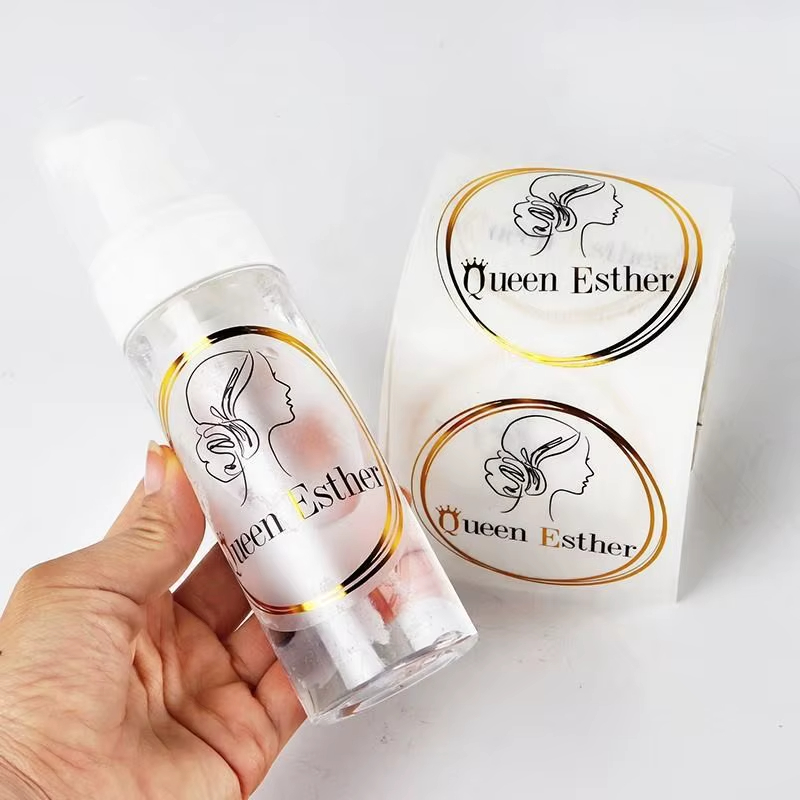
One relevant reference: for an Australian natural health supplement brand, we delivered metallic foil-stamped roll labels using matte BOPP film with scratch-proof lamination, built for a high-end retail shelf. The same film and lamination approach carries over to skincare oil bottles, although your formula still needs its own sample test. For clear film options, review clear custom bopp labels.
Step by Step: From Brief to Approved Sample
- Gather the facts. Bottle material, diameter, label panel height, formula category, and whether the product is wiped, handled or refrigerated.
- Choose the film and laminate using the matrix above. Mark any area where the label crosses a curve or a bottle seam.
- Send artwork with brand color references. Our free design assistance can help adjust artwork for the label panel.
- Approve the photo or digital sample before production.
- Test the physical sample on a filled bottle. Rub it with oily fingertips, leave a drop at the edge, and check again after 24 hours and after a week.
- Release bulk production only after the test result is clear.
Timelines from our brief: samples take 3 days, bulk production 8 to 9 days, and U.S. shipping 5 to 6 business days. Plan your oil stability test inside that window, not after it.
Cost, MOQ and What Drives the Price
You do not need a six-figure order to test. Digital printing and select custom items have no MOQ, which suits launch batches and small SKU runs. Offset printing and standard bulk items start at 1,000 units, with better pricing as quantity grows. With six HP digital label presses and a daily label capacity above 1,000,000, we handle both small and large runs, and every bulk order includes 100 bonus pieces.
| Cost driver | Effect | Trade-off |
|---|---|---|
| Film plus laminate vs plain paper | Higher material cost | Cheaper than relabeling stained stock |
| Foil stamping | Added process cost | Strong shelf impact, but plan the artwork carefully |
| Digital vs offset | No MOQ vs 1,000 minimum | Digital for testing and small batches, offset for volume |
| Number of SKUs | More artwork and setup | Standardize label size across the range where possible |
Common Mistakes When Ordering Labels for Face Oils
- Approving on empty bottles. Oil exposure changes everything. Always test on filled bottles.
- Choosing uncoated paper for looks. If you want a natural paper feel, ask about a protected finish and test it. Compare custom kraft labels against film for oil contact.
- Ignoring the bottle shoulder. Label size must suit the curvature, or corners lift.
- Using thin white ink on clear bottles. Product color shows through and mutes your brand.
- Skipping the physical sample. A screen proof cannot show edge lift or stain.
Buyer's Checklist Before You Send the RFQ
- Bottle material, diameter and panel size confirmed
- Formula category shared (light, rich, fragrant or pigmented oil)
- Film, laminate and finish selected from the matrix
- Brand color references attached
- Quantity split decided: digital test run vs offset volume
- Sample test plan agreed: 24 hours and one week on filled bottles
If you need an alternative construction, review custom waterproof cosmetic labels as a reference point. Our quality terms include free reprint for color mismatch and proportional replacement for defects, backed by our ISO 9001:2015 certified quality management system.
Ready to check your formula against your bottle? Send us your bottle spec and artwork, and we will recommend a film and laminate combination and prepare a sample for your oil test. Our team offers live human support, and you can reach out to request a quote.