Verify Custom BOPP Labels Suppliers for Clear Film
A clear label that looks perfect in a PDF can fail on the filling line. Air pockets form under the film, a haze spreads across the varnish, or white ink lets the bottle color show through. Buyers usually find out when the pallet arrives. If you have already shortlisted printers for Custom BOPP Labels, the next job is verification, not another round of quotes.
This guide is for packaging procurement teams that label bottles, jars and retail containers. It covers what to ask, what to test and where the film itself reaches its limits. I draw on 12 years in custom merchandising and manufacturing, plus the confirmed capabilities of our own plant at custom panda.
What a Shortlist Does Not Tell You
Supplier pages for BOPP film tend to look alike. They list white, clear, natural and metallic options, plus design help. That tells you the material exists. It does not tell you whether the printer can hold white ink opacity on a transparent film, or whether the laminate will stay clear on a curved surface.
For clear film work, a shortlist should be narrowed with three questions:
- Can they print opaque white on clear film? This matters most when the container color or the product behind the label will show through.
- Can they show you a physical or digital proof of that exact build? A generic swatch from another job proves little.
- Do the terms cover application defects and color mismatch? You need to know who owns which failure before you order.
Our role is a label, pin and patch manufacturer. The facility was established in 2012 and covers 8,000 m² with 6 production lines. It runs 6 HP digital label presses, and daily label capacity exceeds 1,000,000. We can speak to what happens in that plant. We cannot speak for your filling line, and a good supplier will say so.
Capabilities Matched to Clear Film Buyer Concerns
Do not accept a list of strengths. Match each capability to a concern you actually have.
| Buyer concern | Relevant capability | What to ask for |
|---|---|---|
| Brand color drifts between runs | Digital presses plus photo or digital sample confirmation before production; free reprint for color mismatch | The reprint trigger in writing, and the reference you will be measured against |
| White ink looks patchy on clear film | Wide substrate selection; white ink is a known failure point on clear substrates that we plan for | A proof of your artwork on clear film, not on white stock |
| Scuffs and fading in transit or on shelf | BOPP lamination and UV resistant inks | Which laminate and ink set apply to your order |
| Premium shelf look | Custom foil stamping colors | A foil sample on the same film as the final label |
| Quality oversight | ISO 9001:2015 certified quality management system | The certificate scope and how nonconforming lots are handled |
One reference point is an Australian health supplement brand. We delivered metallic foil stamped roll labels for it, combining matte BOPP film with scratch proof lamination for a high end retail shelf look. That job used matte film, not clear film. It shows foil and lamination work on BOPP, but it does not prove how a clear build will behave on your container.
Boundary: When Clear BOPP Exposes Application Defects
Clear film hides nothing. On a white or opaque label, a small bubble or a thin white layer can pass. On clear film, the container, the product and the adhesive all become part of the design. Before you blame the printer, or accept a bad lot, separate the defects the film reveals from the ones that start elsewhere.
| Defect | What you see | Likely source | How to verify | When clear BOPP is the wrong choice |
|---|---|---|---|---|
| Trapped air | Silver bubbles or wrinkles under the film, most visible on glass | Applicator pressure, label stiffness on tight curves, or a surface not clean | Apply 20 to 30 samples on your own line before approval | Tight radius containers or squeezable tubes, where stiffer film will lift |
| Cloudy varnish | Milky haze across clear areas, worse under bright retail lighting | Coating or laminate choice, or moisture exposure during storage | Check the proof against a dark background and a lit shelf, then retest after 24 hours in the product’s storage condition | Designs relying on a no label look with no tolerance for slight haze |
| Inconsistent white ink opacity | Gray or see through logos, uneven blocks, bottle color bleeding through | Single white pass on clear film, or a dark container behind thin white | Hold the proof over the real container and its filled product | Dark liquids with small, fine white text; consider a white backed film or an opaque white base layer |
The rule I use: if the defect appears on the proof, the printer owns it. If it appears only after application, test the application first. Many bubble complaints trace back to applicator settings, not print quality.
When your container has a dark base, a compression curve or a rough surface, compare clear film with custom waterproof bopp labels or a white film build. The better material is the one that holds up on your container, not the one that sounds more premium.
Evidence to Request Before You Approve a Supplier
Ask for evidence the supplier can actually produce, then note what is missing. Missing evidence is a question to resolve, not something to fill with assumptions.
- Quality system certificate. We hold ISO 9001:2015 and Disney FAMA certification. Ask any supplier for the certificate itself and check that the scope matches label production.
- A proof on the real film. Request photo or digital confirmation of your artwork on clear film before production starts. This is part of our process, and you should expect it from anyone.
- Physical samples. Our sample lead time for labels is 3 days. Use that window to run a bottle test, not just a visual check.
- Reference jobs close to yours. Ask which projects used the same film, laminate and container type. If none exist, treat your order as a first run and set the acceptance steps accordingly.
- Defect handling terms. Confirm in writing how color mismatch and defective pieces are treated.
A Step by Step Proof Review for Clear Film Labels
- Send the container, not just the artwork. Tell the supplier the bottle or jar material, color, fill and storage temperature.
- Request a proof on clear film. Review it over the real container and at least one dark and one light background.
- Check white areas first. Look for gray cast, streaks and edge thinning in logos and small type.
- Apply physical samples. Use your own applicator and settings. Count bubbles, wrinkles and lifted edges.
- Stress the sample. Leave it overnight in the conditions it will see, such as condensation, refrigeration or oil contact. Check for haze, peeling and ink transfer.
- Sign off with measurable criteria. Record what counts as acceptable color and opacity before bulk starts.
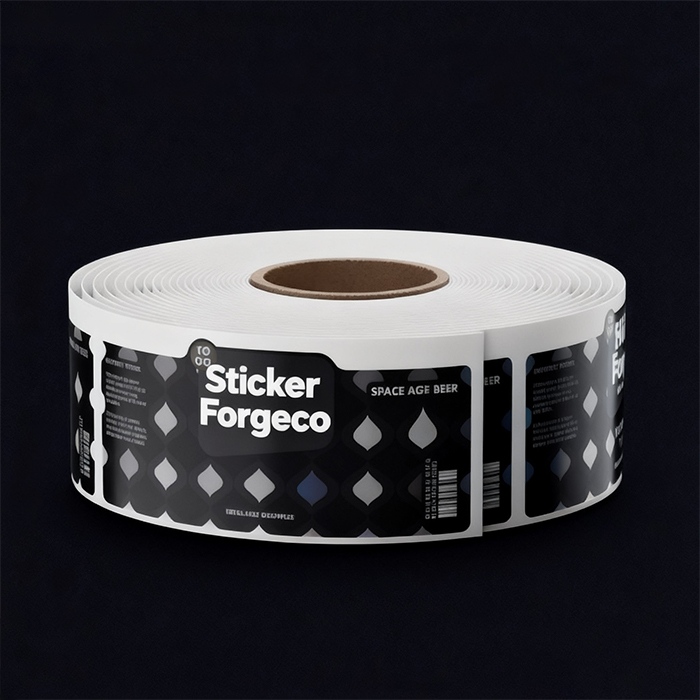
For roll format jobs, custom bopp roll labels need an additional check: unwind the sample roll through your applicator and watch for web breaks or label flagging at speed.
Common Mistakes in Clear Film Sourcing
- Approving on white stock. A white sample hides the opacity problem that clear film reveals.
- Testing on a clean bench bottle. Filled, chilled or oily containers behave differently.
- Treating certification as proof of print quality. ISO 9001:2015 covers the quality system. It does not replace a proof on your film.
- Leaving defect ownership unwritten. Printing flaws and application flaws need separate wording.
- Ordering the final volume before one real test. Digital printing makes a small validation run possible with no minimum on select custom items.
Cooperation Terms and Boundaries
These are the terms confirmed for our labels. They give you a starting frame for the supplier conversation.
| Item | Confirmed term |
|---|---|
| Minimum order | No MOQ for digital printing and select custom items; 1,000 units minimum for offset printing and standard bulk items, with better pricing at higher quantities |
| Sample lead time | 3 days for pins, patches and labels |
| Bulk production | 8 to 9 days |
| U.S. shipping | 5 to 6 business days |
| Color mismatch | Free reprint |
| Defective pieces | Proportional replacement, with 5 day fast re-stocking or repair |
| Pre-production approval | Photo or digital sample confirmation |
| Bulk order bonus | 100 extra pieces with every bulk order |
Free design assistance, live human support and free shipping are also available. Lead times assume approved artwork, so schedule your proof review before you plan your launch date.
Some points remain open until you and your supplier agree on them: the measurable acceptance criteria for opacity and color, who pays for freight on reprints, and how an application-side defect is separated from a print-side defect. We have no established rule for your filling line, so agree those details before the order is placed rather than assuming a standard.
What to Send for a Supplier Fit Check
Clear film suits glass and rigid plastic containers with a flat or gently curved surface. It performs best when the design uses limited white areas, or when the container is light colored. Dark containers, tight curves and fine white type call for a white backed film or a different material. For adjacent formats, see glass bottle labels and plastic bottle labels.
To qualify your project, send us the container type and color, the artwork file, the quantity range and the storage or filling conditions. We will reply with a proof recommendation and sample options. Request a sample or selection advice and we will confirm which film build fits your application.