

What Must a Print Proof Show for Custom Food Labels?
The most expensive mistake in label buying is approving a proof that looked fine on a monitor. Nobody finds the 5 pt allergen line that fills in, the barcode that will not scan on a curved jar, or the net weight statement hidden under a seam until the pallet arrives. If you are at the final artwork stage for custom food labels, the proof is your last cheap chance to catch those problems. A reel of reprinted labels costs far more than a second round of checks.
Below is what a proof should show, which questions to put to your supplier, and where a proof cannot protect you.
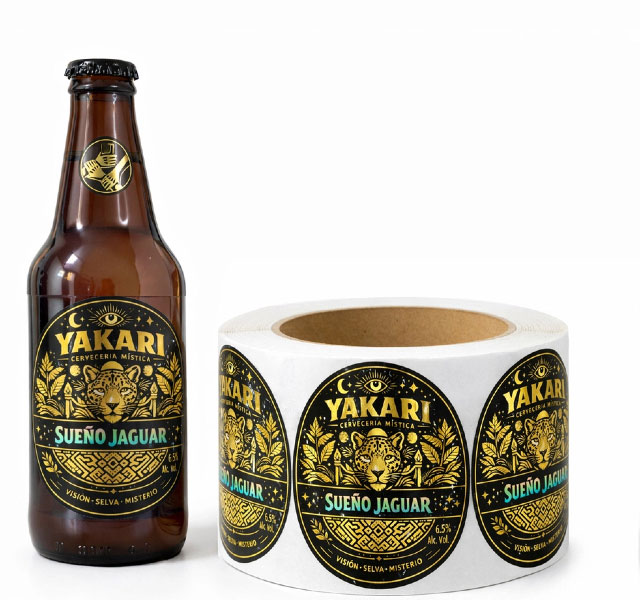
What a Print Proof Must Show Before You Approve
A proof is only useful if it answers specific questions. A flat PDF confirms layout and copy. A photo or physical sample confirms ink, substrate and finish. You usually need both, and they answer different things.
| Proof element | What to confirm | What a PDF cannot tell you |
|---|---|---|
| Die line and safe zone | All mandatory text sits inside the safe zone, away from cut edges and seams | How the label sits after it is applied to the container |
| Ingredient list | Type size, line spacing, contrast and no text reversed out of dark colors | Whether fine strokes fill in on your chosen stock |
| Allergen statement | Distinct styling, such as bold or a box, and a position close to the ingredients | How bold weights hold up after lamination |
| Net weight or volume | Present, readable, and placed where your market expects it | Whether a curve or seam hides it |
| Barcode | Correct number, quiet zones intact, dark bars on a light background | Scan reliability, which needs a real scan test of a printed sample |
| Brand colors | Named color references, with a note of any tolerance you will accept | Exact shade under shelf lighting |
| Finish and special effects | Matte, gloss, foil or varnish areas marked clearly on the proof | How a finish changes contrast on small text |
Our process at custom panda includes photo or digital sample confirmation before production. That step exists because layout approval alone is not enough. Ask for a physical sample when the label carries dense copy or a barcode. Our sample lead time is 3 days, which is short enough to fit into most launch schedules.
Pre-Production Proof FAQ: Legibility Risks on Food Labels
These are the questions food teams ask most often at final approval. Each answer includes the limit, because a proof does not remove every risk.
Will the ingredient list stay readable at small type sizes?
Usually yes, if the type is dark on a light, uncluttered background and not reversed out of a color. Thin serif fonts and light gray text are the usual culprits. Check the proof printed at 100% scale, not zoomed in. Limit: minimum type sizes are set by regulators in your target market, not by the printer. Confirm those with your regulatory adviser. We print what you approve and do not review labels for legal compliance.
How do I make sure the allergen statement stands out?
Give it its own treatment: bold weight, a keyline box or a separate line directly after the ingredients. Do not let it run on in the same paragraph. Limit: heavy bold on matte stock with a gloss laminate can look different from the screen. Look at the physical sample, not just the PDF.
Where should net weight sit, and can a proof prove it is visible?
A proof shows that the statement exists and sits inside the safe zone. It does not show whether a bottle shoulder, a lid ridge or a seam will hide it. Mock the label onto your actual container, or ask for a sample you can wrap around one. Limit: placement rules vary by market. We cannot tell you which rule applies to your product.
Will my barcode scan?
A proof can confirm the number is correct, the bars are dark on a light field, and the quiet zone (the blank margin on both sides) has not been squeezed. It cannot guarantee scan results. The only real test is scanning a printed sample with the scanner your retailer or warehouse uses. Avoid placing a barcode on a colored background, over foil, or across a fold. Limit: glossy laminate can cause glare under some scanners, so test the final finish.
What changes on curved containers?
Curvature stretches artwork toward the edges of the wrap, and text near a tight radius becomes hard to read from the front. On a cylindrical jar or bottle, orient the barcode with the bars running vertically so curvature does not distort their width. Keep mandatory text off the edges where the label wraps away from the viewer. Tapered or ribbed containers are riskier than straight glass or plastic. Limit: no flat proof shows wrinkling or lifting, so test the label on your actual container and material.
Can white text or white ink on a clear label be trusted?
Only after you have seen it on a sample. White ink that is not opaque enough on a clear substrate is a known problem. It makes light text look weak against the product behind it. If your design relies on white copy, ask for a sample filled with your real product, or request an opaque white underlay. For clear stock, see clear custom bopp labels.
Substrate and Finish Choices That Change How You Read the Proof
The same artwork can look different on different materials. Settle the stock before you approve the proof, not after.
| Condition | Risk on the proof | Better choice to discuss |
|---|---|---|
| Refrigerated or frozen product | Condensation causes edges to lift and labels to peel | freezer grade food labels |
| Oily or wet jars | Paper stock stains and ink can smear | Waterproof film with a protective laminate |
| Rustic, dry goods | Uncoated surfaces absorb ink, so fine text softens | custom kraft labels, with larger and bolder type |
| Glass bottles and jars | Wrap tension and curvature affect barcodes and edge text | glass bottle labels tested on your container |
Finish matters too. One of our Australian projects was a set of metallic foil-stamped roll labels for a natural health supplement brand, built on matte BOPP film with scratch-proof lamination. That kind of stack looks excellent on a shelf, but foil and lamination are exactly what you should flag on the proof. Keep mandatory text and barcodes off foil areas, and ask for a physical sample before you commit.
Common Proof Approval Mistakes
- Approving on a phone screen. Screens hide spacing and contrast problems. Print at 100% scale and read it at arm’s length.
- Skipping the real container. A label that is flat on paper is not the label on a tapered jar.
- Treating the barcode as decoration. Check the digits, the contrast and the quiet zone. Then scan a printed sample.
- Last-minute copy edits. Changing an ingredient order after approval means a new proof. Lock your copy with your quality or regulatory contact first.
- Ignoring storage conditions. Freezer, fridge, steam and oil exposure each need a different material. A proof will not show that.
- Vague color notes. “Match the brand green” is not an instruction. Supply a named color reference.
A Practical Proof Approval Workflow
- Freeze the copy. Have ingredients, allergens, net weight and barcode digits signed off internally before the artwork is sent.
- Confirm material and finish. Choose stock based on storage and container, then let the proof reflect that stock.
- Review the digital proof. Check the safe zone, type size, contrast and placement against the checklist above.
- Request a sample. Wrap it on your real container, scan the barcode, and test it in the conditions it will face, such as chilled or wet.
- Approve in writing. Note any accepted tolerances, such as color shift.
- Plan the timeline. After approval, bulk production takes 8 to 9 days and U.S. shipping takes 5 to 6 business days. Build in your own testing time before that.
On quantities: digital printing has no minimum for selected custom items, which suits a proof-stage test run or a small launch. Offset printing starts at 1,000 units, with better pricing at higher quantities. Bulk orders include 100 bonus pieces, and a color mismatch qualifies for a free reprint. Those terms back up the proof but do not replace careful checking.
Our facility is ISO 9001:2015 certified and runs 6 HP digital label presses, so sample and production output come from the same equipment. For product groups beyond food, such as cosmetics or supplements, you can see our wider range of premium product labels on rolls.
Send Your Artwork for a Proof Check
If you are close to approval, send your artwork, container type and storage conditions. Our team can give design assistance and a sample for a scan and wrap test before you place the production order.